cover

Mountains in Motion

How are mountains made?
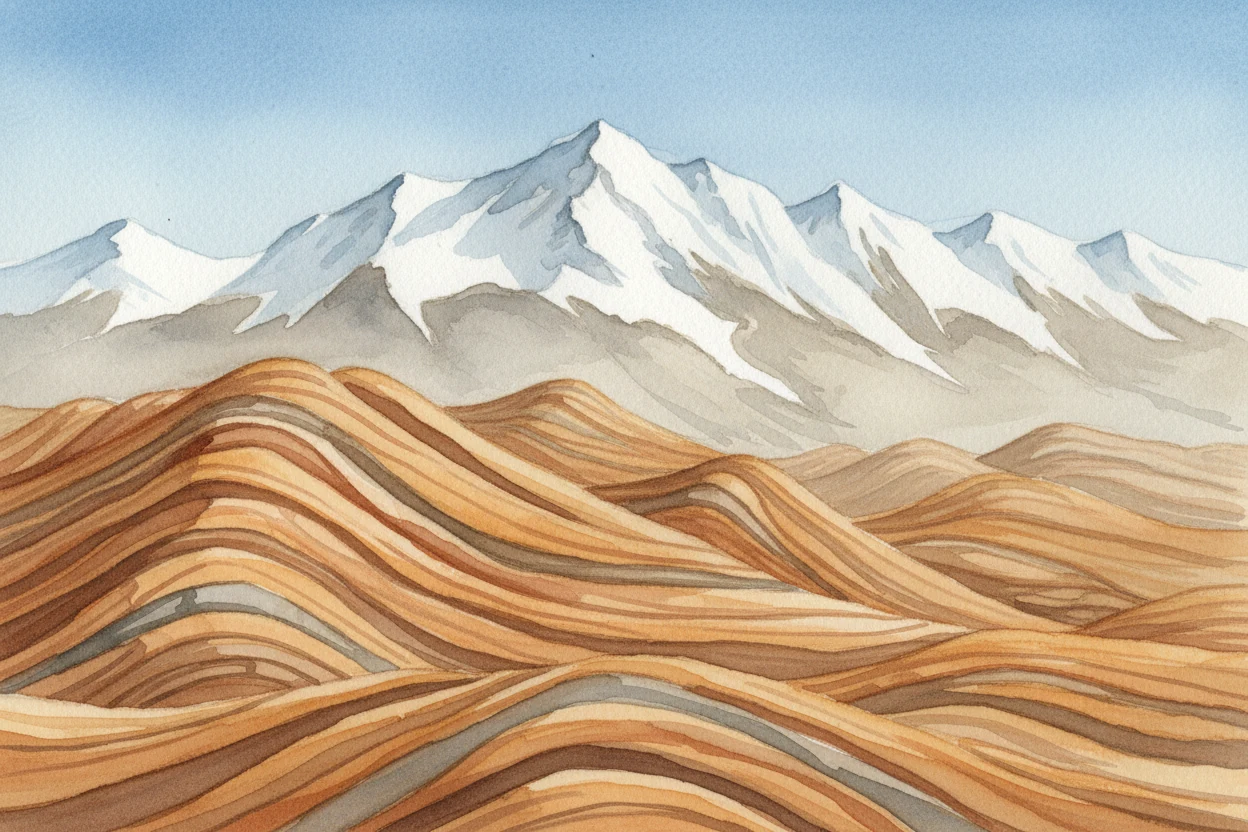
Mountains look like they've been standing forever โ€” solid, still, ancient. ~~But here's the wild part:~~ they're **not f

Mountains look like they've been standing forever โ€” solid, still, ancient. But here's the wild part: they're not finished yet. Right now, while you're reading this, mountains are slowly growing, crumpling, and shoving themselves higher into the sky.

The secret is hiding under your feet. Earth's surface isn't one solid shell โ€” it's cracked into enormous pieces called +

The secret is hiding under your feet. Earth's surface isn't one solid shell โ€” it's cracked into enormous pieces called tectonic plates, like a planetary jigsaw puzzle. These plates float on hot, gooey rock deep below, drifting a few centimeters every year. About as fast as your fingernails grow.

Most of the time, plates just slide past each other. But sometimes two plates drift toward each other on a ~~collision c

Most of the time, plates just slide past each other. But sometimes two plates drift toward each other on a collision course. And when two massive slabs of Earth's crust meet head-on, neither one backs down. Something has to give.

So the rock does what rock does when it can't escape: **it crumples. It folds. It buckles upward** like a rug shoved acr

So the rock does what rock does when it can't escape: it crumples. It folds. It buckles upward like a rug shoved across a floor. Layers that were once flat seabeds tilt vertical. Fossils of ancient ocean creatures end up thousands of meters in the air. The Himalayas โ€” the tallest mountains on Earth โ€” are made from the seafloor that used to sit between India and Asia, now stacked and folded into peaks.

~~But collision isn't the only recipe.~~ Sometimes a plate doesn't crumple โ€” **it cracks**. One slab of crust slides und

But collision isn't the only recipe. Sometimes a plate doesn't crumple โ€” it cracks. One slab of crust slides under another and sinks deep into Earth's hot interior, melting into magma. That molten rock is lighter than the solid stone around it, so it rises back up, forcing its way toward the surface. When it erupts, it builds a mountain one lava flow at a time.

The ++Cascade Range++ in the Pacific Northwest formed this way. So did ++Mount Fuji++. So did the ++Andes++, the longest

The Cascade Range in the Pacific Northwest formed this way. So did Mount Fuji. So did the Andes, the longest mountain chain in the world, stretching seven thousand kilometers down the western edge of South America โ€” all because one plate keeps diving under another, feeding volcano after volcano.

~~Here's the wildest part:~~ **mountains don't just grow**. They also fall apart. The moment a mountain starts rising, w

Here's the wildest part: mountains don't just grow. They also fall apart. The moment a mountain starts rising, wind and rain and ice start tearing it down. Water seeps into cracks and freezes, splitting the rock. Glaciers grind valleys into U-shapes. Rivers carve canyons. It's a slow-motion battle between the forces shoving rock up and the forces wearing it away.

Right now, the ++Himalayas++ are still winning โ€” they're growing about **half a centimeter taller every year**, faster t

Right now, the Himalayas are still winning โ€” they're growing about half a centimeter taller every year, faster than erosion can tear them down. But eventually, millions of years from now, the plates will stop pushing and erosion will have the final word. The Appalachian Mountains used to be as tall as the Himalayas. Now they're worn-down stumps of their former selves, smooth and green and ancient.

So mountains aren't permanent sculptures. They're **temporary wrinkles** in Earth's crust, caught between the planet's r

So mountains aren't permanent sculptures. They're temporary wrinkles in Earth's crust, caught between the planet's restless interior and the patient work of weather. They rise. They fall. And millions of years from now, today's tallest peaks will be tomorrow's hills โ€” while new mountains we can't imagine yet will be shoving themselves into the sky.

How was this book?

A Wonderleaf Book

Mountains in Motion

โ€” How are mountains made? โ€”

Wonderleaf Editions
โ€” ex libris โ€”
A Wonderleaf Book

Mountains in Motion

How are mountains made?

Wonderleaf Editions ยท MMXXVI
Scene 1
Mountains look like they've been standing forever โ€” solid, still, ancient. ~~But here's the wild part:~~ they're **not f
Mountains in Motion2
Scene 1

Mountains look like they've been standing forever โ€” solid, still, ancient. But here's the wild part: they're not finished yet. Right now, while you're reading this, mountains are slowly growing, crumpling, and shoving themselves higher into the sky.

3Mountains in Motion
Scene 2
The secret is hiding under your feet. Earth's surface isn't one solid shell โ€” it's cracked into enormous pieces called +
Mountains in Motion4
Scene 2

The secret is hiding under your feet. Earth's surface isn't one solid shell โ€” it's cracked into enormous pieces called tectonic plates, like a planetary jigsaw puzzle. These plates float on hot, gooey rock deep below, drifting a few centimeters every year. About as fast as your fingernails grow.

5Mountains in Motion
Scene 3
Most of the time, plates just slide past each other. But sometimes two plates drift toward each other on a ~~collision c
Mountains in Motion6
Scene 3

Most of the time, plates just slide past each other. But sometimes two plates drift toward each other on a collision course. And when two massive slabs of Earth's crust meet head-on, neither one backs down. Something has to give.

7Mountains in Motion
Scene 4
So the rock does what rock does when it can't escape: **it crumples. It folds. It buckles upward** like a rug shoved acr
Mountains in Motion8
Scene 4

So the rock does what rock does when it can't escape: it crumples. It folds. It buckles upward like a rug shoved across a floor. Layers that were once flat seabeds tilt vertical. Fossils of ancient ocean creatures end up thousands of meters in the air. The Himalayas โ€” the tallest mountains on Earth โ€” are made from the seafloor that used to sit between India and Asia, now stacked and folded into peaks.

9Mountains in Motion
Scene 5
~~But collision isn't the only recipe.~~ Sometimes a plate doesn't crumple โ€” **it cracks**. One slab of crust slides und
Mountains in Motion10
Scene 5

But collision isn't the only recipe. Sometimes a plate doesn't crumple โ€” it cracks. One slab of crust slides under another and sinks deep into Earth's hot interior, melting into magma. That molten rock is lighter than the solid stone around it, so it rises back up, forcing its way toward the surface. When it erupts, it builds a mountain one lava flow at a time.

11Mountains in Motion
Scene 6
The ++Cascade Range++ in the Pacific Northwest formed this way. So did ++Mount Fuji++. So did the ++Andes++, the longest
Mountains in Motion12
Scene 6

The Cascade Range in the Pacific Northwest formed this way. So did Mount Fuji. So did the Andes, the longest mountain chain in the world, stretching seven thousand kilometers down the western edge of South America โ€” all because one plate keeps diving under another, feeding volcano after volcano.

13Mountains in Motion
Scene 7
~~Here's the wildest part:~~ **mountains don't just grow**. They also fall apart. The moment a mountain starts rising, w
Mountains in Motion14
Scene 7

Here's the wildest part: mountains don't just grow. They also fall apart. The moment a mountain starts rising, wind and rain and ice start tearing it down. Water seeps into cracks and freezes, splitting the rock. Glaciers grind valleys into U-shapes. Rivers carve canyons. It's a slow-motion battle between the forces shoving rock up and the forces wearing it away.

15Mountains in Motion
Scene 8
Right now, the ++Himalayas++ are still winning โ€” they're growing about **half a centimeter taller every year**, faster t
Mountains in Motion16
Scene 8

Right now, the Himalayas are still winning โ€” they're growing about half a centimeter taller every year, faster than erosion can tear them down. But eventually, millions of years from now, the plates will stop pushing and erosion will have the final word. The Appalachian Mountains used to be as tall as the Himalayas. Now they're worn-down stumps of their former selves, smooth and green and ancient.

17Mountains in Motion
Scene 9
So mountains aren't permanent sculptures. They're **temporary wrinkles** in Earth's crust, caught between the planet's r
Mountains in Motion18
Scene 9

So mountains aren't permanent sculptures. They're temporary wrinkles in Earth's crust, caught between the planet's restless interior and the patient work of weather. They rise. They fall. And millions of years from now, today's tallest peaks will be tomorrow's hills โ€” while new mountains we can't imagine yet will be shoving themselves into the sky.

19Mountains in Motion

~ finis ~

Tiny picture books for big little questions.

โ€” a small constellation of questions โ€”
โœฆWonderleaf
Editions