Sky Dance Floor
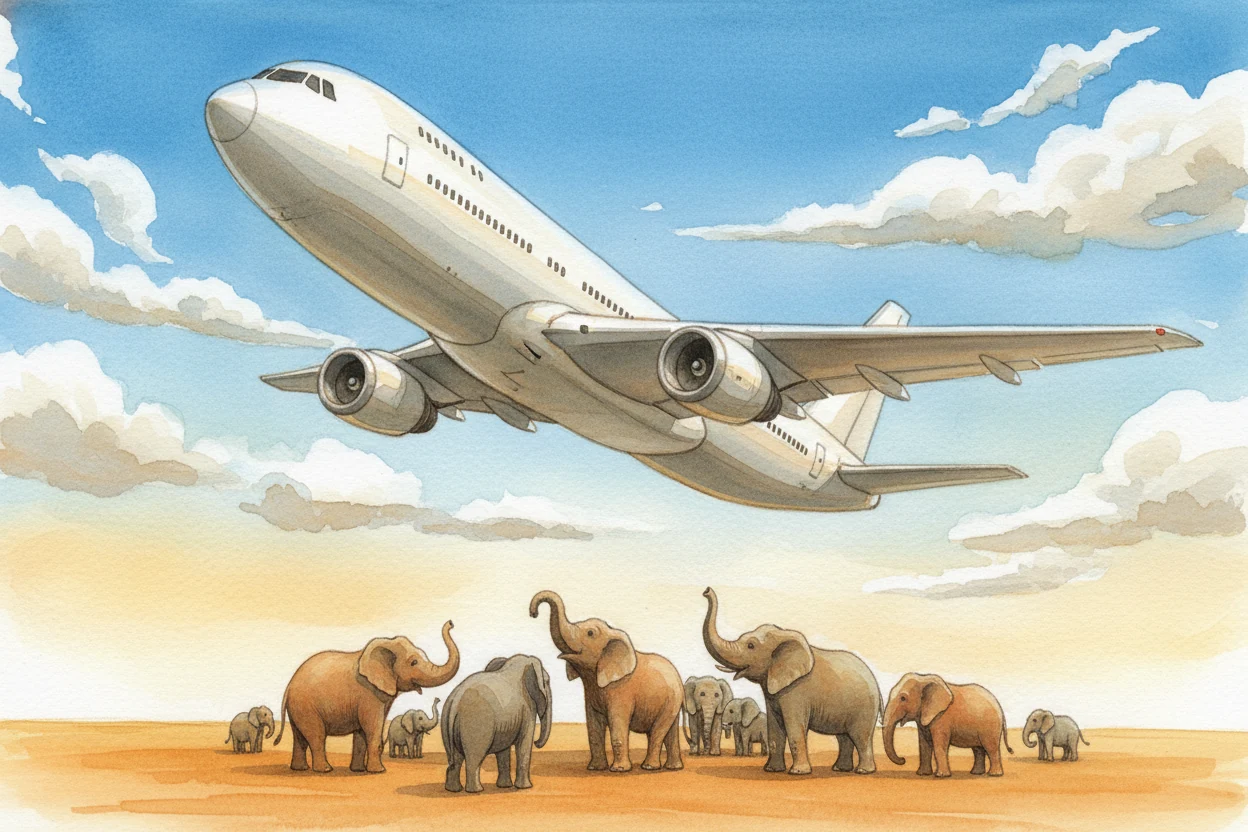
You've probably watched a plane lift off the ground and thought, "Wait โ how does something that heavy justโฆ float up into the sky?" A fully loaded jumbo jet weighs as much as eighty elephants. And yet it climbs smoothly into the air like it's the most natural thing in the world.
The secret lives in the wings. An airplane wing isn't flat like a ruler โ it's curved on top and flatter on the bottom, shaped like a gentle hill. That special curve has a name: an airfoil. And when air rushes over that curve, something wonderful happens.
Picture a river splitting around a rock. The water on one side has to travel a longer path, so it speeds up to get around. Air does the same thing over a wing. The air sliding over the curved top has farther to go, so it moves faster than the air gliding underneath. Faster-moving air has lower pressure โ like how a vacuum cleaner sucks because the air inside is moving fast. That pressure difference creates an upward push.
That upward push is called lift. But here's the thing: lift only works when the plane is moving forward fast enough. A parked plane on the runway has zero lift, no matter how perfect its wings are. So the engines roar, the plane accelerates down the runway, and when it hits about 150 miles per hour โ whoosh โ there's enough air rushing over the wings to lift all those elephants off the ground.
Once you're in the air, four forces are locked in a dance. Lift pushes up. Weight pulls down. Thrust from the engines pushes forward. Drag โ air resistance โ pushes back. When lift balances weight and thrust balances drag, the plane cruises smoothly at 30,000 feet. You're flying because these four invisible hands are in perfect harmony.
Turning is where it gets playful. The pilot tilts the whole plane by moving small flaps on the wings called ailerons. One aileron goes up, the other goes down, and the plane rolls like a log. Then the tail fin โ the rudder โ steers left or right. Banking into a turn, you feel the G-forces press you gently into your seat, and the whole sky tilts around you.
Landing is flying in reverse. The pilot lowers flaps on the back of the wings to create extra lift at slow speeds, cuts the throttle, and lets the plane gently sink. The nose tilts up just before touchdown so the rear wheels kiss the runway first. Then the spoilers pop up on top of the wings to kill the remaining lift, and the brakes grab. You're back on solid ground.
So that's the magic: a curved wing, fast-moving air, and four forces in conversation. Every time a plane lifts off, it's not defying physics โ it's dancing with it. The sky isn't the limit. It's the dance floor.