cover

Nature's GPS

How do animals find their way home?
You're walking home from school and you know every turn without thinking โ€” left at the big oak tree, right at the blue m

You're walking home from school and you know every turn without thinking โ€” left at the big oak tree, right at the blue mailbox, straight past the corner store. Easy. But what about a sea turtle crossing an entire ocean, or a bird flying thousands of miles through storms and darkness? How do animals find their way home when there are no street signs, no maps, and no one to ask for directions?

Some animals use the sun like a compass. ++Bees++, for instance, watch where the sun sits in the sky and calculate angle

Some animals use the sun like a compass. Bees, for instance, watch where the sun sits in the sky and calculate angles โ€” if the sun is here at this time of day, then home must be that direction. It's like using shadows on a sundial to tell time, except they're using the sun's position to tell direction. Even on cloudy days, bees can detect the sun's location through the clouds using special light patterns we can't see.

Others follow their noses across impossible distances. ++Salmon++ are born in a specific stream, swim out to the ocean f

Others follow their noses across impossible distances. Salmon are born in a specific stream, swim out to the ocean for years, and then โ€” when it's time โ€” swim back to the exact creek where they hatched. They remember the smell. Every stream has its own chemical signature, a unique scent made from the minerals in the rocks and the plants along the banks. A salmon sniffs its way home through thousands of miles of water, following a smell it memorized as a baby.

~~Birds do something even stranger:~~ they sense the ++Earth's++ magnetic field. Our planet is basically a **giant magne

Birds do something even stranger: they sense the Earth's magnetic field. Our planet is basically a giant magnet, with invisible lines of force running from the North Pole to the South Pole. Certain birds have tiny crystals in their eyes or beaks that act like built-in compasses, letting them feel which way is north the same way you might feel warmth from the sun on your face. They navigate by an invisible map painted across the sky.

Some animals memorize landmarks like you'd memorize your neighborhood. ++Pigeons++ are famous for this โ€” they look down

Some animals memorize landmarks like you'd memorize your neighborhood. Pigeons are famous for this โ€” they look down and remember the pattern of roads, the bend in a river, the shape of a forest. On their first few trips, they're studying. After that, they're just following a mental map they've drawn in their heads, matching what they see below to what they remember. "That highway, then that lake, then I'm home."

Then there are the animals that navigate by the stars. ++Indigo buntings++, small blue songbirds, learn the night sky as

Then there are the animals that navigate by the stars. Indigo buntings, small blue songbirds, learn the night sky as chicks by watching which stars spin around the North Star. That fixed point becomes their anchor. When they migrate thousands of miles south for winter and then back north for spring, they're reading the stars like a map, the same way sailors did for centuries before GPS. The whole sky is their guidebook.

And some animals โ€” ~~this still puzzles scientists~~ โ€” seem to combine everything at once. A sea turtle hatches on a bea

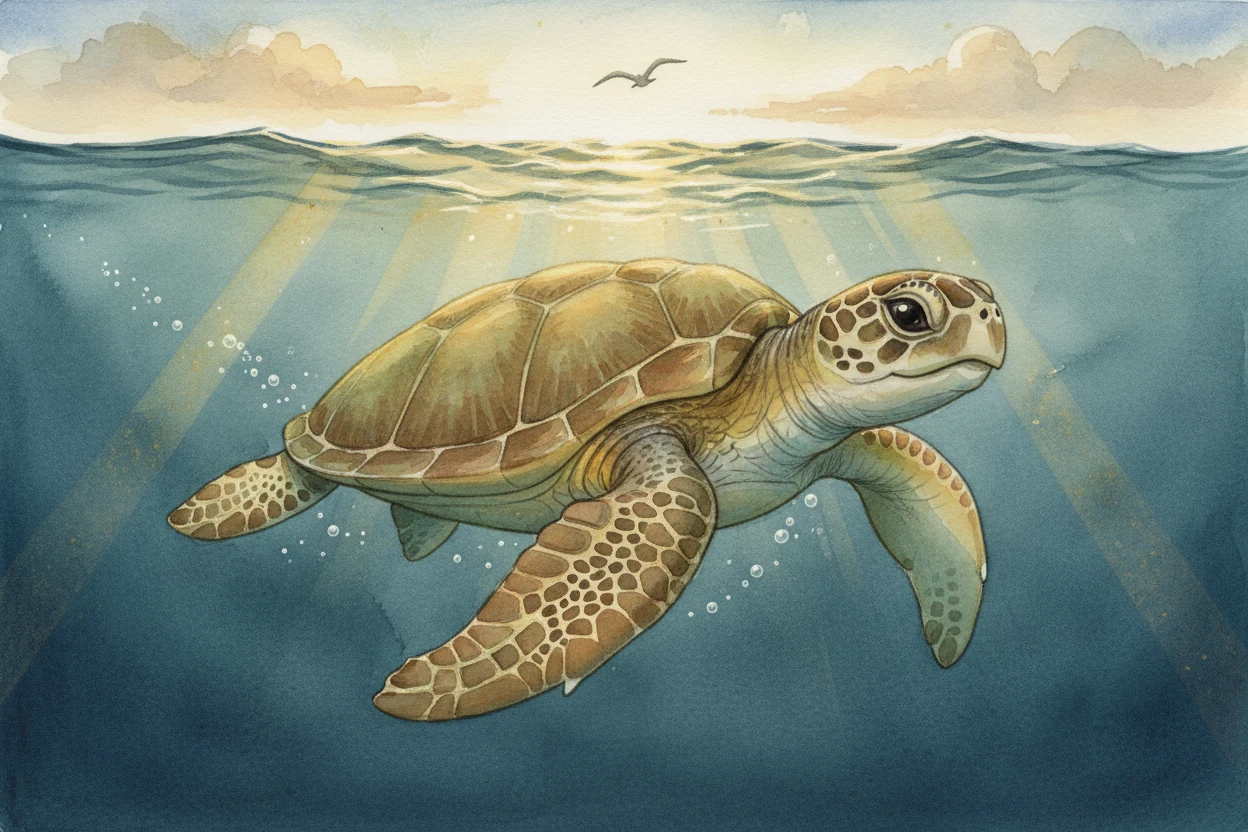
And some animals โ€” this still puzzles scientists โ€” seem to combine everything at once. A sea turtle hatches on a beach in Florida, crawls into the ocean, and disappears for twenty years. Then, as an adult, it swims back across the Atlantic to the exact same beach. It uses magnetic fields to navigate the open ocean, ocean currents as highways, and maybe even the angle of waves near the shore. It's like solving a jigsaw puzzle with pieces made of magnets, smells, sunlight, and memory, all clicking together to say: this way home.

~~So when you walk home today, think about this:~~ you're using **the same brain trick as a pigeon** memorizing landmark

So when you walk home today, think about this: you're using the same brain trick as a pigeon memorizing landmarks. You're just noticing different things โ€” a red door instead of a river bend, a cracked sidewalk instead of a mountain ridge. Every creature on Earth is solving the same problem: how do I get back to the place I belong? We've all just evolved different tools to read the world's hidden directions.

How was this book?

A Wonderleaf Book

Nature's GPS

โ€” How do animals find their way home? โ€”

Wonderleaf Editions
โ€” ex libris โ€”
A Wonderleaf Book

Nature's GPS

How do animals find their way home?

Wonderleaf Editions ยท MMXXVI
Scene 1
You're walking home from school and you know every turn without thinking โ€” left at the big oak tree, right at the blue m
Nature's GPS2
Scene 1

You're walking home from school and you know every turn without thinking โ€” left at the big oak tree, right at the blue mailbox, straight past the corner store. Easy. But what about a sea turtle crossing an entire ocean, or a bird flying thousands of miles through storms and darkness? How do animals find their way home when there are no street signs, no maps, and no one to ask for directions?

3Nature's GPS
Scene 2
Some animals use the sun like a compass. ++Bees++, for instance, watch where the sun sits in the sky and calculate angle
Nature's GPS4
Scene 2

Some animals use the sun like a compass. Bees, for instance, watch where the sun sits in the sky and calculate angles โ€” if the sun is here at this time of day, then home must be that direction. It's like using shadows on a sundial to tell time, except they're using the sun's position to tell direction. Even on cloudy days, bees can detect the sun's location through the clouds using special light patterns we can't see.

5Nature's GPS
Scene 3
Others follow their noses across impossible distances. ++Salmon++ are born in a specific stream, swim out to the ocean f
Nature's GPS6
Scene 3

Others follow their noses across impossible distances. Salmon are born in a specific stream, swim out to the ocean for years, and then โ€” when it's time โ€” swim back to the exact creek where they hatched. They remember the smell. Every stream has its own chemical signature, a unique scent made from the minerals in the rocks and the plants along the banks. A salmon sniffs its way home through thousands of miles of water, following a smell it memorized as a baby.

7Nature's GPS
Scene 4
~~Birds do something even stranger:~~ they sense the ++Earth's++ magnetic field. Our planet is basically a **giant magne
Nature's GPS8
Scene 4

Birds do something even stranger: they sense the Earth's magnetic field. Our planet is basically a giant magnet, with invisible lines of force running from the North Pole to the South Pole. Certain birds have tiny crystals in their eyes or beaks that act like built-in compasses, letting them feel which way is north the same way you might feel warmth from the sun on your face. They navigate by an invisible map painted across the sky.

9Nature's GPS
Scene 5
Some animals memorize landmarks like you'd memorize your neighborhood. ++Pigeons++ are famous for this โ€” they look down
Nature's GPS10
Scene 5

Some animals memorize landmarks like you'd memorize your neighborhood. Pigeons are famous for this โ€” they look down and remember the pattern of roads, the bend in a river, the shape of a forest. On their first few trips, they're studying. After that, they're just following a mental map they've drawn in their heads, matching what they see below to what they remember. "That highway, then that lake, then I'm home."

11Nature's GPS
Scene 6
Then there are the animals that navigate by the stars. ++Indigo buntings++, small blue songbirds, learn the night sky as
Nature's GPS12
Scene 6

Then there are the animals that navigate by the stars. Indigo buntings, small blue songbirds, learn the night sky as chicks by watching which stars spin around the North Star. That fixed point becomes their anchor. When they migrate thousands of miles south for winter and then back north for spring, they're reading the stars like a map, the same way sailors did for centuries before GPS. The whole sky is their guidebook.

13Nature's GPS
Scene 7
And some animals โ€” ~~this still puzzles scientists~~ โ€” seem to combine everything at once. A sea turtle hatches on a bea
Nature's GPS14
Scene 7

And some animals โ€” this still puzzles scientists โ€” seem to combine everything at once. A sea turtle hatches on a beach in Florida, crawls into the ocean, and disappears for twenty years. Then, as an adult, it swims back across the Atlantic to the exact same beach. It uses magnetic fields to navigate the open ocean, ocean currents as highways, and maybe even the angle of waves near the shore. It's like solving a jigsaw puzzle with pieces made of magnets, smells, sunlight, and memory, all clicking together to say: this way home.

15Nature's GPS
Scene 8
~~So when you walk home today, think about this:~~ you're using **the same brain trick as a pigeon** memorizing landmark
Nature's GPS16
Scene 8

So when you walk home today, think about this: you're using the same brain trick as a pigeon memorizing landmarks. You're just noticing different things โ€” a red door instead of a river bend, a cracked sidewalk instead of a mountain ridge. Every creature on Earth is solving the same problem: how do I get back to the place I belong? We've all just evolved different tools to read the world's hidden directions.

17Nature's GPS

~ finis ~

Tiny picture books for big little questions.

โ€” a small constellation of questions โ€”
โœฆWonderleaf
Editions