Light's Relay Race

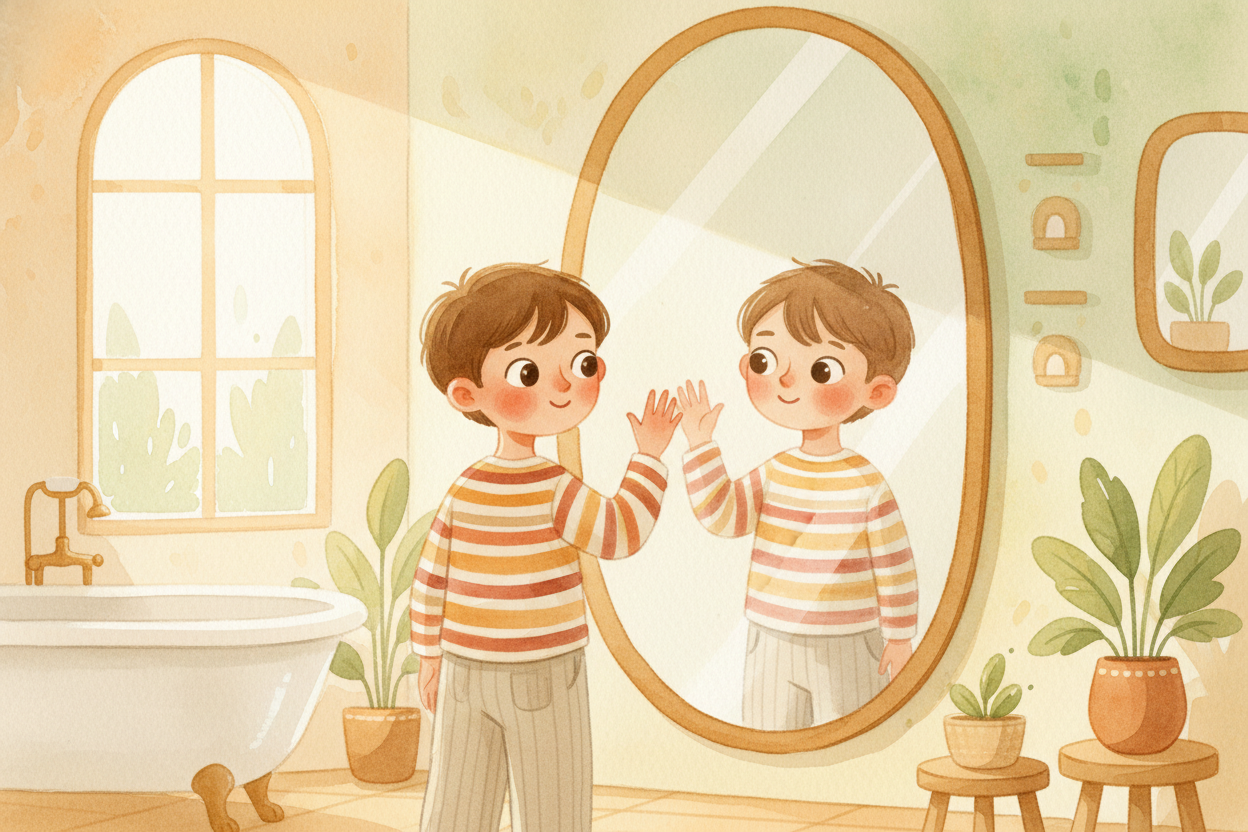
You walk up to a mirror and there you are, staring back. Your reflection copies every move โ wave your hand, it waves. Stick out your tongue, it sticks out its tongue. But what's actually happening? Is there really another you trapped in the glass?

Light is bouncing off you right now โ constantly. Every lamp, every window, every glow sends light rays streaming out in all directions. When those rays hit your face, your shirt, your hands, they bounce off and scatter into the room. That bouncing light is how anyone sees anything at all.

Most surfaces scatter light everywhere. A wall bounces light rays in a thousand random directions โ some toward your eyes, most not. That's why a wall just looks like a wall. But a mirror does something special. It bounces light back in organized lines, like a perfectly trained relay team passing a baton.

A mirror is glass with a thin coat of metal (usually aluminum or silver) on the back. When light hits that smooth metal layer, it reflects at the exact same angle it came in. Straight toward the mirror? Straight back out. Come in from the left at 30 degrees? Bounce back out to the right at 30 degrees. The rule is simple: angle in equals angle out.

So when you stand in front of a mirror, light bounces off your nose, travels straight to the mirror, hits that metal backing, and bounces straight back to your eyes โ carrying a perfect image of your nose. Same for your eyes, your hair, your smile. Every point on you sends its own light ray to the mirror and gets a ray back, all at once. Your brain stitches those rays together into "you."

Here's the weird part: your reflection looks like it's behind the mirror, the same distance back as you are forward. But nothing's actually back there. Your brain is tricked. It assumes light always travels in straight lines, so when rays bounce into your eyes, your brain traces them backward through the mirror and says, "Aha! There's a person back there." It's an optical illusion โ a very convincing one.

That's why mirrors flip left and right but not up and down. They don't actually flip anything โ they just bounce light straight back. But because you're facing the mirror, your left side is across from the reflection's right side. You're looking at yourself as if you're looking at someone facing you. If you wrote a word on your shirt, the reflection would show it backward, because you're backward relative to the mirror.

Funhouse mirrors work by bending the rules. They're curved or wavy instead of flat, so light bounces back at wild angles โ some rays stretched tall, some squeezed short. Your brain still tries to trace the rays backward, but now the reflection looks hilarious. The metal backing is still doing its job; it's just doing it on a rollercoaster of a surface.

So the next time you see yourself in a mirror, remember: you're seeing light that left you, hit metal, and came back in a tiny fraction of a second. The "you" in the mirror is just organized light โ a message your face sent and the mirror returned, perfectly. No magic. Just physics, being surprisingly elegant.