cover

Octopus Color Tricks

How do octopuses change color?
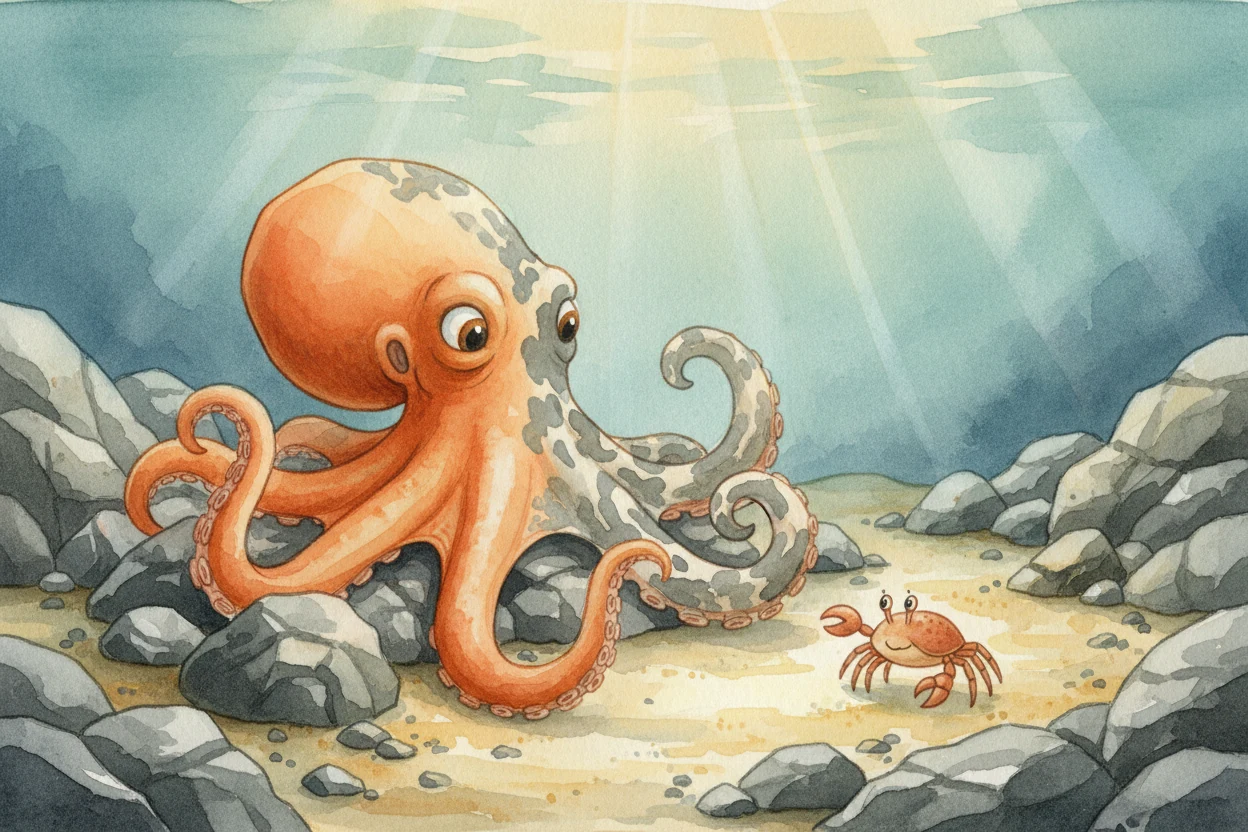
You're sitting on a rock at the bottom of the ocean, minding your own business, when a crab walks past. You're hungry. Y

You're sitting on a rock at the bottom of the ocean, minding your own business, when a crab walks past. You're hungry. You want that crab. But you're bright orange and the rock is gray, so the crab sees you coming from a mile away. Unless... you could change your skin to match the rock. Which is exactly what an octopus can do. In under a second.

The secret is in the octopus's skin, which is packed with millions of tiny color sacs called ++chromatophores++. Think o

The secret is in the octopus's skin, which is packed with millions of tiny color sacs called chromatophores. Think of each chromatophore as a stretchy balloon filled with pigment โ€” red, yellow, or brown. When the balloon is squeezed tight, you can't see the color. When it stretches open, the color spreads across the skin like ink on wet paper.

~~But here's the wild part:~~ the octopus doesn't squeeze these balloons with its hands. Each chromatophore has its own

But here's the wild part: the octopus doesn't squeeze these balloons with its hands. Each chromatophore has its own set of tiny muscles wrapped around it like rubber bands. The octopus's brain sends electrical signals to those muscles โ€” contract here, relax there โ€” and the colors bloom or vanish in patterns across its skin. Millions of them, all at once.

That's how the octopus gets red, orange, yellow, and brown. ~~But what about white?~~ Or **that silvery shimmer** you se

That's how the octopus gets red, orange, yellow, and brown. But what about white? Or that silvery shimmer you see when it slides over a bright shell? For that, the octopus has a second layer underneath the chromatophores: reflector cells called iridophores. These cells act like microscopic mirrors, bouncing light back in shimmering blues, greens, and silvers.

And there's a third layer, even deeper: ++leucophores++, which **scatter white light in all directions**. When the octop

And there's a third layer, even deeper: leucophores, which scatter white light in all directions. When the octopus wants to look pale or ghostly white, it closes its colored chromatophores and lets the white leucophores shine through. Three layers, working together like a living TV screen.

So the octopus sees a gray rock and thinks "gray." Its brain fires signals to pull back the orange and red, lets the whi

So the octopus sees a gray rock and thinks "gray." Its brain fires signals to pull back the orange and red, lets the white shine, maybe adds a flicker of silver. Done. But here's the strange part: octopuses are colorblind. They have only one type of light receptor in their eyes, so they see the world in shades of black and white. They're matching colors they can't even see.

Scientists think the octopus's skin itself might "see" light โ€” not with eyes, but with *light-sensitive proteins* scatte

Scientists think the octopus's skin itself might "see" light โ€” not with eyes, but with light-sensitive proteins scattered through the chromatophores. The skin reads the brightness and texture around it and makes its best guess at the color match, all without asking the brain. It's like your hand learning to draw without checking with your eyes.

The whole system runs ~~in a fraction of a second~~. Chromatophores open and close, iridophores shimmer, leucophores glo

The whole system runs in a fraction of a second. Chromatophores open and close, iridophores shimmer, leucophores glow or dim, and the octopus transforms from orange blob to gray rock to sandy ripple to โ€” oh look, the crab stopped paying attention. And that's all the time an octopus needs.

How was this book?

A Wonderleaf Book

Octopus Color Tricks

โ€” How do octopuses change color? โ€”

Wonderleaf Editions
โ€” ex libris โ€”
A Wonderleaf Book

Octopus Color Tricks

How do octopuses change color?

Wonderleaf Editions ยท MMXXVI
Scene 1
You're sitting on a rock at the bottom of the ocean, minding your own business, when a crab walks past. You're hungry. Y
Octopus Color Tricks2
Scene 1

You're sitting on a rock at the bottom of the ocean, minding your own business, when a crab walks past. You're hungry. You want that crab. But you're bright orange and the rock is gray, so the crab sees you coming from a mile away. Unless... you could change your skin to match the rock. Which is exactly what an octopus can do. In under a second.

3Octopus Color Tricks
Scene 2
The secret is in the octopus's skin, which is packed with millions of tiny color sacs called ++chromatophores++. Think o
Octopus Color Tricks4
Scene 2

The secret is in the octopus's skin, which is packed with millions of tiny color sacs called chromatophores. Think of each chromatophore as a stretchy balloon filled with pigment โ€” red, yellow, or brown. When the balloon is squeezed tight, you can't see the color. When it stretches open, the color spreads across the skin like ink on wet paper.

5Octopus Color Tricks
Scene 3
~~But here's the wild part:~~ the octopus doesn't squeeze these balloons with its hands. Each chromatophore has its own
Octopus Color Tricks6
Scene 3

But here's the wild part: the octopus doesn't squeeze these balloons with its hands. Each chromatophore has its own set of tiny muscles wrapped around it like rubber bands. The octopus's brain sends electrical signals to those muscles โ€” contract here, relax there โ€” and the colors bloom or vanish in patterns across its skin. Millions of them, all at once.

7Octopus Color Tricks
Scene 4
That's how the octopus gets red, orange, yellow, and brown. ~~But what about white?~~ Or **that silvery shimmer** you se
Octopus Color Tricks8
Scene 4

That's how the octopus gets red, orange, yellow, and brown. But what about white? Or that silvery shimmer you see when it slides over a bright shell? For that, the octopus has a second layer underneath the chromatophores: reflector cells called iridophores. These cells act like microscopic mirrors, bouncing light back in shimmering blues, greens, and silvers.

9Octopus Color Tricks
Scene 5
And there's a third layer, even deeper: ++leucophores++, which **scatter white light in all directions**. When the octop
Octopus Color Tricks10
Scene 5

And there's a third layer, even deeper: leucophores, which scatter white light in all directions. When the octopus wants to look pale or ghostly white, it closes its colored chromatophores and lets the white leucophores shine through. Three layers, working together like a living TV screen.

11Octopus Color Tricks
Scene 6
So the octopus sees a gray rock and thinks "gray." Its brain fires signals to pull back the orange and red, lets the whi
Octopus Color Tricks12
Scene 6

So the octopus sees a gray rock and thinks "gray." Its brain fires signals to pull back the orange and red, lets the white shine, maybe adds a flicker of silver. Done. But here's the strange part: octopuses are colorblind. They have only one type of light receptor in their eyes, so they see the world in shades of black and white. They're matching colors they can't even see.

13Octopus Color Tricks
Scene 7
Scientists think the octopus's skin itself might "see" light โ€” not with eyes, but with *light-sensitive proteins* scatte
Octopus Color Tricks14
Scene 7

Scientists think the octopus's skin itself might "see" light โ€” not with eyes, but with light-sensitive proteins scattered through the chromatophores. The skin reads the brightness and texture around it and makes its best guess at the color match, all without asking the brain. It's like your hand learning to draw without checking with your eyes.

15Octopus Color Tricks
Scene 8
The whole system runs ~~in a fraction of a second~~. Chromatophores open and close, iridophores shimmer, leucophores glo
Octopus Color Tricks16
Scene 8

The whole system runs in a fraction of a second. Chromatophores open and close, iridophores shimmer, leucophores glow or dim, and the octopus transforms from orange blob to gray rock to sandy ripple to โ€” oh look, the crab stopped paying attention. And that's all the time an octopus needs.

17Octopus Color Tricks

~ finis ~

Tiny picture books for big little questions.

โ€” a small constellation of questions โ€”
โœฆWonderleaf
Editions