cover

Water's Climb Up

How do plants drink water?
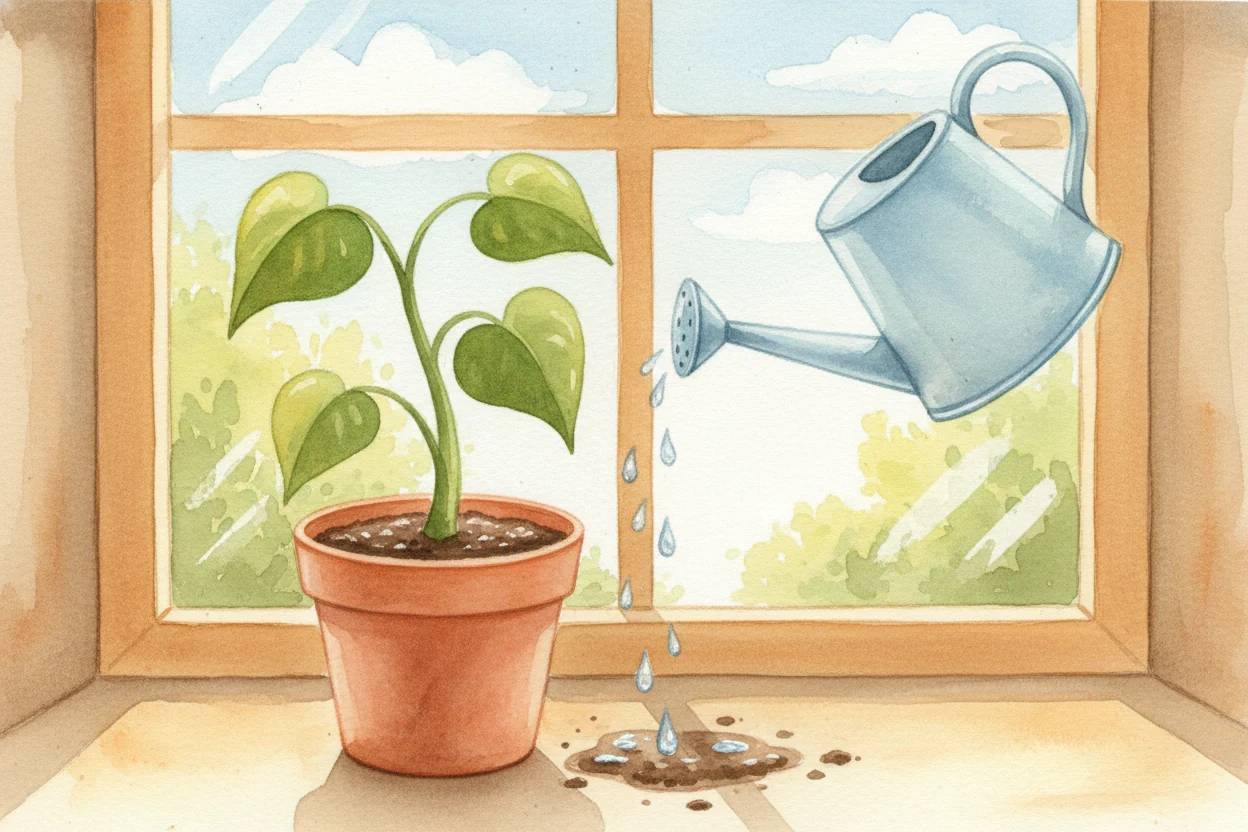
You water a plant, and the soil gets wet. But the leaves up top stay green and fresh, even on a hot day. ~~How does the

You water a plant, and the soil gets wet. But the leaves up top stay green and fresh, even on a hot day. How does the water climb all the way up there? The plant doesn't have a mouth, or a stomach, or hands to lift a cup. Yet somehow, water travels from the dirt to the very tip of every leaf.

The secret starts underground with tiny root hairs โ€” **thousands of them**, _like the finest threads_, spreading through

The secret starts underground with tiny root hairs โ€” thousands of them, like the finest threads, spreading through the soil. Each root hair is so thin you'd need a microscope to see one clearly. When you water the plant, these root hairs soak up the water like a sponge soaking up a spill.

Water moves into the root hairs through their walls in a process called ++osmosis++. Think of it like this: **if you put

Water moves into the root hairs through their walls in a process called osmosis. Think of it like this: if you put a dry sponge next to a wet one, water spreads into the dry sponge until both are equally damp. The root hair's inside is "thirstier" than the soil, so water flows in naturally, no effort required.

Once inside the roots, the water enters a highway system โ€” tiny tubes called ++xylem++ that run from the roots up throug

Once inside the roots, the water enters a highway system โ€” tiny tubes called xylem that run from the roots up through the stem and into every leaf. Xylem tubes are stacked like straws bundled together, creating a long, unbroken path. The water rides up this highway, sometimes several stories high in a big tree.

~~But water doesn't climb by magic.~~ It gets pulled. At the top of the plant, in the leaves, water evaporates out throu

But water doesn't climb by magic. It gets pulled. At the top of the plant, in the leaves, water evaporates out through tiny pores called stomata โ€” imagine hundreds of little windows opening to let steam out. This evaporation is called transpiration, and it's like sucking on a straw: as water leaves the top, it pulls more water up from below.

The pull is strong because **water molecules hold hands**. They stick to each other in a continuous chain from root to l

The pull is strong because water molecules hold hands. They stick to each other in a continuous chain from root to leaf, so when one molecule evaporates at the top, it tugs the whole line upward. It's called cohesion โ€” the water column stays connected like a rope being pulled through the xylem tubes.

How much water? A single sunflower can pull up and release **several cups of water** on a hot day. A big oak tree can mo

How much water? A single sunflower can pull up and release several cups of water on a hot day. A big oak tree can move over a hundred gallons. All that lifting happens silently, automatically, powered by nothing but evaporation and the stickiness of water itself.

~~So the next time you water a plant~~, picture the journey: **root hairs soaking it in**, ++xylem++ highways carrying i

So the next time you water a plant, picture the journey: root hairs soaking it in, xylem highways carrying it up, leaves breathing it out. It's a quiet, elegant machine, running on sunshine and the simple fact that water loves to stick together. No pump needed.

How was this book?

A Wonderleaf Book

Water's Climb Up

โ€” How do plants drink water? โ€”

Wonderleaf Editions
โ€” ex libris โ€”
A Wonderleaf Book

Water's Climb Up

How do plants drink water?

Wonderleaf Editions ยท MMXXVI
Scene 1
You water a plant, and the soil gets wet. But the leaves up top stay green and fresh, even on a hot day. ~~How does the
Water's Climb Up2
Scene 1

You water a plant, and the soil gets wet. But the leaves up top stay green and fresh, even on a hot day. How does the water climb all the way up there? The plant doesn't have a mouth, or a stomach, or hands to lift a cup. Yet somehow, water travels from the dirt to the very tip of every leaf.

3Water's Climb Up
Scene 2
The secret starts underground with tiny root hairs โ€” **thousands of them**, _like the finest threads_, spreading through
Water's Climb Up4
Scene 2

The secret starts underground with tiny root hairs โ€” thousands of them, like the finest threads, spreading through the soil. Each root hair is so thin you'd need a microscope to see one clearly. When you water the plant, these root hairs soak up the water like a sponge soaking up a spill.

5Water's Climb Up
Scene 3
Water moves into the root hairs through their walls in a process called ++osmosis++. Think of it like this: **if you put
Water's Climb Up6
Scene 3

Water moves into the root hairs through their walls in a process called osmosis. Think of it like this: if you put a dry sponge next to a wet one, water spreads into the dry sponge until both are equally damp. The root hair's inside is "thirstier" than the soil, so water flows in naturally, no effort required.

7Water's Climb Up
Scene 4
Once inside the roots, the water enters a highway system โ€” tiny tubes called ++xylem++ that run from the roots up throug
Water's Climb Up8
Scene 4

Once inside the roots, the water enters a highway system โ€” tiny tubes called xylem that run from the roots up through the stem and into every leaf. Xylem tubes are stacked like straws bundled together, creating a long, unbroken path. The water rides up this highway, sometimes several stories high in a big tree.

9Water's Climb Up
Scene 5
~~But water doesn't climb by magic.~~ It gets pulled. At the top of the plant, in the leaves, water evaporates out throu
Water's Climb Up10
Scene 5

But water doesn't climb by magic. It gets pulled. At the top of the plant, in the leaves, water evaporates out through tiny pores called stomata โ€” imagine hundreds of little windows opening to let steam out. This evaporation is called transpiration, and it's like sucking on a straw: as water leaves the top, it pulls more water up from below.

11Water's Climb Up
Scene 6
The pull is strong because **water molecules hold hands**. They stick to each other in a continuous chain from root to l
Water's Climb Up12
Scene 6

The pull is strong because water molecules hold hands. They stick to each other in a continuous chain from root to leaf, so when one molecule evaporates at the top, it tugs the whole line upward. It's called cohesion โ€” the water column stays connected like a rope being pulled through the xylem tubes.

13Water's Climb Up
Scene 7
How much water? A single sunflower can pull up and release **several cups of water** on a hot day. A big oak tree can mo
Water's Climb Up14
Scene 7

How much water? A single sunflower can pull up and release several cups of water on a hot day. A big oak tree can move over a hundred gallons. All that lifting happens silently, automatically, powered by nothing but evaporation and the stickiness of water itself.

15Water's Climb Up
Scene 8
~~So the next time you water a plant~~, picture the journey: **root hairs soaking it in**, ++xylem++ highways carrying i
Water's Climb Up16
Scene 8

So the next time you water a plant, picture the journey: root hairs soaking it in, xylem highways carrying it up, leaves breathing it out. It's a quiet, elegant machine, running on sunshine and the simple fact that water loves to stick together. No pump needed.

17Water's Climb Up

~ finis ~

Tiny picture books for big little questions.

โ€” a small constellation of questions โ€”
โœฆWonderleaf
Editions