cover

Falling With Style

How do satellites stay in orbit?
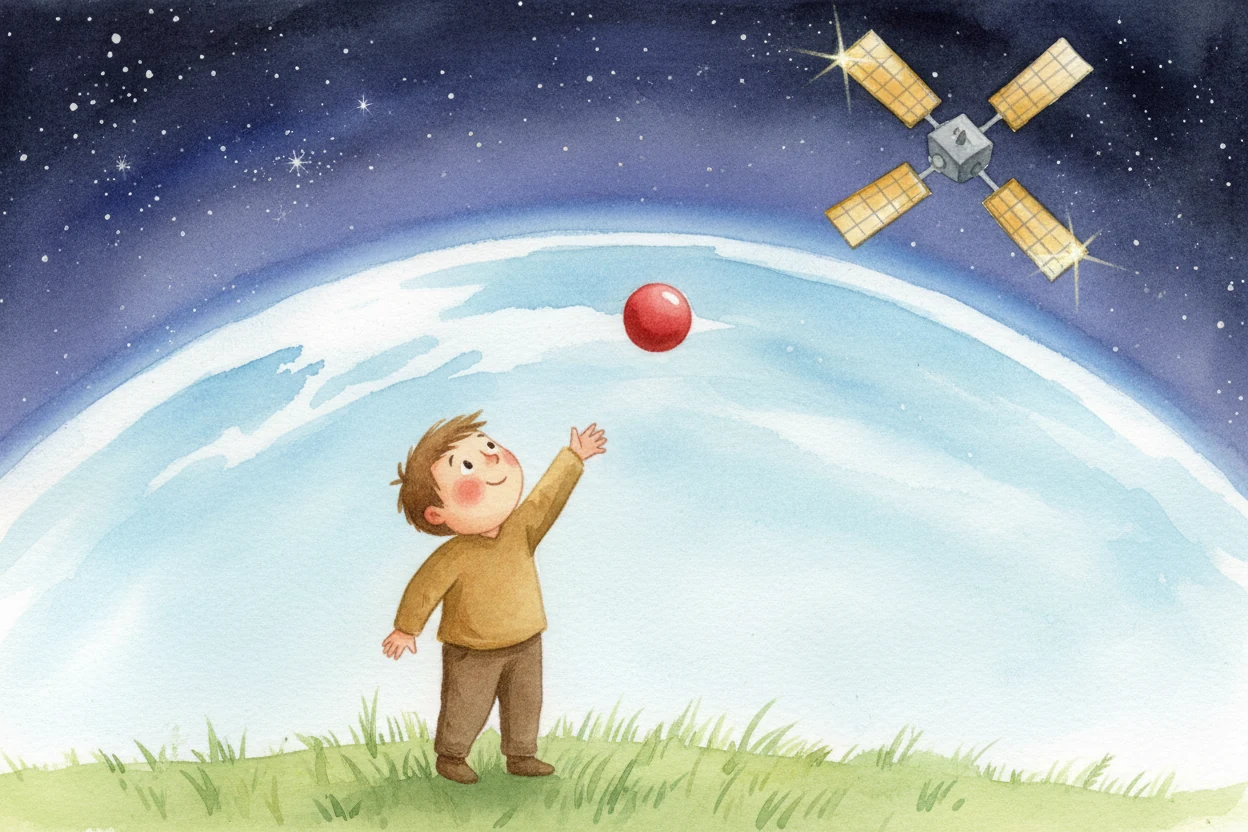
Right now, thousands of satellites are zooming around Earth, never touching the ground, never falling down. ~~How do the

Right now, thousands of satellites are zooming around Earth, never touching the ground, never falling down. How do they stay up there without engines running all the time, without strings holding them, without anything pushing them along? It seems impossible โ€” like throwing a ball so hard it never lands.

~~Here's the secret:~~ **satellites ARE falling**. They're falling toward Earth every single second. But they're also mo

Here's the secret: satellites ARE falling. They're falling toward Earth every single second. But they're also moving forward so fast โ€” about 17,000 miles per hour โ€” that as they fall, Earth's curved surface falls away beneath them at exactly the same rate. They fall around the planet instead of into it.

Imagine you're on a merry-go-round holding a ball on a string, spinning it around your head. **The ball wants to fly str

Imagine you're on a merry-go-round holding a ball on a string, spinning it around your head. The ball wants to fly straight out into space, but the string pulls it into a circle. Satellites work the same way โ€” except instead of a string, gravity is the invisible force pulling them into their circular path.

If a satellite moved too slowly, gravity would win the tug-of-war and pull it down into the atmosphere, where it would ~

If a satellite moved too slowly, gravity would win the tug-of-war and pull it down into the atmosphere, where it would burn up like a shooting star. If it moved too fast, it would break free of gravity's grip and drift off into deep space. The speed has to be just right โ€” fast enough to keep falling around, slow enough to stay caught.

**The closer a satellite is to Earth, the faster it has to go** to stay in orbit. That's because gravity pulls harder wh

The closer a satellite is to Earth, the faster it has to go to stay in orbit. That's because gravity pulls harder when you're close. Low satellites zip around the whole planet in 90 minutes. Satellites way out at 22,000 miles can take their time โ€” they circle once every 24 hours, hovering over the same spot as Earth spins.

To get a satellite into orbit, you need a rocket powerful enough to push it above the atmosphere and fast enough to give

To get a satellite into orbit, you need a rocket powerful enough to push it above the atmosphere and fast enough to give it that perfect sideways speed. The rocket doesn't go straight up and stop โ€” it curves, tips over, and flings the satellite forward at thousands of miles per hour before falling away.

Once a satellite is up there, it **barely needs any fuel**. There's ~~no air in space~~ to slow it down, no friction to

Once a satellite is up there, it barely needs any fuel. There's no air in space to slow it down, no friction to fight. It can coast in its orbit for years, even decades, falling around and around Earth in the same graceful path, held by nothing but gravity and speed.

So satellites don't float โ€” ~~they fall with style~~. Every orbit is a **perfect balance**: gravity's pull inward, speed

So satellites don't float โ€” they fall with style. Every orbit is a perfect balance: gravity's pull inward, speed's push outward, falling and flying at exactly the same time. It's the most elegant trick in physics, and it's happening right over your head.

How was this book?

A Wonderleaf Book

Falling With Style

โ€” How do satellites stay in orbit? โ€”

Wonderleaf Editions
โ€” ex libris โ€”
A Wonderleaf Book

Falling With Style

How do satellites stay in orbit?

Wonderleaf Editions ยท MMXXVI
Scene 1
Right now, thousands of satellites are zooming around Earth, never touching the ground, never falling down. ~~How do the
Falling With Style2
Scene 1

Right now, thousands of satellites are zooming around Earth, never touching the ground, never falling down. How do they stay up there without engines running all the time, without strings holding them, without anything pushing them along? It seems impossible โ€” like throwing a ball so hard it never lands.

3Falling With Style
Scene 2
~~Here's the secret:~~ **satellites ARE falling**. They're falling toward Earth every single second. But they're also mo
Falling With Style4
Scene 2

Here's the secret: satellites ARE falling. They're falling toward Earth every single second. But they're also moving forward so fast โ€” about 17,000 miles per hour โ€” that as they fall, Earth's curved surface falls away beneath them at exactly the same rate. They fall around the planet instead of into it.

5Falling With Style
Scene 3
Imagine you're on a merry-go-round holding a ball on a string, spinning it around your head. **The ball wants to fly str
Falling With Style6
Scene 3

Imagine you're on a merry-go-round holding a ball on a string, spinning it around your head. The ball wants to fly straight out into space, but the string pulls it into a circle. Satellites work the same way โ€” except instead of a string, gravity is the invisible force pulling them into their circular path.

7Falling With Style
Scene 4
If a satellite moved too slowly, gravity would win the tug-of-war and pull it down into the atmosphere, where it would ~
Falling With Style8
Scene 4

If a satellite moved too slowly, gravity would win the tug-of-war and pull it down into the atmosphere, where it would burn up like a shooting star. If it moved too fast, it would break free of gravity's grip and drift off into deep space. The speed has to be just right โ€” fast enough to keep falling around, slow enough to stay caught.

9Falling With Style
Scene 5
**The closer a satellite is to Earth, the faster it has to go** to stay in orbit. That's because gravity pulls harder wh
Falling With Style10
Scene 5

The closer a satellite is to Earth, the faster it has to go to stay in orbit. That's because gravity pulls harder when you're close. Low satellites zip around the whole planet in 90 minutes. Satellites way out at 22,000 miles can take their time โ€” they circle once every 24 hours, hovering over the same spot as Earth spins.

11Falling With Style
Scene 6
To get a satellite into orbit, you need a rocket powerful enough to push it above the atmosphere and fast enough to give
Falling With Style12
Scene 6

To get a satellite into orbit, you need a rocket powerful enough to push it above the atmosphere and fast enough to give it that perfect sideways speed. The rocket doesn't go straight up and stop โ€” it curves, tips over, and flings the satellite forward at thousands of miles per hour before falling away.

13Falling With Style
Scene 7
Once a satellite is up there, it **barely needs any fuel**. There's ~~no air in space~~ to slow it down, no friction to
Falling With Style14
Scene 7

Once a satellite is up there, it barely needs any fuel. There's no air in space to slow it down, no friction to fight. It can coast in its orbit for years, even decades, falling around and around Earth in the same graceful path, held by nothing but gravity and speed.

15Falling With Style
Scene 8
So satellites don't float โ€” ~~they fall with style~~. Every orbit is a **perfect balance**: gravity's pull inward, speed
Falling With Style16
Scene 8

So satellites don't float โ€” they fall with style. Every orbit is a perfect balance: gravity's pull inward, speed's push outward, falling and flying at exactly the same time. It's the most elegant trick in physics, and it's happening right over your head.

17Falling With Style

~ finis ~

Tiny picture books for big little questions.

โ€” a small constellation of questions โ€”
โœฆWonderleaf
Editions