cover

Finding Firefly Worlds

How do scientists find planets around other stars?
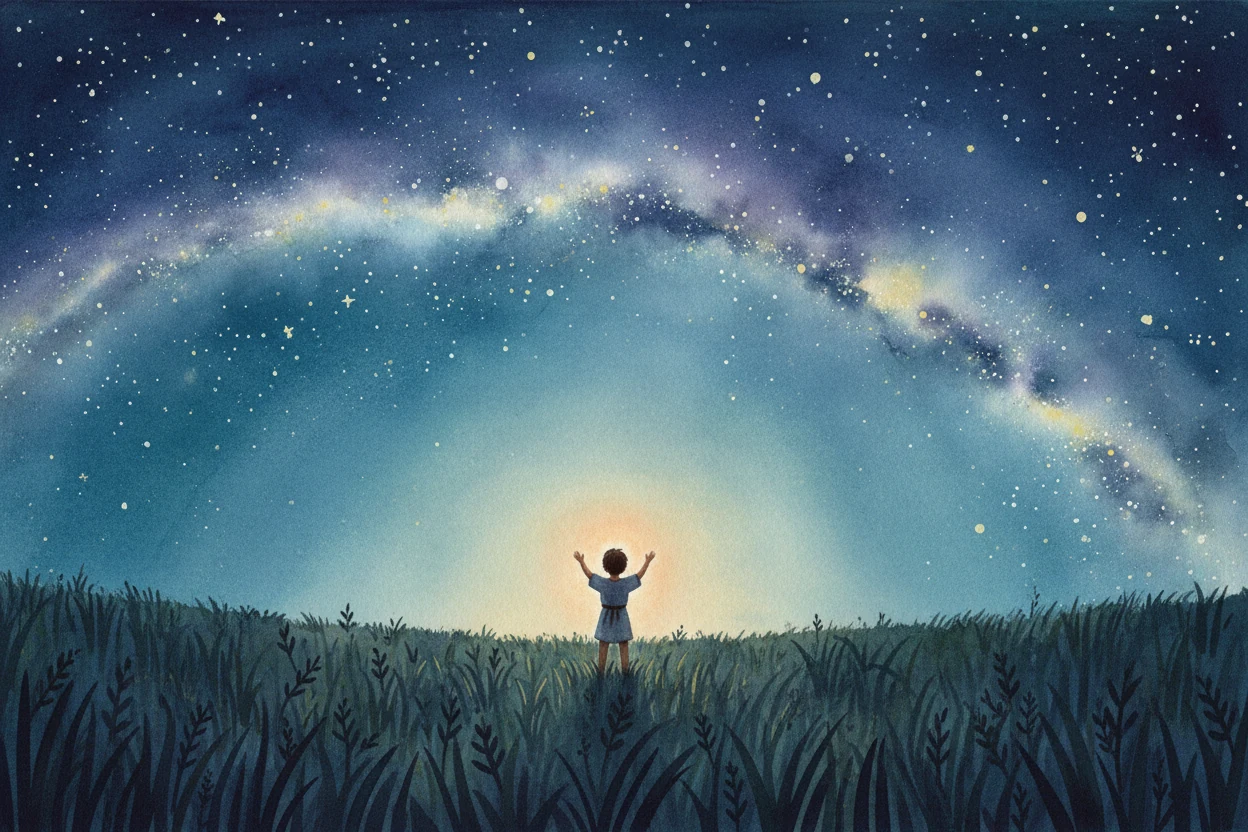
You're standing in a dark field at night, and someone a mile away turns on a tiny flashlight. Now imagine a firefly land

You're standing in a dark field at night, and someone a mile away turns on a tiny flashlight. Now imagine a firefly lands on that flashlight. Could you see the firefly? That's basically what astronomers are trying to do when they look for planets around distant stars โ€” except the "flashlight" is a billion times brighter than the "firefly," and they're both trillions of miles away.

~~Here's the problem:~~ stars are **enormous balls of nuclear fire**, blazing with their own light. Planets are cold roc

Here's the problem: stars are enormous balls of nuclear fire, blazing with their own light. Planets are cold rocks or gas balls that only reflect a star's light โ€” like trying to spot a grain of sand next to a searchlight. You can't just point a telescope at a star and see its planets hovering nearby. The star's glare drowns them out completely.

So astronomers got clever. They realized you don't always have to see something directly to know it's there. If you watc

So astronomers got clever. They realized you don't always have to see something directly to know it's there. If you watch a streetlamp and notice it wobbling back and forth, you can guess an invisible dog on a leash is pulling its owner in circles around the pole. Stars do the same wobble when planets orbit them โ€” the planet's gravity tugs the star slightly as it goes around.

By measuring how the star's light shifts color โ€” a tiny bit bluer as it wobbles toward us, a tiny bit redder as it wobbl

By measuring how the star's light shifts color โ€” a tiny bit bluer as it wobbles toward us, a tiny bit redder as it wobbles away โ€” astronomers can calculate the wobble. It's called the radial velocity method, and it works like catching someone humming a song as they walk toward you and then away. The pitch changes, even though they're singing the same note. That wobble told us about the first exoplanet ever found, in 1995.

~~But there's an even sneakier trick:~~ the ++transit method++. Imagine you're staring at a lightbulb across the room, a

But there's an even sneakier trick: the transit method. Imagine you're staring at a lightbulb across the room, and a moth flies between you and the bulb. For a split second, the light dims just a little. When a planet crosses in front of its star from our point of view, the star dims the same way โ€” usually by less than one percent, but sensitive instruments can catch it.

NASA's ++Kepler Space Telescope++ stared at over 150,000 stars for years, waiting for those **tiny dips in brightness**.

NASA's Kepler Space Telescope stared at over 150,000 stars for years, waiting for those tiny dips in brightness. Every time a star dimmed in a regular pattern โ€” once every few days, or months, or years โ€” that rhythm meant a planet was orbiting. Kepler found thousands of them, proving that planets are everywhere in the galaxy, not just around our Sun.

From the depth and length of the dimming, scientists can figure out the planet's size and how far it orbits from its sta

From the depth and length of the dimming, scientists can figure out the planet's size and how far it orbits from its star. A deep, quick dip? A big planet zipping close to its star. A shallow, slow dip? A smaller planet farther out. It's like watching shadows on a wall and deducing the size and speed of whatever's casting them.

Some planets are ~~scorching hot gas giants~~ orbiting closer to their stars than ++Mercury++ does to our Sun. Others ar

Some planets are scorching hot gas giants orbiting closer to their stars than Mercury does to our Sun. Others are frozen ice worlds in the dark outer edges. A few โ€” just a few โ€” are rocky planets in the "Goldilocks zone," where water could be liquid. We've found over 5,000 exoplanets so far, and we're just getting started.

How was this book?

A Wonderleaf Book

Finding Firefly Worlds

โ€” How do scientists find planets around other stars? โ€”

Wonderleaf Editions
โ€” ex libris โ€”
A Wonderleaf Book

Finding Firefly Worlds

How do scientists find planets around other stars?

Wonderleaf Editions ยท MMXXVI
Scene 1
You're standing in a dark field at night, and someone a mile away turns on a tiny flashlight. Now imagine a firefly land
Finding Firefly Worlds2
Scene 1

You're standing in a dark field at night, and someone a mile away turns on a tiny flashlight. Now imagine a firefly lands on that flashlight. Could you see the firefly? That's basically what astronomers are trying to do when they look for planets around distant stars โ€” except the "flashlight" is a billion times brighter than the "firefly," and they're both trillions of miles away.

3Finding Firefly Worlds
Scene 2
~~Here's the problem:~~ stars are **enormous balls of nuclear fire**, blazing with their own light. Planets are cold roc
Finding Firefly Worlds4
Scene 2

Here's the problem: stars are enormous balls of nuclear fire, blazing with their own light. Planets are cold rocks or gas balls that only reflect a star's light โ€” like trying to spot a grain of sand next to a searchlight. You can't just point a telescope at a star and see its planets hovering nearby. The star's glare drowns them out completely.

5Finding Firefly Worlds
Scene 3
So astronomers got clever. They realized you don't always have to see something directly to know it's there. If you watc
Finding Firefly Worlds6
Scene 3

So astronomers got clever. They realized you don't always have to see something directly to know it's there. If you watch a streetlamp and notice it wobbling back and forth, you can guess an invisible dog on a leash is pulling its owner in circles around the pole. Stars do the same wobble when planets orbit them โ€” the planet's gravity tugs the star slightly as it goes around.

7Finding Firefly Worlds
Scene 4
By measuring how the star's light shifts color โ€” a tiny bit bluer as it wobbles toward us, a tiny bit redder as it wobbl
Finding Firefly Worlds8
Scene 4

By measuring how the star's light shifts color โ€” a tiny bit bluer as it wobbles toward us, a tiny bit redder as it wobbles away โ€” astronomers can calculate the wobble. It's called the radial velocity method, and it works like catching someone humming a song as they walk toward you and then away. The pitch changes, even though they're singing the same note. That wobble told us about the first exoplanet ever found, in 1995.

9Finding Firefly Worlds
Scene 5
~~But there's an even sneakier trick:~~ the ++transit method++. Imagine you're staring at a lightbulb across the room, a
Finding Firefly Worlds10
Scene 5

But there's an even sneakier trick: the transit method. Imagine you're staring at a lightbulb across the room, and a moth flies between you and the bulb. For a split second, the light dims just a little. When a planet crosses in front of its star from our point of view, the star dims the same way โ€” usually by less than one percent, but sensitive instruments can catch it.

11Finding Firefly Worlds
Scene 6
NASA's ++Kepler Space Telescope++ stared at over 150,000 stars for years, waiting for those **tiny dips in brightness**.
Finding Firefly Worlds12
Scene 6

NASA's Kepler Space Telescope stared at over 150,000 stars for years, waiting for those tiny dips in brightness. Every time a star dimmed in a regular pattern โ€” once every few days, or months, or years โ€” that rhythm meant a planet was orbiting. Kepler found thousands of them, proving that planets are everywhere in the galaxy, not just around our Sun.

13Finding Firefly Worlds
Scene 7
From the depth and length of the dimming, scientists can figure out the planet's size and how far it orbits from its sta
Finding Firefly Worlds14
Scene 7

From the depth and length of the dimming, scientists can figure out the planet's size and how far it orbits from its star. A deep, quick dip? A big planet zipping close to its star. A shallow, slow dip? A smaller planet farther out. It's like watching shadows on a wall and deducing the size and speed of whatever's casting them.

15Finding Firefly Worlds
Scene 8
Some planets are ~~scorching hot gas giants~~ orbiting closer to their stars than ++Mercury++ does to our Sun. Others ar
Finding Firefly Worlds16
Scene 8

Some planets are scorching hot gas giants orbiting closer to their stars than Mercury does to our Sun. Others are frozen ice worlds in the dark outer edges. A few โ€” just a few โ€” are rocky planets in the "Goldilocks zone," where water could be liquid. We've found over 5,000 exoplanets so far, and we're just getting started.

17Finding Firefly Worlds

~ finis ~

Tiny picture books for big little questions.

โ€” a small constellation of questions โ€”
โœฆWonderleaf
Editions