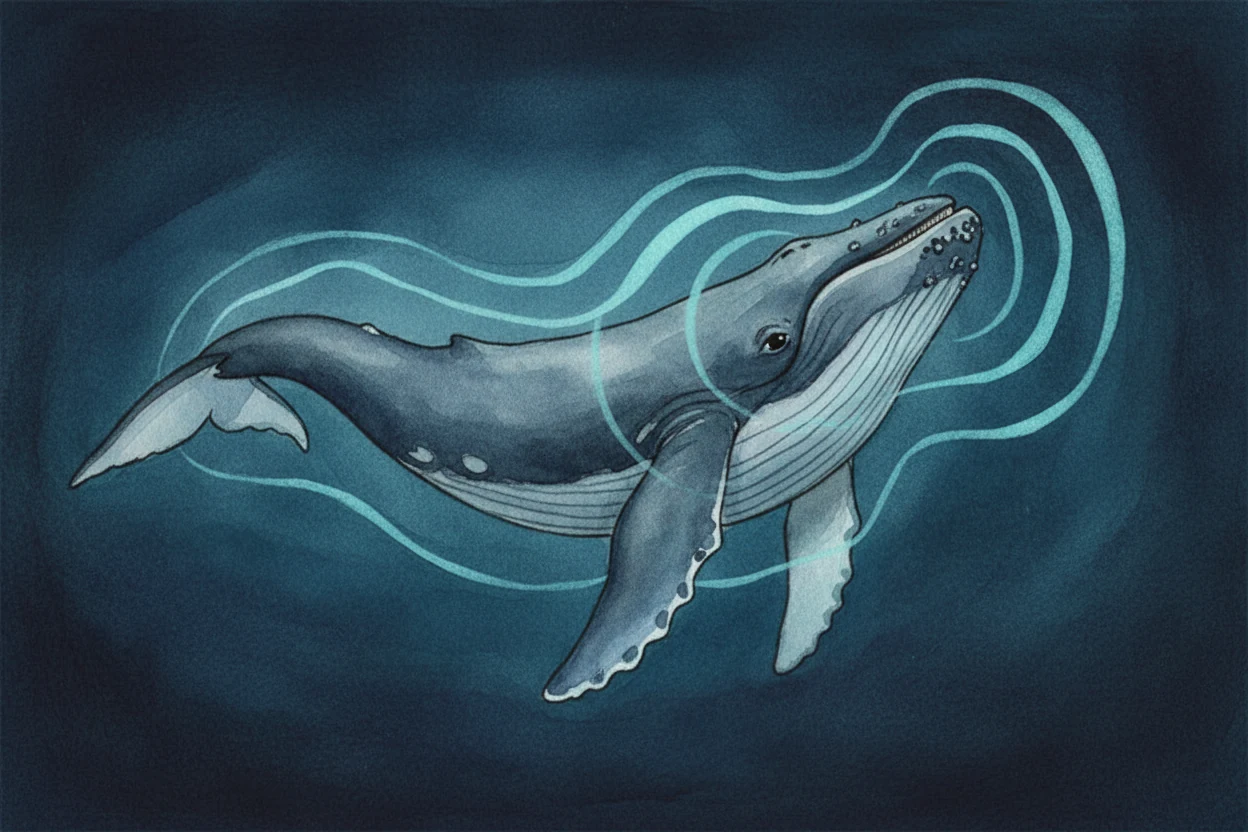
Songs Through the Sea
Deep in the ocean, where sunlight fades to blue-black and the nearest whale might be miles away, how do whales have a conversation? They can't exactly swim over and tap a friend on the shoulder. So they do something that sounds like magic: they sing through the water itself.
Water is a whale's telephone network. When a whale makes a sound โ a rumble, a click, a long musical note โ that sound travels as a pressure wave through the ocean, the same way ripples spread when you drop a stone in a pond. Except sound moves through water almost five times faster than through air, so a whale's call can zoom across miles of ocean in minutes.
Different whales speak different dialects. Humpback whales are the opera singers: they compose long, complex songs with repeating phrases, like verses in a ballad. Males sing these songs during mating season, and scientists think they might be showing off โ "Listen to my range! Check out this high note!" Other humpbacks in the area learn the same song, so a whole population ends up singing the same hit single, which slowly evolves each year like a musical trend.
Sperm whales, on the other hand, are the percussionists. They make rapid clicks โ cuh-cuh-cuh-click-click โ like someone tapping out Morse code. Each sperm whale family has its own click pattern, called a coda, that works like a family accent. When whales meet, they exchange codas: "I'm from the Caribbean clan." "Oh, I'm Pacific Northwest!" If the codas don't match, they might just swim past each other like strangers on a subway.
Blue whales โ the largest animals on Earth โ have the lowest voices. Their calls rumble at frequencies so deep that humans can barely hear them, down around 10-40 Hertz. That's lower than the lowest note on a piano. But low sounds travel farther through water than high sounds, so a blue whale's call can cross entire ocean basins. A whale off the coast of California might be heard by a whale near Hawaii, over 2,000 miles away.
Whales don't just broadcast; they listen, too. A whale's ears aren't the floppy external kind โ they're tiny openings on the sides of the head, connected to inner ear bones surrounded by special foam-like tissue. But whales also "hear" through their lower jaw, which picks up vibrations from the water and channels them to the inner ear. It's like having a second pair of ears built into your chin.
Sometimes whales talk in secret codes that humans only recently cracked. Orcas, for example, use specific calls to coordinate hunts: one pattern means "circle around the fish," another means "drive them toward the surface." Each orca pod has its own call library โ up to seventeen distinct calls โ that they teach to their calves, the way you'd teach a child the family's inside jokes. If an orca gets separated and hears a familiar call pattern, it knows: "That's my family. I'm going home."
Humans have made the ocean noisier โ ship engines, sonar, underwater construction โ and all that racket can drown out whale conversations, like trying to talk at a rock concert. Some whales have started "speaking up," making their calls louder or at different frequencies to cut through the noise. It's the underwater version of raising your voice in a crowded room.
So when a humpback floats in the midnight ocean and lets loose a twenty-minute song that twists and loops back on itself, it's not just making pretty noise. It's sending a message into the blue: "I'm here. I'm strong. I'm looking for family, for a mate, for someone who speaks my language." And somewhere, miles away, another whale hears the song through the dark water โ and answers back.