Secret Water Fight
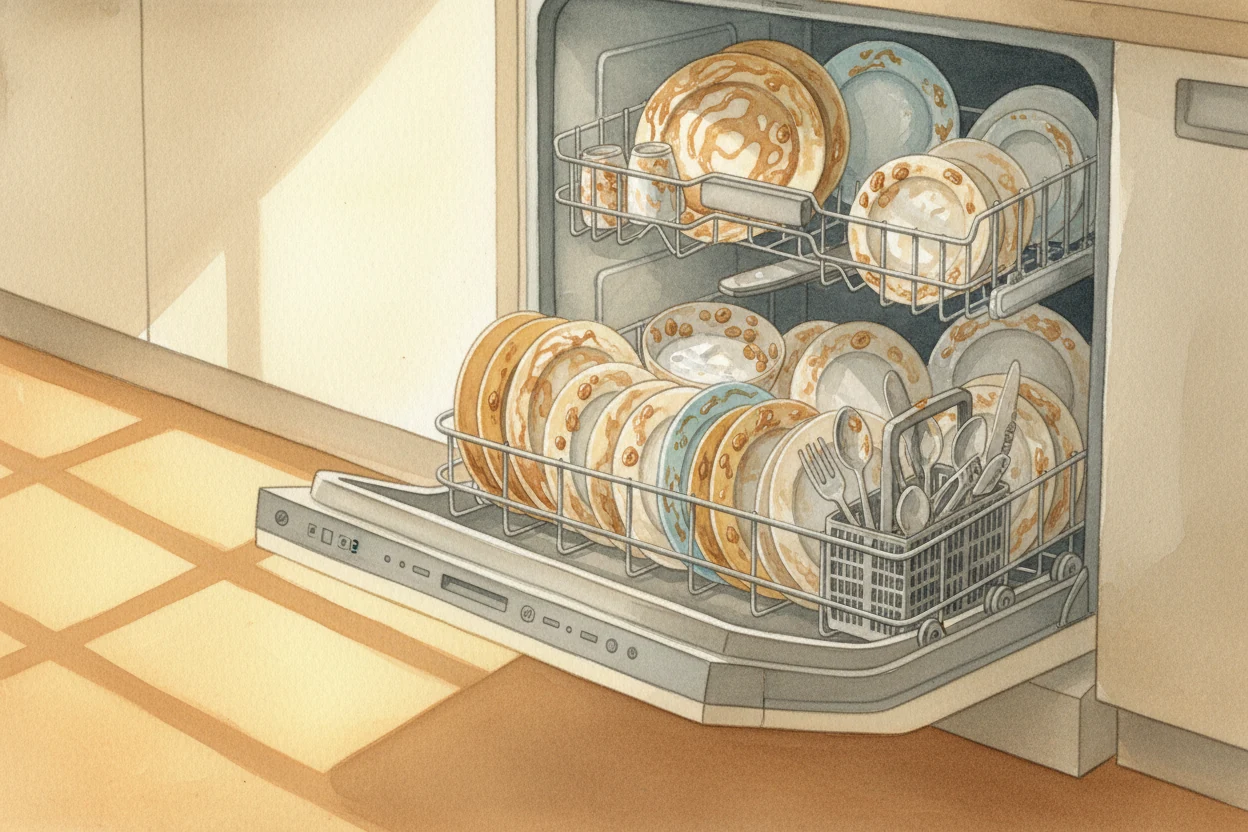
You load your breakfast dishes into the dishwasher, close the door, press a button, and walk away. An hour later, they're clean. But what happened in there? It's time to open the secret world inside the machine.
First, you need to know: there's no one in there scrubbing. Instead, the dishwasher is basically a super-organized water fight. When you press start, a pump at the bottom begins pulling water in from your house's pipes. The water flows into a little reservoir at the machine's base, like filling a tiny pool.
Now here's the clever part. That pump doesn't just fill the tub โ it shoots the water UP through spinning arms. These arms look like sprinkler helicopter blades, with holes all along them. As water blasts out of the holes, the force makes the arms spin, just like a lawn sprinkler spins when you turn it on. The dishwasher becomes a pressurized water carousel.
But water alone won't cut through dried cheese or oily fingerprints. So the machine adds detergent โ either from a pod that pops open or from a little compartment that releases powder or gel. The detergent is full of molecules that grab onto grease on one end and water on the other end, like tiny two-handed workers. They yank the grease off your plate and hold it in the water so it can't stick back on.
Temperature matters too. Cold water is lazy โ grease just laughs at it and stays stuck. So the dishwasher heats the water to around 140โ160ยฐF, hot enough that grease melts and oils go liquid. The heat also helps the detergent work faster, breaking down proteins in dried egg and starches in crusty rice. It's like the difference between washing your hands with cold tap water versus warm water and soap.
The wash cycle runs for a while โ spray, spin, spray, spin โ then the machine drains all that dirty water out through a hose to your sink's drain pipe. But it's not done yet. It fills up again with fresh water and does a rinse cycle: more spinning arms, more spraying, but this time no soap. Just hot water to flush away any leftover detergent and food bits. Some dishwashers rinse twice to be extra sure.
Finally, drying. Some dishwashers have a heating element at the bottom that warms the air inside, evaporating the water off the dishes. Fancier ones blow hot air around. The simplest ones just use the residual heat from the hot rinse water โ the dishes are so hot that water evaporates on its own, like a puddle in the sun. Plastic doesn't hold heat well, which is why plastic containers sometimes stay a little wet.
So that's the secret: it's all water pressure, heat, chemistry, and spin. No brushes, no hands, no magic โ just a machine that knows exactly how hard to spray, how hot to heat, and how long to rinse. Your dishes come out clean because physics and soap make a very good team.