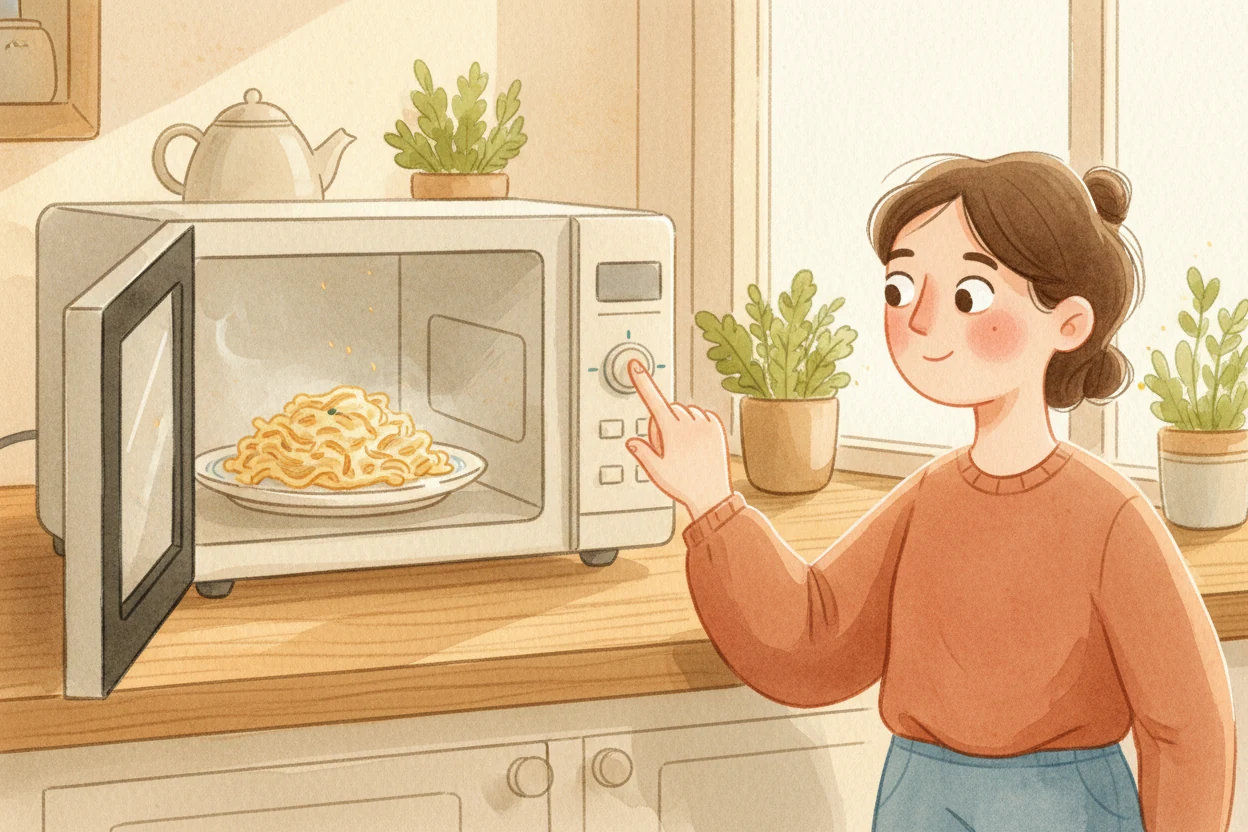
Microwave's Secret Dance
You press a button, the microwave hums, and sixty seconds later your leftovers are piping hot. But nothing glowed red like a stovetop. Nothing touched the food at all. So what just happened in there?
Inside the microwave's metal box lives a gadget called a magnetron โ a tube about the size of a flashlight. When you hit start, electricity powers it up, and it starts firing invisible waves into the box. These waves are called microwaves, and they're a type of energy, like light or radio signals, but with a special superpower: they make water molecules wiggle.
Your food โ that pasta, a mug of coffee, a slice of pizza โ is full of tiny water molecules. Normally they jiggle around randomly, minding their own business. But when a microwave wave passes through, it grabs those water molecules and flips them back and forth, over two billion times per second. Flip, flip, flip, flip, flip, faster than anything you can imagine.
All that flipping creates friction โ the molecules bump into their neighbors, and bumping makes heat. It's like rubbing your hands together on a cold day, except it's happening everywhere inside the food at once, invisibly, at ridiculous speed.
The microwaves bounce around inside the metal walls like a rubber ball in a racquetball court โ they can't escape, so they just keep ricocheting until the food absorbs them. That's why the inside of a microwave is metal: metal reflects microwaves. The glass door has a metal mesh so you can see in, but the waves can't get out.
But here's the weird part: microwaves heat unevenly. Some spots get bombarded by lots of waves crossing paths โ those spots heat up fast. Other spots barely get touched and stay cold. That's why your food has a scorching-hot pocket of tomato sauce next to a frozen chunk of cheese.
The spinning glass plate tries to fix this. As your food rotates, different parts move through the hot zones and cold zones, so the heat evens out โ a little. But microwave ovens are impatient machines. They heat the water fast and call it done, even if the middle is still cold.
So when you open the door and find one edge of your burrito molten and the other edge frozen, you're not doing anything wrong. You've just met the microwave's trade-off: speed for precision. It zaps water molecules into a frenzy, heats your lunch in a minute flat, and leaves you to stir the hot spots into the cold. Fair deal, when you're hungry.