cover

Lunch's Secret Power

How does food turn into energy?
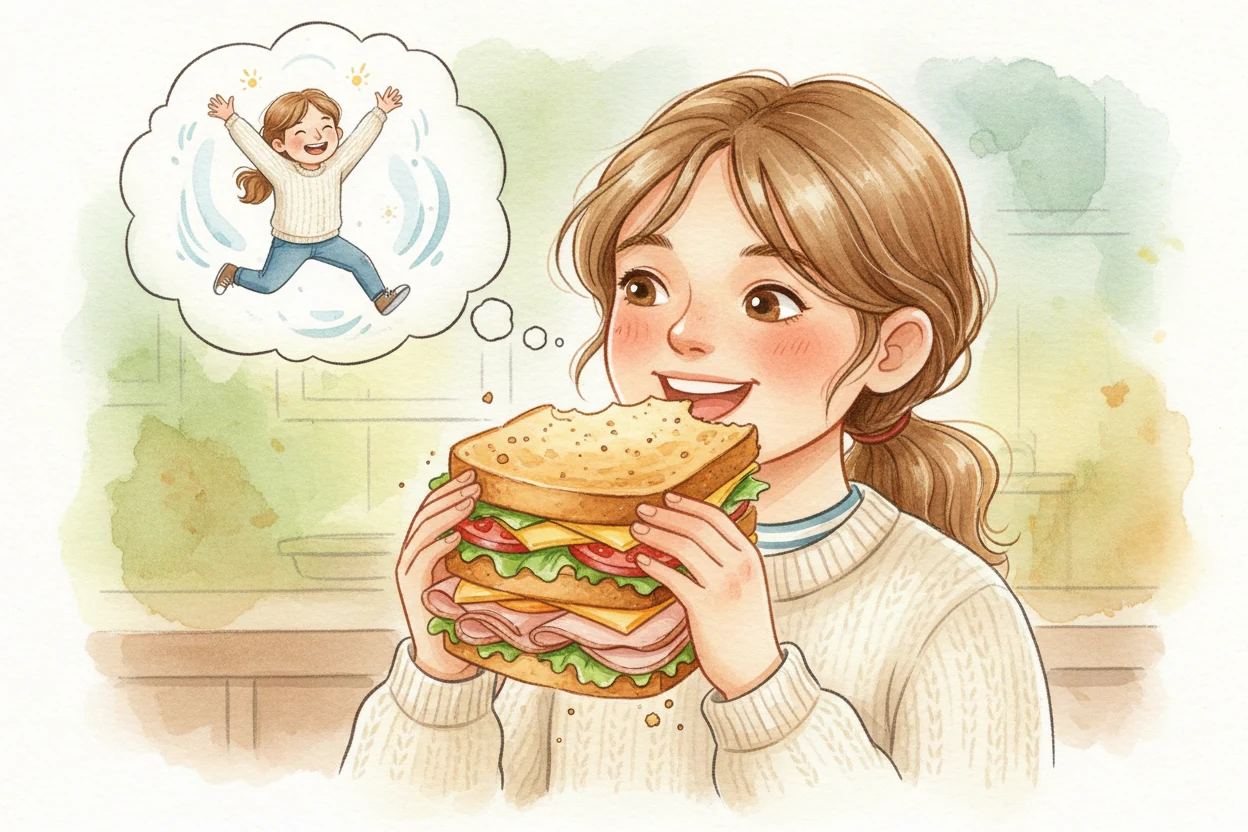
You bite into a sandwich โ€” bread, cheese, maybe some turkey โ€” and half an hour later you're running around, thinking, la

You bite into a sandwich โ€” bread, cheese, maybe some turkey โ€” and half an hour later you're running around, thinking, laughing, living. How did lunch become the power to move your body and fire your brain? The answer is one of the coolest tricks your cells know how to pull off.

Food is built from ++molecules++ โ€” mostly sugars, fats, and proteins โ€” and those molecules are held together by chemical

Food is built from molecules โ€” mostly sugars, fats, and proteins โ€” and those molecules are held together by chemical bonds. Think of each bond like a tiny coiled spring. Your body's job is to snap those springs and catch the energy they release.

It starts in your stomach and intestines, where food gets broken into smaller pieces. A sandwich becomes ++glucose++ (a

It starts in your stomach and intestines, where food gets broken into smaller pieces. A sandwich becomes glucose (a simple sugar), fatty acids, and amino acids floating in your bloodstream. These are the fuel molecules โ€” small enough to slip into your cells.

Once glucose enters a cell, it meets the ++mitochondria++ โ€” **tiny bean-shaped power plants**, hundreds of them in every

Once glucose enters a cell, it meets the mitochondria โ€” tiny bean-shaped power plants, hundreds of them in every cell. The mitochondria are where the magic happens. They take glucose and, through a series of chemical steps, crack it open.

Inside the ++mitochondrion++, glucose gets pulled apart in a process called ++cellular respiration++. Oxygen you breathe

Inside the mitochondrion, glucose gets pulled apart in a process called cellular respiration. Oxygen you breathed in helps break the bonds. As each bond snaps, the mitochondrion catches the released energy and stuffs it into a molecule called ATP โ€” adenosine triphosphate.

++ATP++ is your body's **universal energy currency**. It's a molecule with three phosphate groups stuck together **like

ATP is your body's universal energy currency. It's a molecule with three phosphate groups stuck together like a stack of springs. When your muscle needs to contract, or your brain cell needs to fire, it snaps off one phosphate from ATP โ€” and that snap releases the energy to do the work.

One glucose molecule, fully burned with oxygen, makes about **thirty-two ATP**. Your mitochondria crank out ~~billions o

One glucose molecule, fully burned with oxygen, makes about thirty-two ATP. Your mitochondria crank out billions of ATP molecules every second. Every thought you think, every step you take, every heartbeat โ€” all powered by ATP snapping its phosphate spring.

So food doesn't "become" energy the way ice becomes water. Food stores energy in chemical bonds โ€” and your cells are **e

So food doesn't "become" energy the way ice becomes water. Food stores energy in chemical bonds โ€” and your cells are expert locksmiths, cracking those bonds and transferring the energy into ATP, the coin your body spends to live. That sandwich? It's a pile of tiny locked batteries, and you just ate the keys.

How was this book?

A Wonderleaf Book

Lunch's Secret Power

โ€” How does food turn into energy? โ€”

Wonderleaf Editions
โ€” ex libris โ€”
A Wonderleaf Book

Lunch's Secret Power

How does food turn into energy?

Wonderleaf Editions ยท MMXXVI
Scene 1
You bite into a sandwich โ€” bread, cheese, maybe some turkey โ€” and half an hour later you're running around, thinking, la
Lunch's Secret Power2
Scene 1

You bite into a sandwich โ€” bread, cheese, maybe some turkey โ€” and half an hour later you're running around, thinking, laughing, living. How did lunch become the power to move your body and fire your brain? The answer is one of the coolest tricks your cells know how to pull off.

3Lunch's Secret Power
Scene 2
Food is built from ++molecules++ โ€” mostly sugars, fats, and proteins โ€” and those molecules are held together by chemical
Lunch's Secret Power4
Scene 2

Food is built from molecules โ€” mostly sugars, fats, and proteins โ€” and those molecules are held together by chemical bonds. Think of each bond like a tiny coiled spring. Your body's job is to snap those springs and catch the energy they release.

5Lunch's Secret Power
Scene 3
It starts in your stomach and intestines, where food gets broken into smaller pieces. A sandwich becomes ++glucose++ (a
Lunch's Secret Power6
Scene 3

It starts in your stomach and intestines, where food gets broken into smaller pieces. A sandwich becomes glucose (a simple sugar), fatty acids, and amino acids floating in your bloodstream. These are the fuel molecules โ€” small enough to slip into your cells.

7Lunch's Secret Power
Scene 4
Once glucose enters a cell, it meets the ++mitochondria++ โ€” **tiny bean-shaped power plants**, hundreds of them in every
Lunch's Secret Power8
Scene 4

Once glucose enters a cell, it meets the mitochondria โ€” tiny bean-shaped power plants, hundreds of them in every cell. The mitochondria are where the magic happens. They take glucose and, through a series of chemical steps, crack it open.

9Lunch's Secret Power
Scene 5
Inside the ++mitochondrion++, glucose gets pulled apart in a process called ++cellular respiration++. Oxygen you breathe
Lunch's Secret Power10
Scene 5

Inside the mitochondrion, glucose gets pulled apart in a process called cellular respiration. Oxygen you breathed in helps break the bonds. As each bond snaps, the mitochondrion catches the released energy and stuffs it into a molecule called ATP โ€” adenosine triphosphate.

11Lunch's Secret Power
Scene 6
++ATP++ is your body's **universal energy currency**. It's a molecule with three phosphate groups stuck together **like
Lunch's Secret Power12
Scene 6

ATP is your body's universal energy currency. It's a molecule with three phosphate groups stuck together like a stack of springs. When your muscle needs to contract, or your brain cell needs to fire, it snaps off one phosphate from ATP โ€” and that snap releases the energy to do the work.

13Lunch's Secret Power
Scene 7
One glucose molecule, fully burned with oxygen, makes about **thirty-two ATP**. Your mitochondria crank out ~~billions o
Lunch's Secret Power14
Scene 7

One glucose molecule, fully burned with oxygen, makes about thirty-two ATP. Your mitochondria crank out billions of ATP molecules every second. Every thought you think, every step you take, every heartbeat โ€” all powered by ATP snapping its phosphate spring.

15Lunch's Secret Power
Scene 8
So food doesn't "become" energy the way ice becomes water. Food stores energy in chemical bonds โ€” and your cells are **e
Lunch's Secret Power16
Scene 8

So food doesn't "become" energy the way ice becomes water. Food stores energy in chemical bonds โ€” and your cells are expert locksmiths, cracking those bonds and transferring the energy into ATP, the coin your body spends to live. That sandwich? It's a pile of tiny locked batteries, and you just ate the keys.

17Lunch's Secret Power

~ finis ~

Tiny picture books for big little questions.

โ€” a small constellation of questions โ€”
โœฆWonderleaf
Editions