Desert's Sky Messages
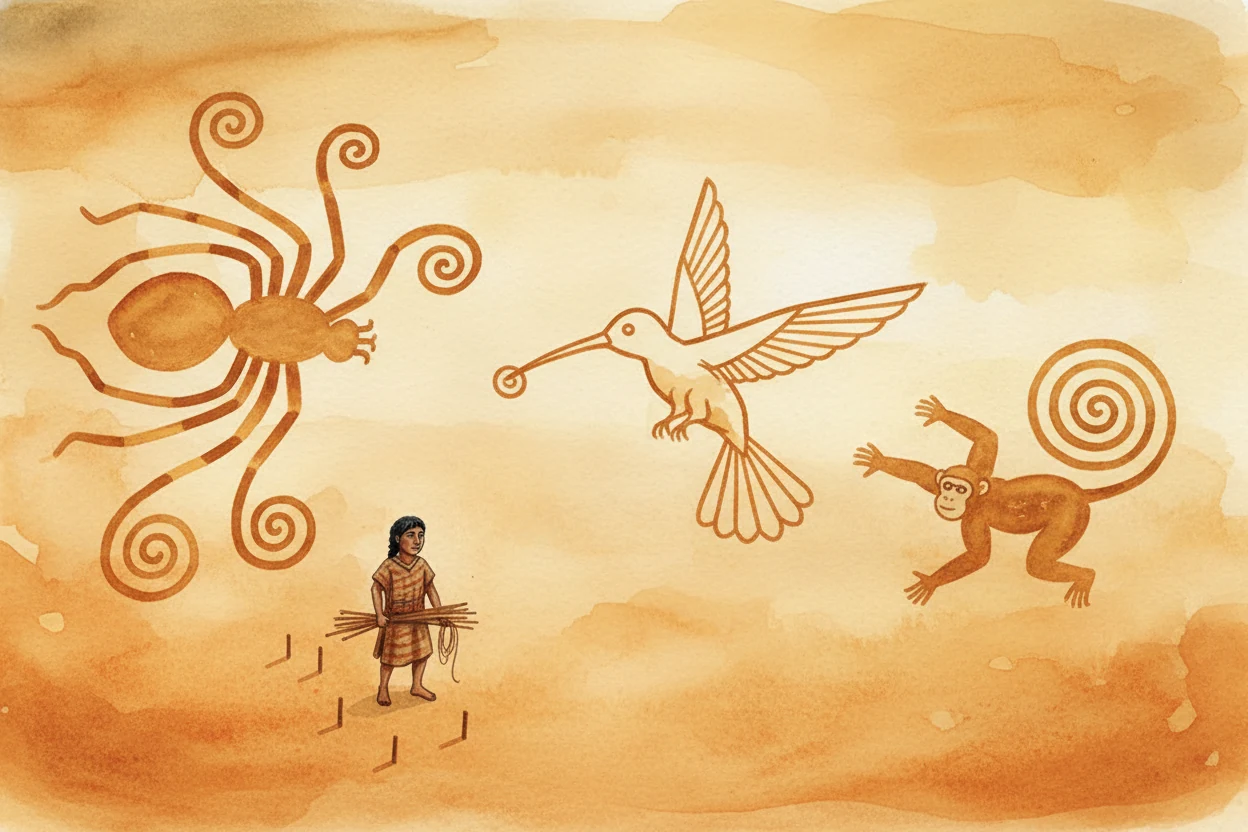
Imagine standing in the middle of a desert in Peru, looking down at your feet. You see rocks, sand, maybe a lizard. Nothing special. But if you could suddenly fly straight up like a rocket—high, high into the sky—you'd gasp. Because drawn across the desert floor below you, bigger than football fields, are perfect pictures: a spider with curly legs, a hummingbird with an impossibly long beak, a monkey with a spiral tail. They're called the Nazca Lines, and they've been lying there for about 2,000 years, waiting to be discovered.
The Nazca people made them between roughly 500 BCE and 500 CE—that's before the Inca, before anyone in Peru had metal tools or wheels. They had string, wooden stakes, and an idea. The desert floor here is covered in dark reddish rocks. Underneath those rocks? Lighter-colored sand. So the Nazca didn't paint or carve. They just cleared away the top layer of rocks, revealing the pale ground beneath, and suddenly: lines.
Some of the drawings are animals—seventy of them, from spiders to orcas. Others are plants or strange beings with giant eyes. And then there are the geometric shapes: perfectly straight lines that run for miles, triangles, spirals, trapezoids that look like landing strips. Some lines are so straight that modern surveyors can barely match them. How did they do it without flying above to check their work? String stretched tight between stakes. Walk the line, move the rocks, repeat. For years.
Here's the wild part: the Nazca probably never saw the full pictures. A monkey drawing might be 300 feet across—try seeing that shape while you're standing on one of its fingers. It's like drawing a portrait while your nose is pressed to the canvas. They built these massive images for eyes in the sky. But whose eyes?
For decades, people cooked up dramatic theories. Aliens landing strips! Ancient astronauts! Secret messages! But archaeologists have a simpler, stranger answer: the lines were likely paths for walking, and the images were for the gods. The Nazca lived in one of the driest places on Earth. Rain was everything. So they made enormous offerings to the sky—images so big only the gods above could see them whole. Walking the lines might have been a kind of prayer, a ritual procession when water was needed.
Some figures might have pointed to water sources or aligned with the stars and sun at certain times of year—like a giant calendar drawn in rocks. The hummingbird, for instance, appears near underground water channels. The lines didn't just ask for rain; they mapped the desert's hidden veins. The Nazca were saying: we see what's invisible, we honor what's below and what's above.
The lines survived because this desert is one of the stillest places on the planet—almost no rain, almost no wind, almost no people for centuries. The rocks they moved stayed moved. In a way, the Nazca drew with permanence itself. They didn't have paper or paint that would last. So they used the one canvas that wouldn't wash away: the earth, in a place where nothing erases.
Today, you can see them from small planes that buzz over the desert, or from a metal tower built beside the highway. Tourists press their faces to airplane windows and say the same thing the Nazca might have whispered 2,000 years ago: "The gods must see this." And maybe, in a way, we've become those gods—the eyes in the sky the Nazca were drawing for. They made something so big it could only be seen by the future. And here we are, looking down, finally seeing the spider spin, the hummingbird hover, the monkey's tail curl into forever.