Stone Mountains of Time
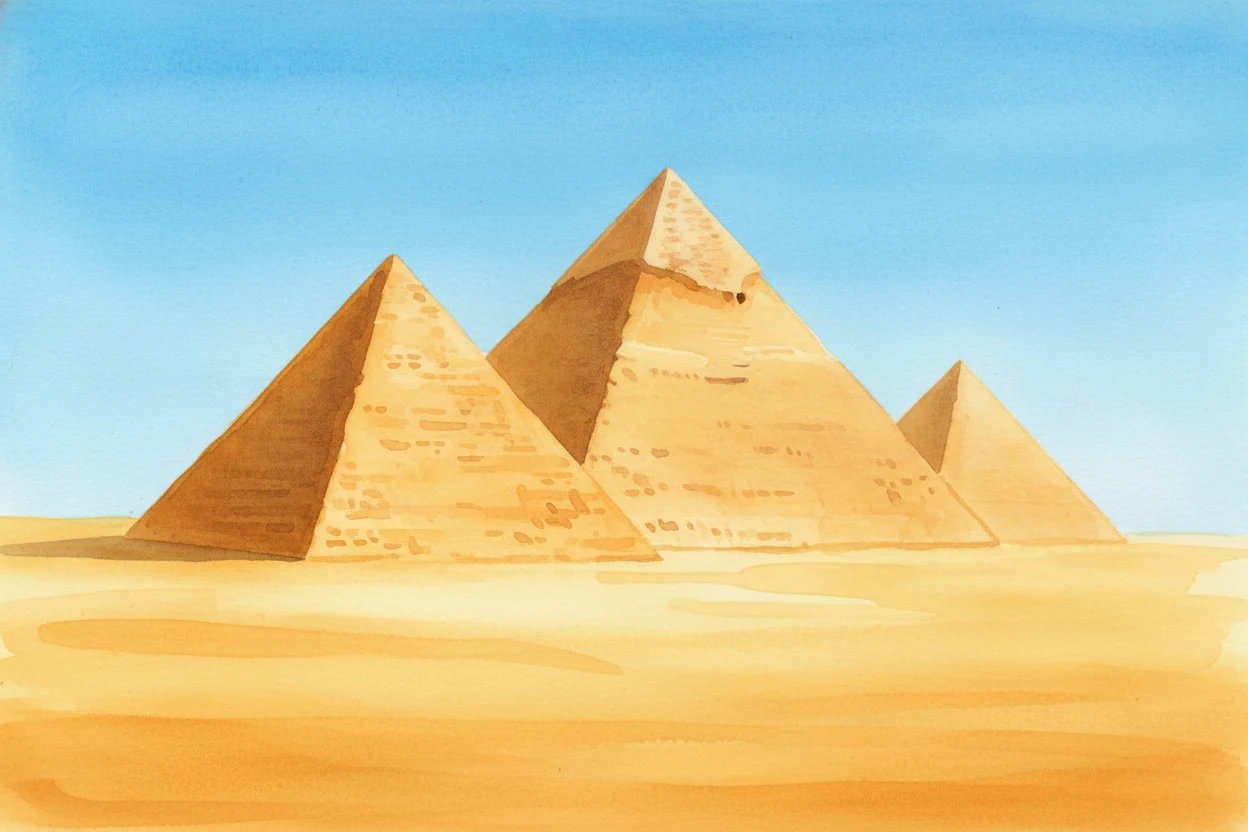
In the desert outside Cairo, three enormous stone mountains rise from the sand โ perfect triangles that have stood for more than four thousand years. They're not natural hills. They're tombs, built by hand, one block at a time, for three ancient Egyptian kings.
The biggest one, the Great Pyramid, was built for King Khufu around 2560 BCE. It's made of more than two million limestone blocks, each one weighing as much as a car. The whole thing was originally covered in smooth white limestone that gleamed like a mirror in the sun.
How did they do it without cranes or trucks? They carved the blocks from quarries using copper chisels and wooden wedges, then moved them on sledges โ flat wooden platforms pulled by teams of workers over paths made slippery with water. It was like moving a car across ice, one slow tug at a time.
Ramps spiraled up the pyramid's sides as it grew taller, like a path winding up a mountain. Tens of thousands of workers โ farmers, laborers, craftsmen โ worked in rotating shifts for twenty years. They weren't slaves; they were paid in bread, beer, and onions, and they took pride in building something eternal.
Inside, narrow passageways lead to a hidden chamber where Khufu's body was placed in a stone coffin, surrounded by treasures for the afterlife. The Egyptians believed the pyramid was a machine for resurrection โ a stairway to the stars, helping the king's soul climb to join the gods.
The other two pyramids belong to Khufu's son Khafre and his grandson Menkaure. Khafre's pyramid looks taller because it sits on higher ground, but it's actually a bit smaller. Next to Khafre's pyramid crouches the Sphinx โ a giant lion with a pharaoh's face, carved from a single ridge of bedrock.
For thousands of years, people wondered if the pyramids held secret chambers or hidden magic. Modern scanners have found mysterious voids inside โ empty spaces we still can't explain. The pyramids keep their secrets close.
Today, the white limestone casing is mostly gone, stripped away for other buildings centuries ago, and the pyramids look like giant stone staircases. But they're still the oldest of the Seven Wonders of the Ancient World โ and the only one still standing. You can walk right up to them, put your hand on a block, and touch something built when mammoths still roamed the earth.