cover

Sky's Secret Dance

What causes the northern lights?
Have you ever seen a photograph of green and pink curtains shimmering across the night sky near the North Pole? Those ar

Have you ever seen a photograph of green and pink curtains shimmering across the night sky near the North Pole? Those are the aurora borealis โ€” the northern lights โ€” and they're not painted on or projected from the ground. They're actually happening up there, about sixty miles above Earth's surface. The question is: what makes them glow?
To understand the northern lights, you need to know what the Sun is really doing. It's ~~not just sitting there shining~

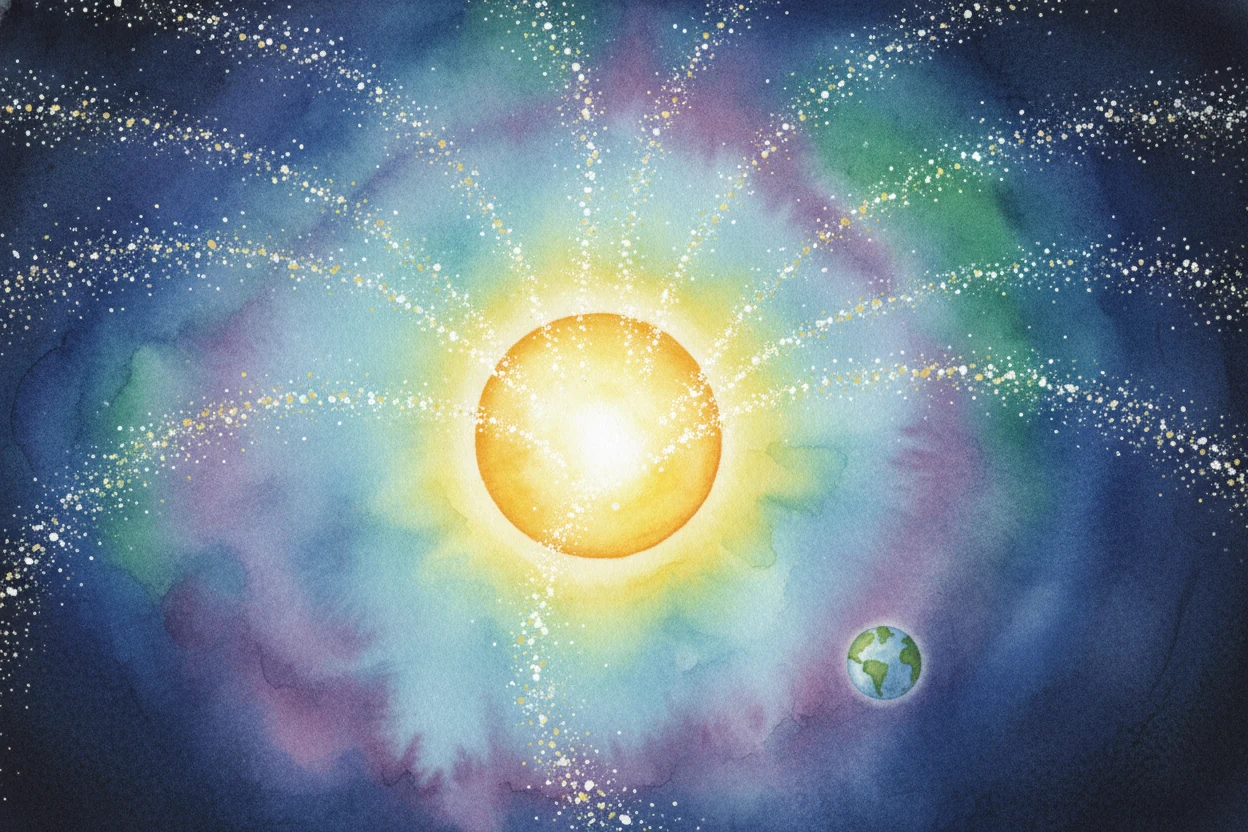
To understand the northern lights, you need to know what the Sun is really doing. It's not just sitting there shining. The Sun is constantly throwing off a wind โ€” not air, but a stream of tiny charged particles called electrons and protons. This "solar wind" rushes outward in all directions at about a million miles per hour. Earth sits right in the path of that invisible storm.

Now, ++Earth++ has a **secret shield**. Deep inside our planet, molten iron swirls around, and that motion generates a m

Now, Earth has a secret shield. Deep inside our planet, molten iron swirls around, and that motion generates a magnetic field โ€” an invisible bubble that wraps around the whole Earth like a force field. When the solar wind particles come racing toward us, most of them hit that magnetic field and get deflected away, curving around Earth and continuing off into space. Without this shield, the solar wind would strip away our atmosphere.
~~But here's where it gets interesting.~~ The magnetic field isn't perfectly round. It has **two weak spots**: the north

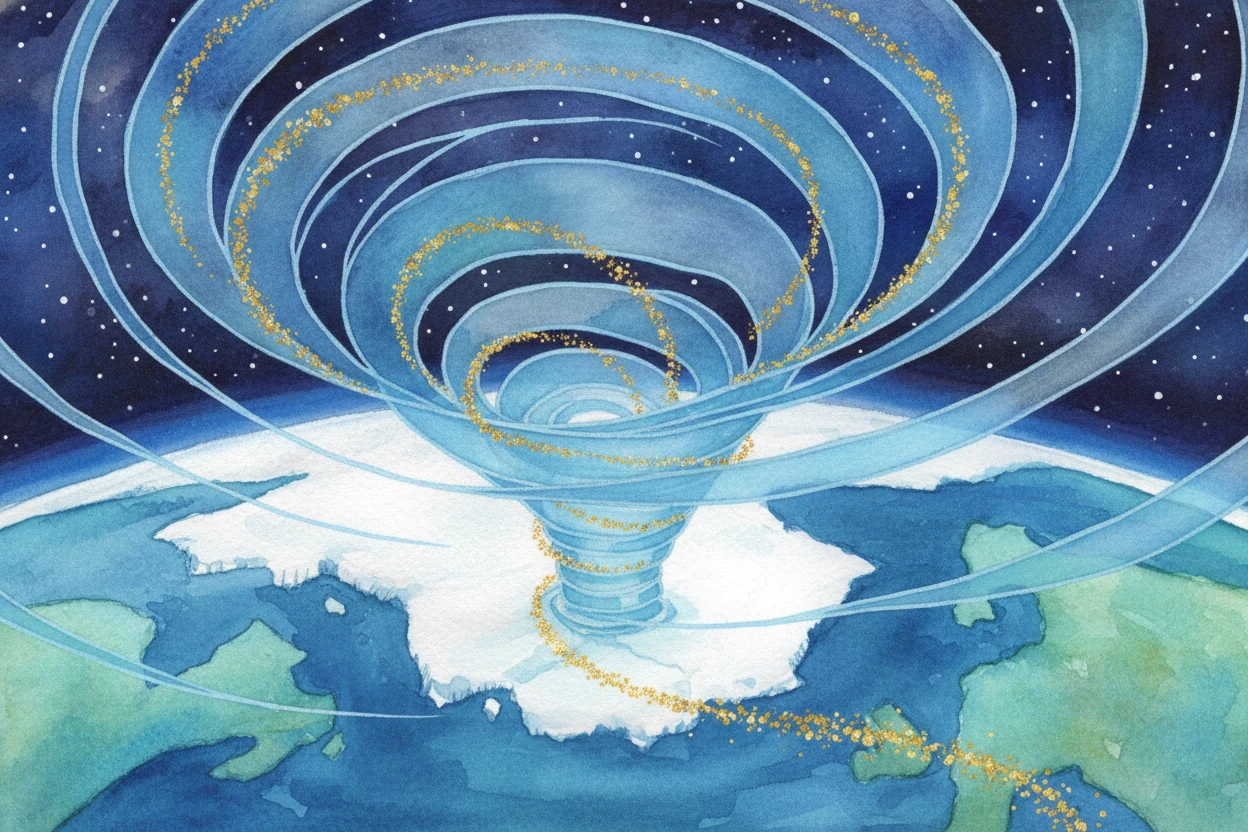
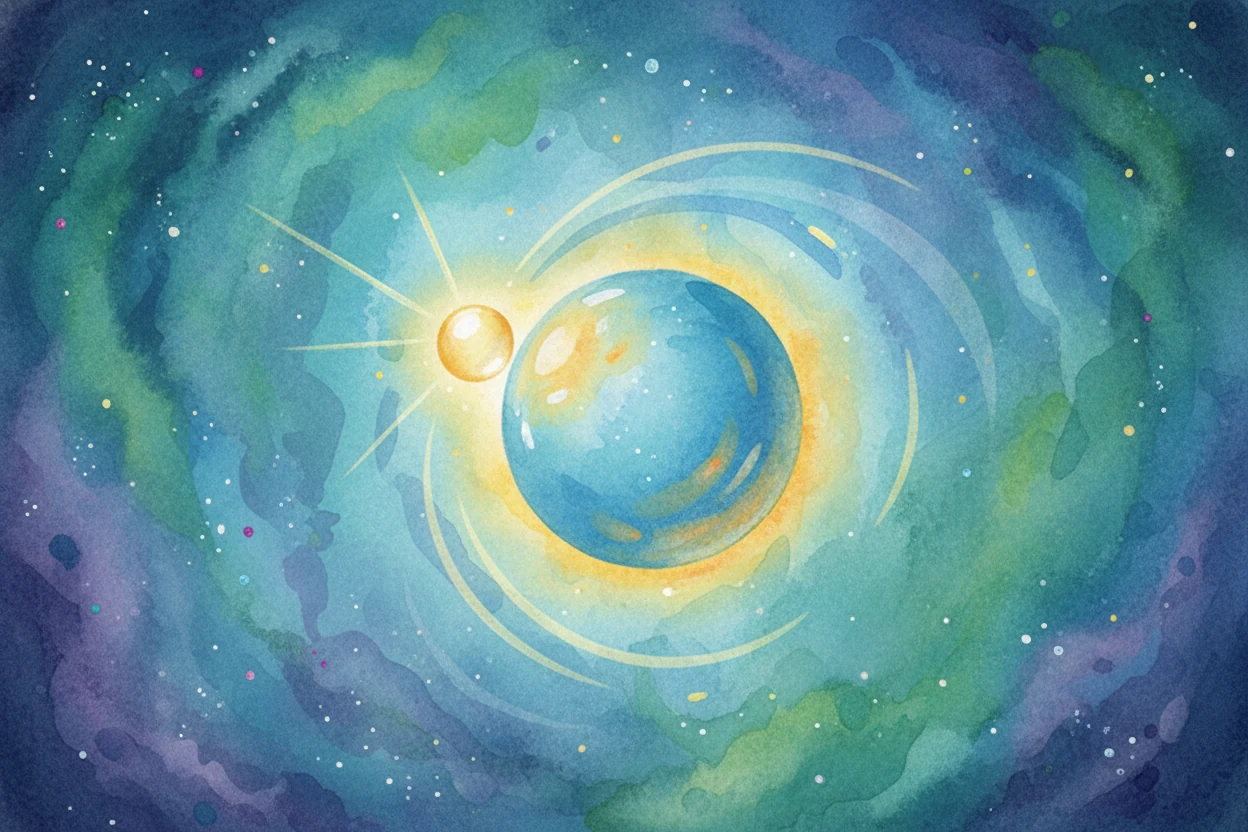
But here's where it gets interesting. The magnetic field isn't perfectly round. It has two weak spots: the north and south magnetic poles, where the field lines funnel down into Earth like water swirling into a drain. Some of those solar wind particles slip through the gaps at the poles and spiral down the magnetic field lines toward the surface.
As those charged particles plunge toward Earth, they slam into air molecules โ€” mostly oxygen and nitrogen โ€” floating six

As those charged particles plunge toward Earth, they slam into air molecules โ€” mostly oxygen and nitrogen โ€” floating sixty to two hundred miles up. Imagine you're a calm oxygen atom minding your own business, and suddenly a high-speed electron crashes into you. The collision pumps energy into the oxygen atom, and the atom gets excited โ€” literally, that's what physicists call it.

~~An excited atom can't stay excited forever.~~ Within a fraction of a second, it releases that extra energy as a photon

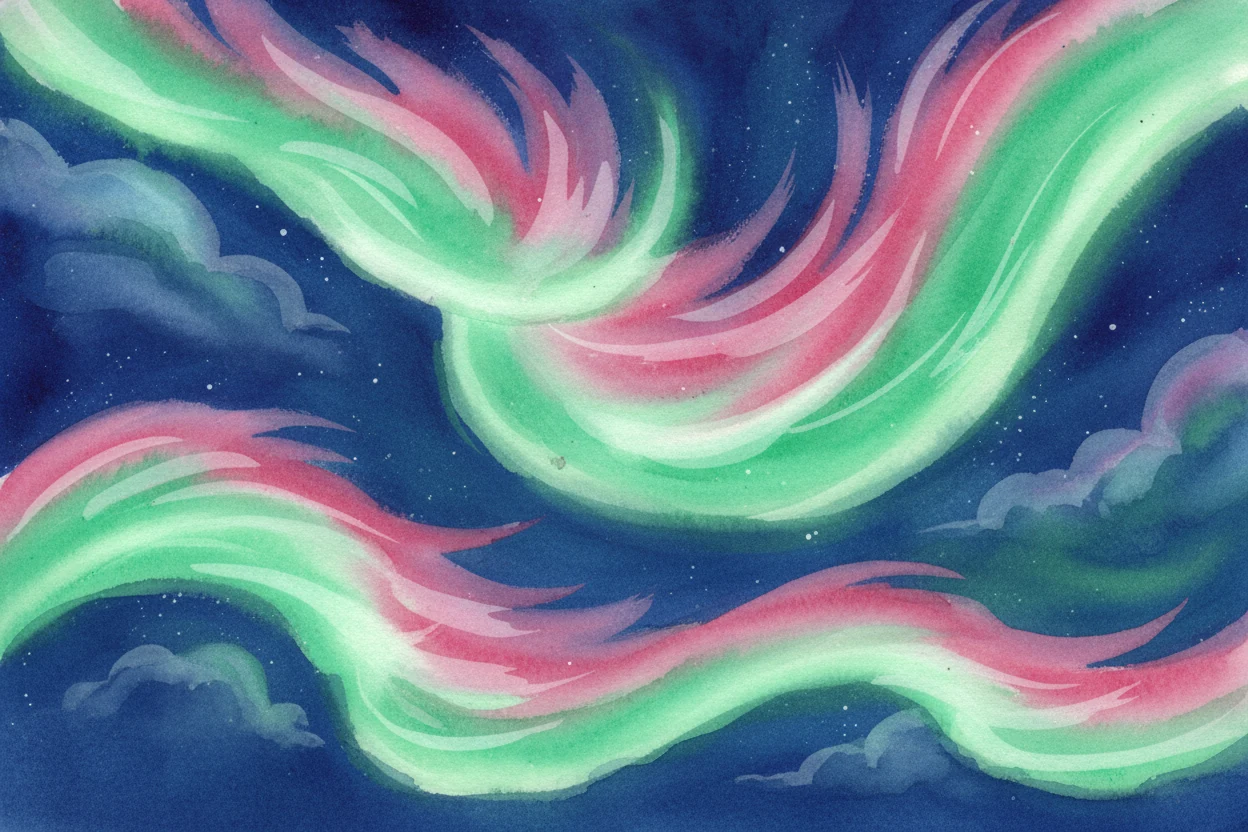
An excited atom can't stay excited forever. Within a fraction of a second, it releases that extra energy as a photon โ€” a particle of light. The color of the light depends on which type of atom got hit and how high up the collision happened. Oxygen at high altitudes glows red. Oxygen lower down glows green. Nitrogen glows blue or purple. Millions of these tiny atomic light bulbs flicker on and off every second, and together they paint those rippling curtains across the sky.
The aurora isn't static โ€” it dances. That's because the solar wind isn't steady. When the Sun ~~burps out~~ an extra-str

The aurora isn't static โ€” it dances. That's because the solar wind isn't steady. When the Sun burps out an extra-strong blast of particles, called a solar storm, the aurora gets brighter and spreads farther south. The curtains twist, fold, and shimmer as different clumps of particles arrive and hit different layers of the atmosphere. Some nights the show is a faint glow. Other nights, the whole sky pulses with color.
So the northern lights are really just Earth's atmosphere lighting up when solar wind particles sneak past our magnetic

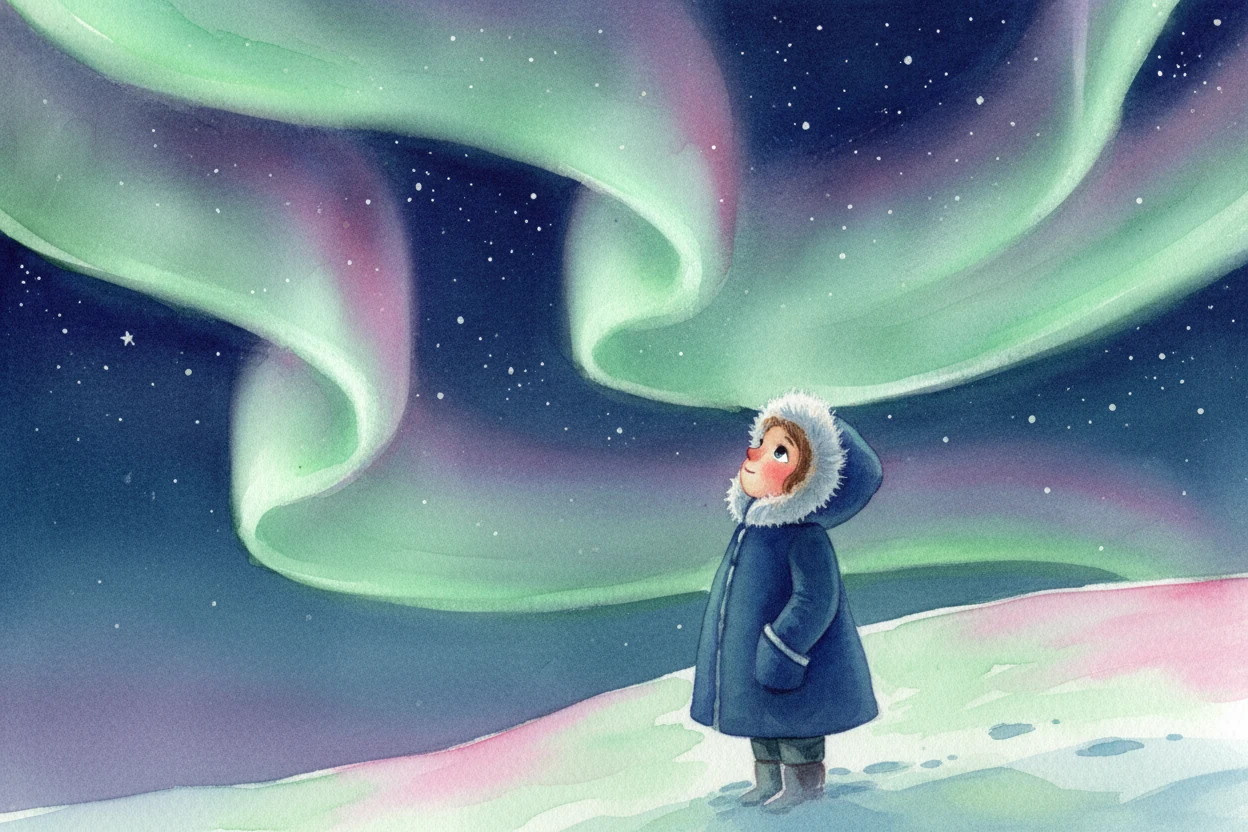
So the northern lights are really just Earth's atmosphere lighting up when solar wind particles sneak past our magnetic shield and crash into air molecules near the poles. The same thing happens at the South Pole โ€” those are called the aurora australis, the southern lights. It's a light show powered by the Sun, shaped by Earth's magnetic field, and painted by the atoms in our air. And it's been happening, night after night, for as long as Earth has had an atmosphere and a magnetic field โ€” long before anyone was around to look up and wonder.

How was this book?

A Wonderleaf Book

Sky's Secret Dance

โ€” What causes the northern lights? โ€”

Wonderleaf Editions
โ€” ex libris โ€”
A Wonderleaf Book

Sky's Secret Dance

What causes the northern lights?

Wonderleaf Editions ยท MMXXVI
Scene 1
Have you ever seen a photograph of green and pink curtains shimmering across the night sky near the North Pole? Those ar
Sky's Secret Dance2
Scene 1

Have you ever seen a photograph of green and pink curtains shimmering across the night sky near the North Pole? Those are the aurora borealis โ€” the northern lights โ€” and they're not painted on or projected from the ground. They're actually happening up there, about sixty miles above Earth's surface. The question is: what makes them glow?

3Sky's Secret Dance
Scene 2
To understand the northern lights, you need to know what the Sun is really doing. It's ~~not just sitting there shining~
Sky's Secret Dance4
Scene 2

To understand the northern lights, you need to know what the Sun is really doing. It's not just sitting there shining. The Sun is constantly throwing off a wind โ€” not air, but a stream of tiny charged particles called electrons and protons. This "solar wind" rushes outward in all directions at about a million miles per hour. Earth sits right in the path of that invisible storm.

5Sky's Secret Dance
Scene 3
Now, ++Earth++ has a **secret shield**. Deep inside our planet, molten iron swirls around, and that motion generates a m
Sky's Secret Dance6
Scene 3

Now, Earth has a secret shield. Deep inside our planet, molten iron swirls around, and that motion generates a magnetic field โ€” an invisible bubble that wraps around the whole Earth like a force field. When the solar wind particles come racing toward us, most of them hit that magnetic field and get deflected away, curving around Earth and continuing off into space. Without this shield, the solar wind would strip away our atmosphere.

7Sky's Secret Dance
Scene 4
~~But here's where it gets interesting.~~ The magnetic field isn't perfectly round. It has **two weak spots**: the north
Sky's Secret Dance8
Scene 4

But here's where it gets interesting. The magnetic field isn't perfectly round. It has two weak spots: the north and south magnetic poles, where the field lines funnel down into Earth like water swirling into a drain. Some of those solar wind particles slip through the gaps at the poles and spiral down the magnetic field lines toward the surface.

9Sky's Secret Dance
Scene 5
As those charged particles plunge toward Earth, they slam into air molecules โ€” mostly oxygen and nitrogen โ€” floating six
Sky's Secret Dance10
Scene 5

As those charged particles plunge toward Earth, they slam into air molecules โ€” mostly oxygen and nitrogen โ€” floating sixty to two hundred miles up. Imagine you're a calm oxygen atom minding your own business, and suddenly a high-speed electron crashes into you. The collision pumps energy into the oxygen atom, and the atom gets excited โ€” literally, that's what physicists call it.

11Sky's Secret Dance
Scene 6
~~An excited atom can't stay excited forever.~~ Within a fraction of a second, it releases that extra energy as a photon
Sky's Secret Dance12
Scene 6

An excited atom can't stay excited forever. Within a fraction of a second, it releases that extra energy as a photon โ€” a particle of light. The color of the light depends on which type of atom got hit and how high up the collision happened. Oxygen at high altitudes glows red. Oxygen lower down glows green. Nitrogen glows blue or purple. Millions of these tiny atomic light bulbs flicker on and off every second, and together they paint those rippling curtains across the sky.

13Sky's Secret Dance
Scene 7
The aurora isn't static โ€” it dances. That's because the solar wind isn't steady. When the Sun ~~burps out~~ an extra-str
Sky's Secret Dance14
Scene 7

The aurora isn't static โ€” it dances. That's because the solar wind isn't steady. When the Sun burps out an extra-strong blast of particles, called a solar storm, the aurora gets brighter and spreads farther south. The curtains twist, fold, and shimmer as different clumps of particles arrive and hit different layers of the atmosphere. Some nights the show is a faint glow. Other nights, the whole sky pulses with color.

15Sky's Secret Dance
Scene 8
So the northern lights are really just Earth's atmosphere lighting up when solar wind particles sneak past our magnetic
Sky's Secret Dance16
Scene 8

So the northern lights are really just Earth's atmosphere lighting up when solar wind particles sneak past our magnetic shield and crash into air molecules near the poles. The same thing happens at the South Pole โ€” those are called the aurora australis, the southern lights. It's a light show powered by the Sun, shaped by Earth's magnetic field, and painted by the atoms in our air. And it's been happening, night after night, for as long as Earth has had an atmosphere and a magnetic field โ€” long before anyone was around to look up and wonder.
17Sky's Secret Dance

~ finis ~

Tiny picture books for big little questions.

โ€” a small constellation of questions โ€”
โœฆWonderleaf
Editions