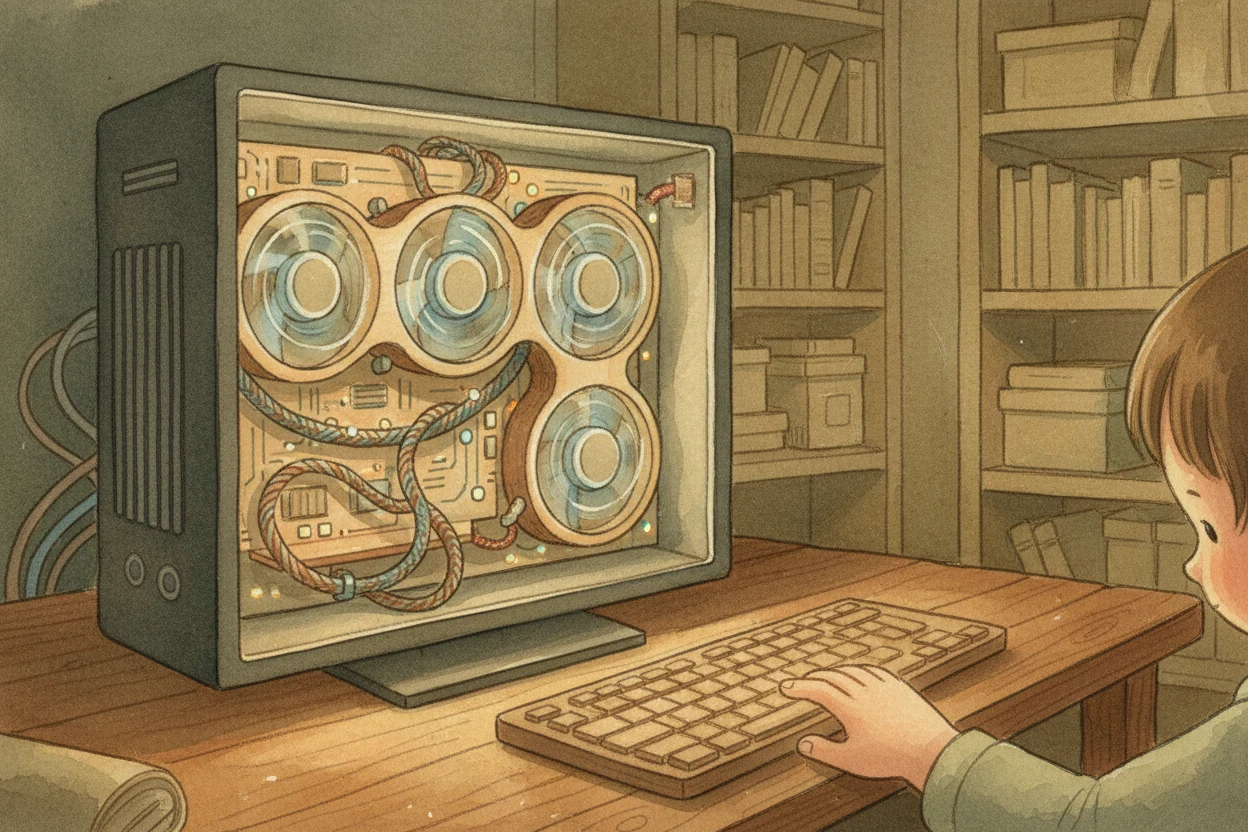
Electric River City
When you tap a key or click a button, your computer springs into action โ lights blink, fans whum, the screen changes. But what's actually happening inside? What is a computer "thinking" as it works? Let's peek under the hood.
Here's the secret: computers don't think like you do. You think in words, pictures, feelings โ a whole swirl of ideas at once. A computer thinks in the tiniest, simplest steps imaginable. It only knows two things: 1 and 0. On and off. Yes and no. That's it.
Every letter you type, every photo you see, every song you hear โ it's all just billions of 1s and 0s zipping through microscopic switches at lightning speed. The letter "A"? That's the pattern 01000001. A red pixel on your screen? 11111111 00000000 00000000. The computer doesn't "see" an A or understand red โ it just follows the pattern.
So how does flipping billions of switches turn into "thinking"? Inside the computer's brain โ a chip called the CPU โ there are instruction lists, like the world's most detailed recipe book. "If this switch is 1 and that switch is 0, flip this other switch to 1." Millions of these tiny rules, stacked on top of each other, every second.
When you click "play" on a video, here's what happens. The computer reads the instruction: "Load video file." It breaks that into a thousand smaller steps. Find the file's location in memory. Copy the first chunk of data. Send it to the video decoder. Decode the 1s and 0s into color and brightness values. Send those to the screen. Repeat, thirty times per second.
Every one of those steps is something the CPU already knows how to do โ it's in its instruction book. "Add these two numbers." "Copy this batch of 1s and 0s from here to there." "Compare these two values." The computer isn't inventing anything. It's just very, very fast at following directions.
And here's the wild part: even when a computer seems creative โ writing a sentence, drawing a picture, playing chess โ it's still just following those same simple steps, billions of times. A chess program doesn't "think" about strategy the way you do. It calculates millions of possible moves, scores each one with math, and picks the highest number. All 1s and 0s, all the way down.
So when your computer "works," it's not daydreaming or wondering or hoping. It's racing through an unimaginably long list of the simplest possible questions โ "Is this a 1 or a 0? What does the instruction book say to do next?" โ faster than you can blink. Trillions of tiny decisions that, somehow, add up to everything you see on the screen.