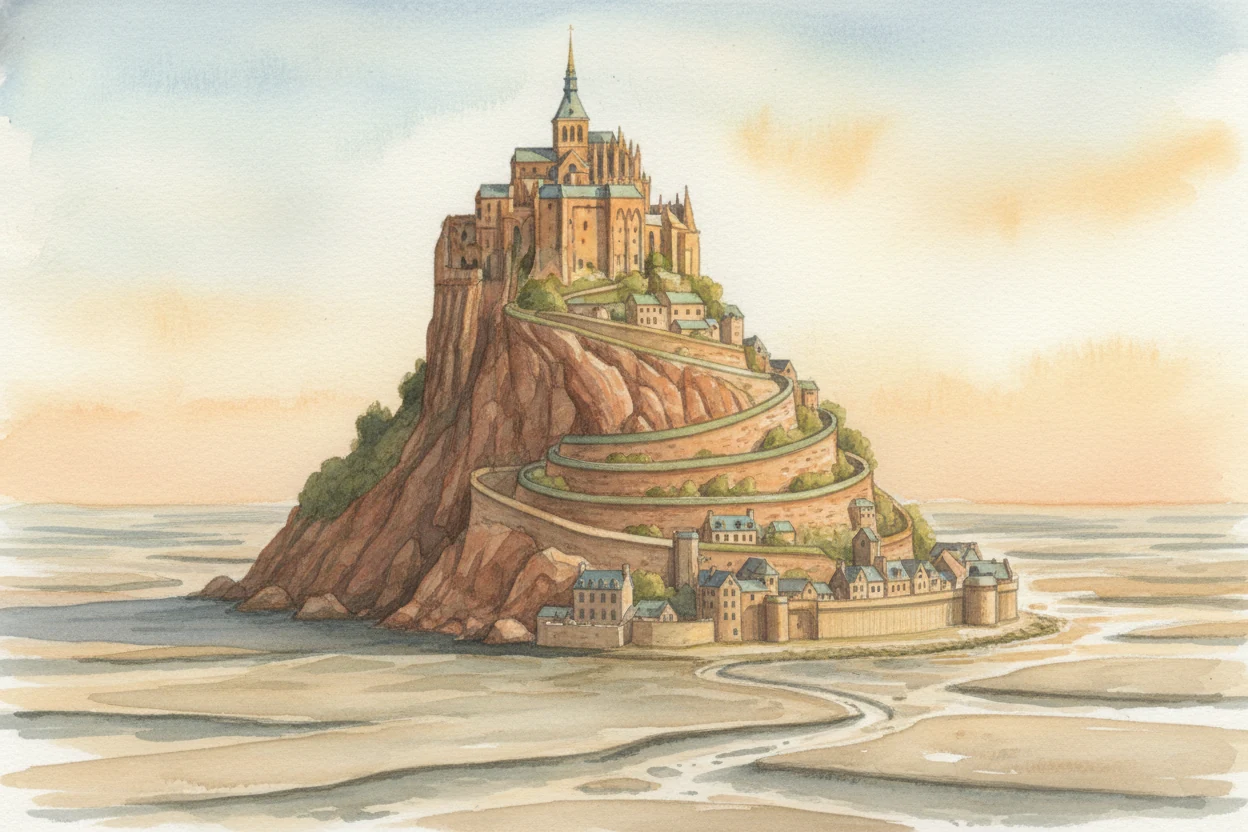
The Archangel's Rock
There's an island off the coast of France that looks like someone stacked a medieval village on top of a rock, crowned it with a monastery, and then surrounded the whole thing with quicksand. It's called Mont-Saint-Michel, and yes, it's real.
The story starts in the year 708, when a bishop named Aubert claimed the Archangel Michael appeared in his dreams three times, ordering him to build a church on this rock. Michael had to be persistent โ the first two times, Aubert thought he was just having weird dreams and ignored them.
So they built it. First a small church, then over centuries, a massive abbey. Monks lived at the top, copying manuscripts and praying. Below them, a village grew โ shopkeepers, innkeepers, guards โ all clinging to the steep granite slopes like barnacles on a ship.
Here's the twist that makes Mont-Saint-Michel magical: it's an island only half the time. The bay around it has some of the most extreme tides in Europe โ the water rushes in fast enough that people say it comes "at the speed of a galloping horse." At high tide, you need a boat. At low tide, you can walk across the sand.
During the Hundred Years' War, when England and France were fighting, Mont-Saint-Michel became a fortress. Its walls held strong for over thirty years of sieges. The English never took it. Knights defended it, cannons fired from its ramparts, and the whole time, monks kept praying in the abbey above the battle.
After the French Revolution, the government turned the abbey into a prison. For decades, political prisoners lived in cells where monks used to pray. It wasn't until 1863 that someone said, "Wait, this is a masterpiece of medieval architecture โ maybe we shouldn't keep convicts here," and restoration began.
Today, Mont-Saint-Michel is one of France's most visited landmarks. A modern bridge replaced the old causeway, so tourists can drive right up to it. The village still has its winding streets, souvenir shops where monasteries used to be, and restaurants serving omelets โ a local specialty since the 1800s.
At night, when the day-trippers leave and the tide comes in, the abbey lights up like a golden crown floating on the dark water. For a moment, you can almost imagine Bishop Aubert looking at his rock and thinking, "Okay, Michael, you were right โ this was a pretty good spot for a church."