Moon's Secret Recipe
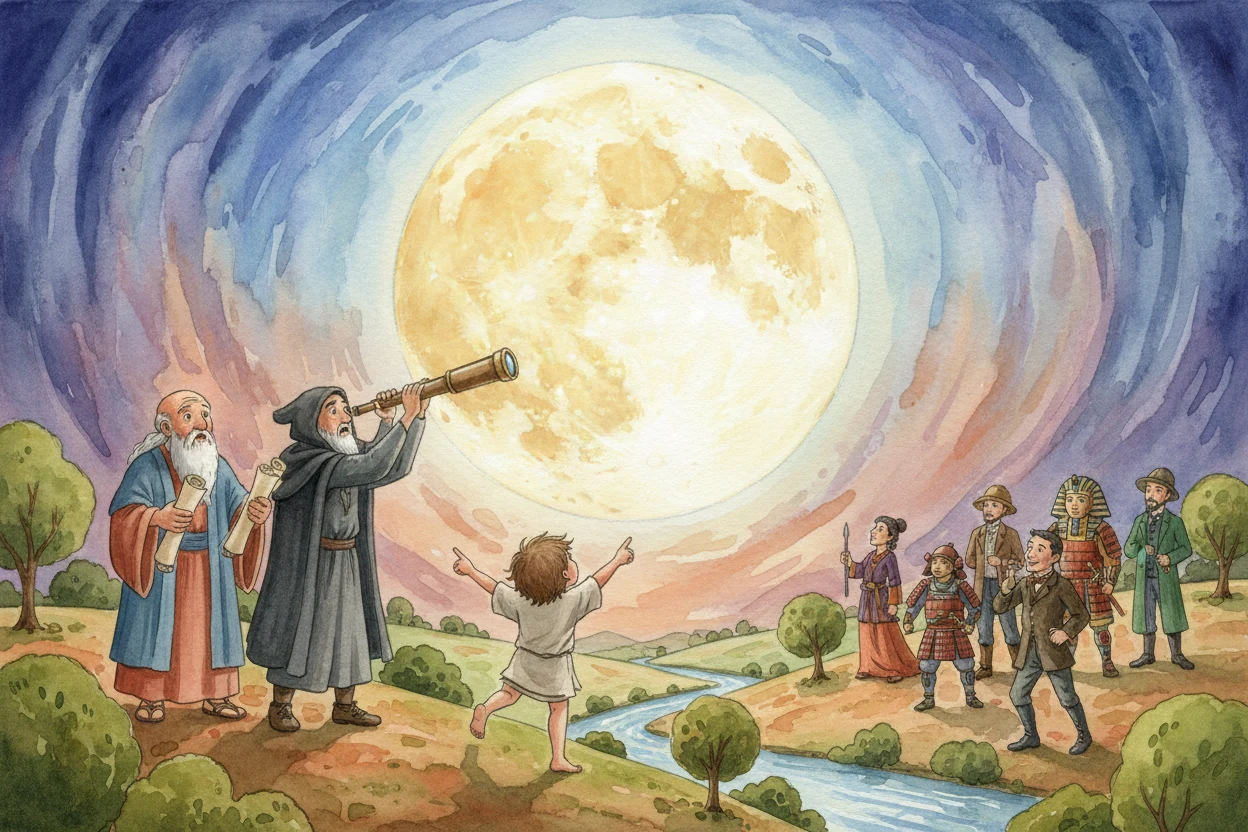
For thousands of years, people stared up at the moon and wondered what it could possibly be made of. Was it a giant pearl? A ball of ice? Some cultures thought it was made of silver, glowing in the night. Others imagined it was cheese โ after all, it had holes like Swiss cheese has holes, didn't it? But the moon turned out to be made of something much stranger than cheese or silver or anything anyone expected.
The moon is made of rock. Not fancy space rock or magical moon crystals โ just regular, boring rock. The kind of rock you'd find on Earth, only without any water, without any air, and without anything alive crawling around on it. If you picked up a moon rock and compared it to a rock from a mountain here on Earth, you'd find many of the same minerals: oxygen, silicon, magnesium, iron, calcium. The moon is Earth's cousin, made of similar stuff.
But here's where it gets interesting. The moon isn't just made of rock that happened to gather out in space. Scientists now think the moon was born from Earth itself, in the most violent way possible. About 4.5 billion years ago, when Earth was still young and molten, a planet the size of Mars smashed into it at incredible speed. Imagine two balls of hot cookie dough colliding in mid-air, splattering everywhere.
The impact was so powerful that it vaporized rock, turning solid stone into hot gas. Chunks of Earth's outer layers โ its crust and mantle โ were blasted into space, where they began orbiting around what was left of our planet. For a while, Earth had a ring around it, like Saturn, made entirely of smashed-up rock and dust and vapor.
Gravity pulled all that orbiting debris together, bit by bit. The hot gas cooled back into liquid, the liquid cooled into solid rock, and all those pieces stuck together like a snowball rolling downhill and gathering more snow. Within about a hundred million years โ which is fast, for space โ the moon had formed. It was born hot, its surface covered in an ocean of molten rock called magma.
As the moon cooled, lighter rocks floated to the top of the magma ocean and hardened into the bright crust we see today. Heavier rocks sank down to form the moon's mantle and core. Then, for the next several hundred million years, asteroids and comets kept smashing into the moon's surface, punching giant craters into it. Those dark spots you see on the moon at night? They're ancient impact craters that filled with dark volcanic rock called basalt.
Today, the moon's surface is covered in a layer of fine gray dust called regolith โ basically, billions of years of rocks being smashed into powder by meteorites. Under that dust is solid rock, and under that rock is more rock, all the way down to a small iron core at the center. No cheese. No air pockets. No silver. Just 4.5 billion years of rock that used to be part of Earth, now floating 240,000 miles away.
When the Apollo astronauts walked on the moon and brought back rock samples, scientists confirmed it: moon rocks and Earth rocks share the same chemical fingerprint, like siblings from the same parent. The moon really is a piece of us, orbiting overhead every night. So the next time someone asks what the moon is made of, you can tell them: it's made of Earth, stolen by a cosmic collision and reassembled in the sky. Which is way better than cheese.