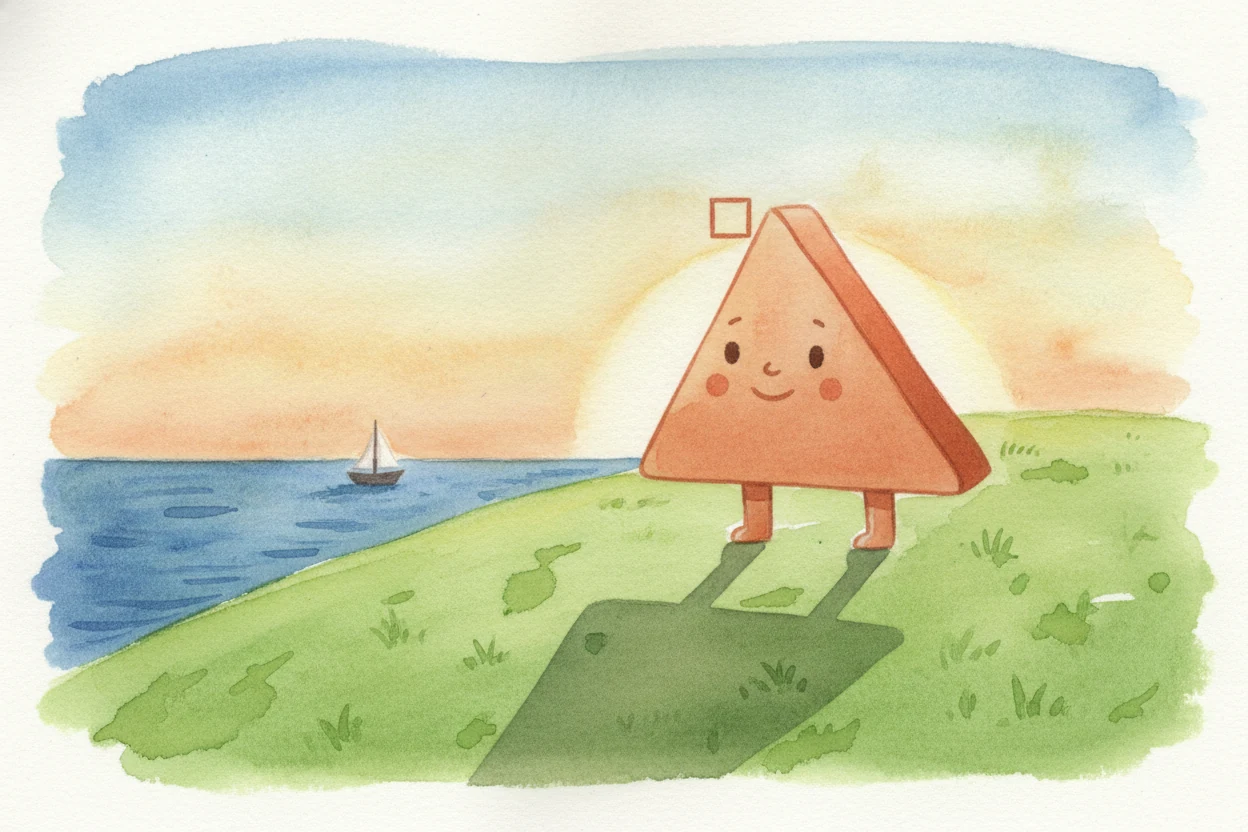
Triangle's Secret Code

Trigonometry has a scary name, but it's really just the study of triangles โ especially the cozy right triangle, the one with a perfect square corner. Long ago, people who wanted to measure things they couldn't reach โ the height of a mountain, the distance to a ship, the width of a river โ discovered that triangles held a secret. If you knew an angle and one side, you could figure out all the rest. Trigonometry is the toolkit that unlocks that secret.

Here's the magical part. Take a right triangle, and pick one of the slanted angles to focus on โ let's call it your "angle of interest." No matter how big or small you draw the triangle, as long as that angle stays the same, the shape of the triangle stays the same too. Stretch it, shrink it โ the sides always keep the same proportions to each other. That steadiness is the whole reason trigonometry works.

Every right triangle has three sides, and they each get a job title. The longest side, leaning across from the square corner, is the hypotenuse. The side touching your angle of interest is the adjacent side โ "adjacent" just means "next to." And the side across the triangle from your angle is the opposite side. Three sides, three names. Once you can spot them, the rest is easy.

Now meet sine. Sine takes your angle and answers one simple question: "How tall is the opposite side compared to the hypotenuse?" It's a ratio โ the opposite side divided by the hypotenuse. If the opposite side is half as long as the hypotenuse, the sine of that angle is one-half. Sine is basically a fraction that describes "how steeply up" your triangle leans.

Cosine is sine's twin, and it asks the other question: "How far across does the adjacent side reach compared to the hypotenuse?" That's the adjacent side divided by the hypotenuse. Where sine watches the "up," cosine watches the "across." Together, sine and cosine split every slant into two honest measurements: how much you climb, and how much you scoot sideways.

The best way to see them dance is to draw a circle with a radius of exactly one โ the "unit circle." Spin a spoke from the center out to the edge. Wherever the tip lands, its height above the middle line is the sine of the spinning angle, and its sideways distance is the cosine. As the spoke turns all the way around, sine and cosine just read off the tip's position, like a clock hand reporting where it points.

Keep spinning that spoke and watch the height. It rises to the top, sinks to the bottom, rises again โ over and over, forever. If you trace that bobbing height as the spoke turns, you get a smooth, rolling wave. That wave is the sine wave. Cosine makes the very same wave, just starting from a different spot. Anything in the world that repeats โ ocean swells, a swing, a sound, a heartbeat's blip โ can be described by these gentle waves.

So this is the quiet power of sine and cosine. With nothing but one angle, they can tell you how tall a tree is from its shadow, where a satellite floats, how to draw a video-game character turning, or how to bend a bridge so it stands. They turn angles into distances, and distances back into angles, like a translator fluent in two languages at once.

And that's trigonometry โ not a monster of a word at all, just the friendly study of triangles and the two faithful helpers, sine and cosine, who measure the climb and the scoot. Next time you spot a triangle leaning against the world, remember: it's quietly holding the answer to "how tall?" and "how far?" โ waiting for someone curious enough to ask.