cover

Rock vs Furnace

What makes a planet different from a star?
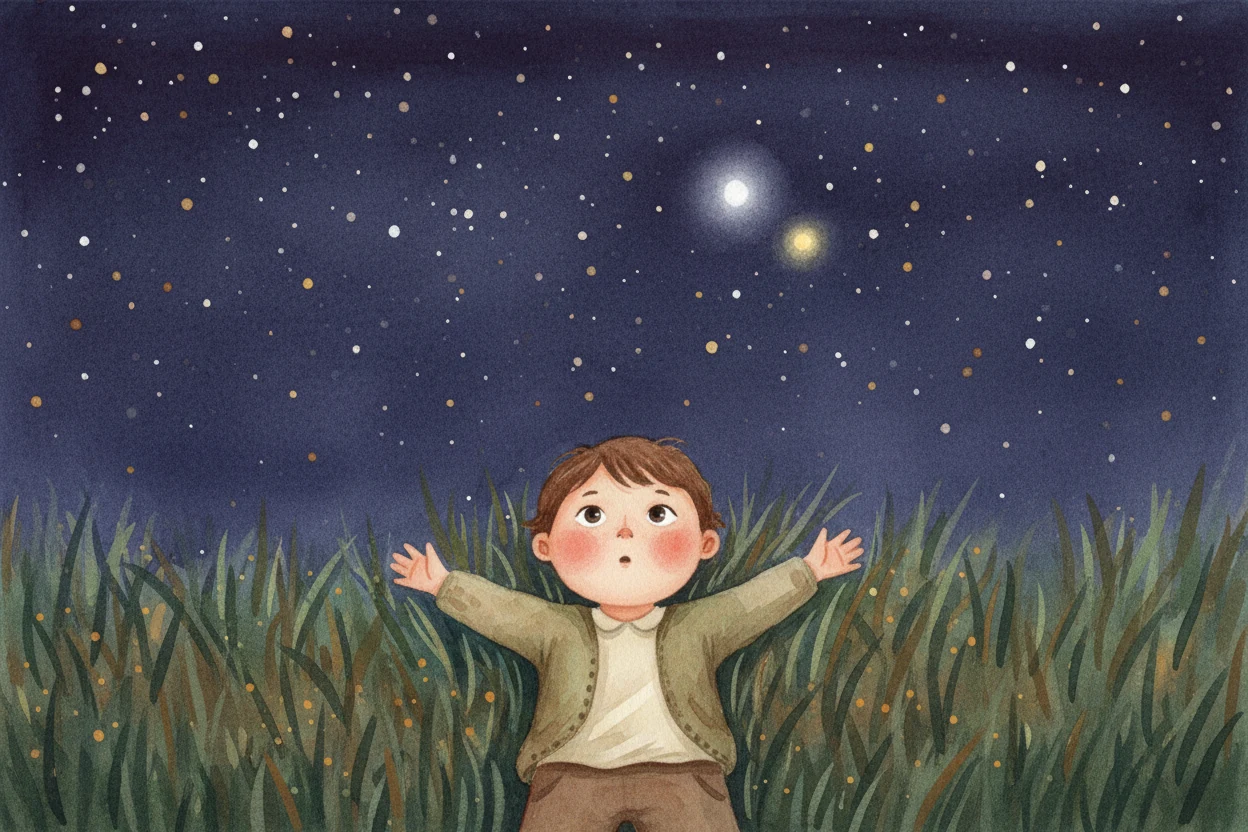
When you look up at the night sky, you see thousands of bright dots. Some are planets. Some are stars. They look almost

When you look up at the night sky, you see thousands of bright dots. Some are planets. Some are stars. They look almost the same from here โ€” tiny pinpricks of light. But up close? One is a cold rock drifting through space. The other is a nuclear furnace hot enough to melt anything in the universe.

A star makes its own light. Deep in its core, hydrogen atoms are being **crushed together so hard** they fuse into heliu

A star makes its own light. Deep in its core, hydrogen atoms are being crushed together so hard they fuse into helium โ€” the same reaction that powers a hydrogen bomb, but happening continuously, forever. That fusion releases so much energy it lights up half a galaxy. Our Sun is a star. It's been burning for five billion years and it'll keep going for five billion more.

A planet makes no light of its own. It's just a ball of rock or gas that formed from leftover dust after a star was born

A planet makes no light of its own. It's just a ball of rock or gas that formed from leftover dust after a star was born. Earth, Mars, Jupiter โ€” they're all planets. When you see them shining in the night sky, you're seeing reflected sunlight bouncing off their surfaces, the way a mirror catches a flashlight beam. Without a star nearby, a planet would be invisible.

Stars are also vastly bigger. You could fit **over a million Earths** inside the Sun. And the Sun is a medium-sized star

Stars are also vastly bigger. You could fit over a million Earths inside the Sun. And the Sun is a medium-sized star โ€” some stars out there are so huge you could fit a billion Earths inside them. Planets, even the big ones like Jupiter, are tiny by comparison. It's the difference between a beach ball and a grain of sand.

Temperature is another giveaway. The surface of the ++Sun++ is about 10,000 degrees Fahrenheit. The core? **Fifteen mill

Temperature is another giveaway. The surface of the Sun is about 10,000 degrees Fahrenheit. The core? Fifteen million degrees. Hot enough to vaporize any material instantly. Planets are cold by comparison. Even Mercury, the closest planet to the Sun, has a daytime temperature of only 800 degrees. Earth's average temperature is a pleasant 59 degrees โ€” cold enough for oceans, forests, and us.

~~Here's the key difference:~~ a star has enough mass to trigger fusion. If you pile up enough hydrogen in one place โ€” *

Here's the key difference: a star has enough mass to trigger fusion. If you pile up enough hydrogen in one place โ€” about 80 times the mass of Jupiter โ€” gravity squeezes the core so hard that atoms start fusing. Suddenly, you have a star. Anything smaller never gets hot enough. It just sits there as a cold planet or a failed star called a brown dwarf, glowing dimly from leftover heat.

This is why planets orbit stars, not the other way around. **The star is the heavyweight** โ€” its gravity holds the whole

This is why planets orbit stars, not the other way around. The star is the heavyweight โ€” its gravity holds the whole solar system together. Planets are caught in that gravitational pull, circling the star like marbles rolling around the rim of a bowl. Earth orbits the Sun. The Sun doesn't orbit Earth. Mass is destiny.

So when you see a bright dot in the sky, ~~here's the trick~~ to tell them apart. **Stars twinkle** โ€” their light flicke

So when you see a bright dot in the sky, here's the trick to tell them apart. Stars twinkle โ€” their light flickers as it passes through our atmosphere. Planets shine steadily. And if you watch over a few nights, planets move slowly against the background stars. The ancient Greeks called them "wanderers" for exactly that reason. They couldn't make their own light, but they refused to stay still.

How was this book?

A Wonderleaf Book

Rock vs Furnace

โ€” What makes a planet different from a star? โ€”

Wonderleaf Editions
โ€” ex libris โ€”
A Wonderleaf Book

Rock vs Furnace

What makes a planet different from a star?

Wonderleaf Editions ยท MMXXVI
Scene 1
When you look up at the night sky, you see thousands of bright dots. Some are planets. Some are stars. They look almost
Rock vs Furnace2
Scene 1

When you look up at the night sky, you see thousands of bright dots. Some are planets. Some are stars. They look almost the same from here โ€” tiny pinpricks of light. But up close? One is a cold rock drifting through space. The other is a nuclear furnace hot enough to melt anything in the universe.

3Rock vs Furnace
Scene 2
A star makes its own light. Deep in its core, hydrogen atoms are being **crushed together so hard** they fuse into heliu
Rock vs Furnace4
Scene 2

A star makes its own light. Deep in its core, hydrogen atoms are being crushed together so hard they fuse into helium โ€” the same reaction that powers a hydrogen bomb, but happening continuously, forever. That fusion releases so much energy it lights up half a galaxy. Our Sun is a star. It's been burning for five billion years and it'll keep going for five billion more.

5Rock vs Furnace
Scene 3
A planet makes no light of its own. It's just a ball of rock or gas that formed from leftover dust after a star was born
Rock vs Furnace6
Scene 3

A planet makes no light of its own. It's just a ball of rock or gas that formed from leftover dust after a star was born. Earth, Mars, Jupiter โ€” they're all planets. When you see them shining in the night sky, you're seeing reflected sunlight bouncing off their surfaces, the way a mirror catches a flashlight beam. Without a star nearby, a planet would be invisible.

7Rock vs Furnace
Scene 4
Stars are also vastly bigger. You could fit **over a million Earths** inside the Sun. And the Sun is a medium-sized star
Rock vs Furnace8
Scene 4

Stars are also vastly bigger. You could fit over a million Earths inside the Sun. And the Sun is a medium-sized star โ€” some stars out there are so huge you could fit a billion Earths inside them. Planets, even the big ones like Jupiter, are tiny by comparison. It's the difference between a beach ball and a grain of sand.

9Rock vs Furnace
Scene 5
Temperature is another giveaway. The surface of the ++Sun++ is about 10,000 degrees Fahrenheit. The core? **Fifteen mill
Rock vs Furnace10
Scene 5

Temperature is another giveaway. The surface of the Sun is about 10,000 degrees Fahrenheit. The core? Fifteen million degrees. Hot enough to vaporize any material instantly. Planets are cold by comparison. Even Mercury, the closest planet to the Sun, has a daytime temperature of only 800 degrees. Earth's average temperature is a pleasant 59 degrees โ€” cold enough for oceans, forests, and us.

11Rock vs Furnace
Scene 6
~~Here's the key difference:~~ a star has enough mass to trigger fusion. If you pile up enough hydrogen in one place โ€” *
Rock vs Furnace12
Scene 6

Here's the key difference: a star has enough mass to trigger fusion. If you pile up enough hydrogen in one place โ€” about 80 times the mass of Jupiter โ€” gravity squeezes the core so hard that atoms start fusing. Suddenly, you have a star. Anything smaller never gets hot enough. It just sits there as a cold planet or a failed star called a brown dwarf, glowing dimly from leftover heat.

13Rock vs Furnace
Scene 7
This is why planets orbit stars, not the other way around. **The star is the heavyweight** โ€” its gravity holds the whole
Rock vs Furnace14
Scene 7

This is why planets orbit stars, not the other way around. The star is the heavyweight โ€” its gravity holds the whole solar system together. Planets are caught in that gravitational pull, circling the star like marbles rolling around the rim of a bowl. Earth orbits the Sun. The Sun doesn't orbit Earth. Mass is destiny.

15Rock vs Furnace
Scene 8
So when you see a bright dot in the sky, ~~here's the trick~~ to tell them apart. **Stars twinkle** โ€” their light flicke
Rock vs Furnace16
Scene 8

So when you see a bright dot in the sky, here's the trick to tell them apart. Stars twinkle โ€” their light flickers as it passes through our atmosphere. Planets shine steadily. And if you watch over a few nights, planets move slowly against the background stars. The ancient Greeks called them "wanderers" for exactly that reason. They couldn't make their own light, but they refused to stay still.

17Rock vs Furnace

~ finis ~

Tiny picture books for big little questions.

โ€” a small constellation of questions โ€”
โœฆWonderleaf
Editions