cover

Jungle to Wrapper

Where does chocolate come from?
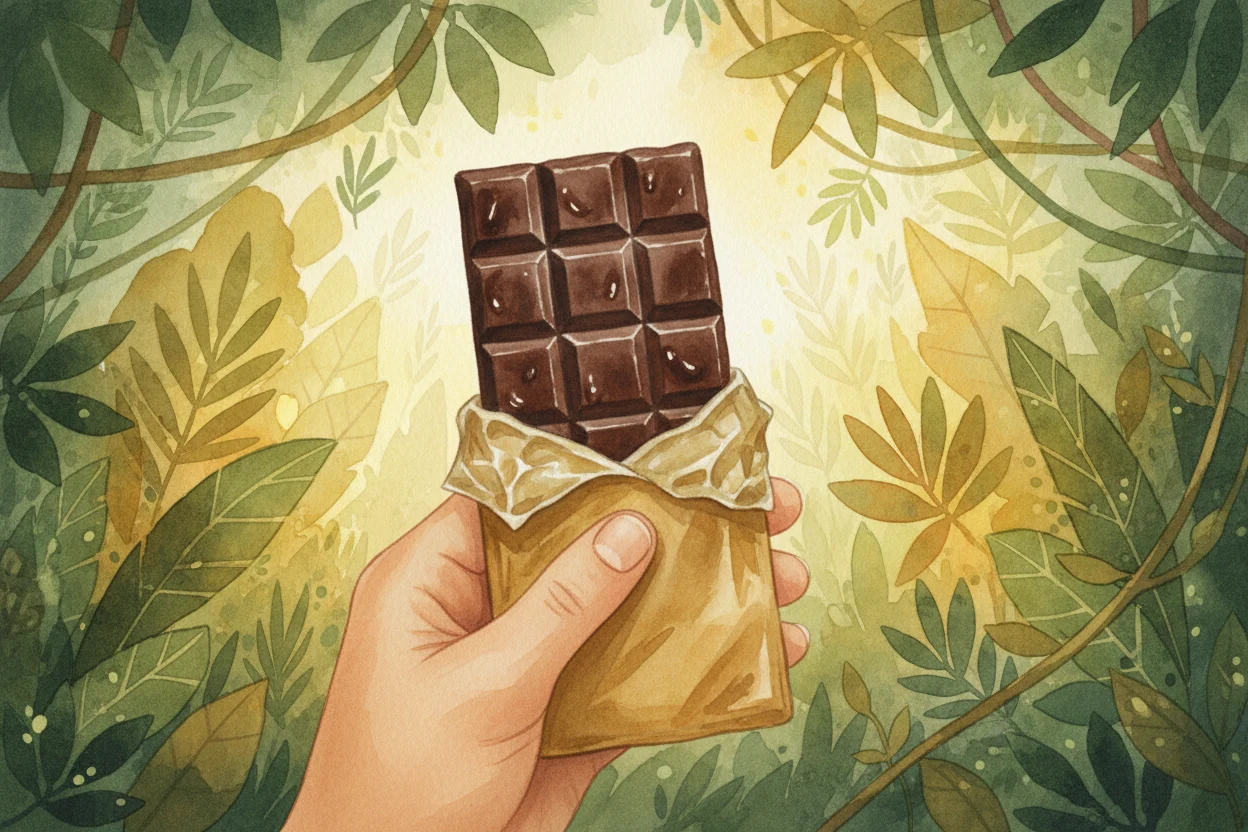
You unwrap a ++chocolate bar++, and it melts on your tongue โ€” *smooth, sweet, a little bitter*. ~~But chocolate didn't s

You unwrap a chocolate bar, and it melts on your tongue โ€” smooth, sweet, a little bitter. But chocolate didn't start in a wrapper. It started in a jungle, growing on a tree most people have never heard of.

The tree is called ++Theobroma cacao++ โ€” *"food of the gods"* in Greek โ€” and it grows near the equator where it's hot an

The tree is called Theobroma cacao โ€” "food of the gods" in Greek โ€” and it grows near the equator where it's hot and wet all year. The cacao tree is picky: it wants shade from taller trees, constant humidity, and soil rich with rotting leaves. It won't grow just anywhere.

~~Here's the weird part:~~ cacao pods don't grow on branches like apples. They sprout **directly from the trunk** and th

Here's the weird part: cacao pods don't grow on branches like apples. They sprout directly from the trunk and thick limbs, hanging like football-shaped ornaments. Inside each pod, thirty to fifty seeds sit in white, sticky pulp. Those seeds are cacao beans โ€” the raw ingredient of chocolate.

Farmers harvest the pods with machetes, crack them open, and scoop out the beans and pulp. Then comes *fermentation*: th

Farmers harvest the pods with machetes, crack them open, and scoop out the beans and pulp. Then comes fermentation: the beans are piled under banana leaves for a week, heating up as microbes eat the pulp. The beans turn from purple to brown, and their flavor changes from bitter and astringent to something complex โ€” fruity, earthy, the very beginning of chocolate.

After fermenting, the beans are spread in the sun to dry, then packed into sacks and shipped to chocolate makers around

After fermenting, the beans are spread in the sun to dry, then packed into sacks and shipped to chocolate makers around the world. At the factory, the beans are roasted like coffee โ€” the heat deepens the flavor and makes the shells brittle. The shells are cracked off, leaving behind cacao nibs: pure, unsweetened chocolate in its roughest form.

The nibs go into a grinder, and ~~here's where the magic happens~~. Cacao nibs are about **fifty percent fat** โ€” cocoa b

The nibs go into a grinder, and here's where the magic happens. Cacao nibs are about fifty percent fat โ€” cocoa butter. As the grinder crushes them, friction melts that fat, and the solid nibs turn into a thick, dark liquid called chocolate liquor. It's not booze; it's pure liquid chocolate, bitter and intense.

To make the chocolate you know, the liquor is mixed with sugar, more cocoa butter, and sometimes milk powder. The mixtur

To make the chocolate you know, the liquor is mixed with sugar, more cocoa butter, and sometimes milk powder. The mixture is refined โ€” ground again and again until it's silky smooth โ€” then conched, stirred for hours or days until the flavors mellow and blend. Finally, it's tempered: carefully heated and cooled so it hardens with a shiny snap.

The finished chocolate is poured into molds, cooled, wrapped, and sent to stores. ~~From jungle to wrapper~~, the journe

The finished chocolate is poured into molds, cooled, wrapped, and sent to stores. From jungle to wrapper, the journey takes weeks and crosses continents. And all of it โ€” the fermenting, roasting, grinding, conching โ€” exists to turn a bitter purple seed into the bar melting in your hand.

How was this book?

A Wonderleaf Book

Jungle to Wrapper

โ€” Where does chocolate come from? โ€”

Wonderleaf Editions
โ€” ex libris โ€”
A Wonderleaf Book

Jungle to Wrapper

Where does chocolate come from?

Wonderleaf Editions ยท MMXXVI
Scene 1
You unwrap a ++chocolate bar++, and it melts on your tongue โ€” *smooth, sweet, a little bitter*. ~~But chocolate didn't s
Jungle to Wrapper2
Scene 1

You unwrap a chocolate bar, and it melts on your tongue โ€” smooth, sweet, a little bitter. But chocolate didn't start in a wrapper. It started in a jungle, growing on a tree most people have never heard of.

3Jungle to Wrapper
Scene 2
The tree is called ++Theobroma cacao++ โ€” *"food of the gods"* in Greek โ€” and it grows near the equator where it's hot an
Jungle to Wrapper4
Scene 2

The tree is called Theobroma cacao โ€” "food of the gods" in Greek โ€” and it grows near the equator where it's hot and wet all year. The cacao tree is picky: it wants shade from taller trees, constant humidity, and soil rich with rotting leaves. It won't grow just anywhere.

5Jungle to Wrapper
Scene 3
~~Here's the weird part:~~ cacao pods don't grow on branches like apples. They sprout **directly from the trunk** and th
Jungle to Wrapper6
Scene 3

Here's the weird part: cacao pods don't grow on branches like apples. They sprout directly from the trunk and thick limbs, hanging like football-shaped ornaments. Inside each pod, thirty to fifty seeds sit in white, sticky pulp. Those seeds are cacao beans โ€” the raw ingredient of chocolate.

7Jungle to Wrapper
Scene 4
Farmers harvest the pods with machetes, crack them open, and scoop out the beans and pulp. Then comes *fermentation*: th
Jungle to Wrapper8
Scene 4

Farmers harvest the pods with machetes, crack them open, and scoop out the beans and pulp. Then comes fermentation: the beans are piled under banana leaves for a week, heating up as microbes eat the pulp. The beans turn from purple to brown, and their flavor changes from bitter and astringent to something complex โ€” fruity, earthy, the very beginning of chocolate.

9Jungle to Wrapper
Scene 5
After fermenting, the beans are spread in the sun to dry, then packed into sacks and shipped to chocolate makers around
Jungle to Wrapper10
Scene 5

After fermenting, the beans are spread in the sun to dry, then packed into sacks and shipped to chocolate makers around the world. At the factory, the beans are roasted like coffee โ€” the heat deepens the flavor and makes the shells brittle. The shells are cracked off, leaving behind cacao nibs: pure, unsweetened chocolate in its roughest form.

11Jungle to Wrapper
Scene 6
The nibs go into a grinder, and ~~here's where the magic happens~~. Cacao nibs are about **fifty percent fat** โ€” cocoa b
Jungle to Wrapper12
Scene 6

The nibs go into a grinder, and here's where the magic happens. Cacao nibs are about fifty percent fat โ€” cocoa butter. As the grinder crushes them, friction melts that fat, and the solid nibs turn into a thick, dark liquid called chocolate liquor. It's not booze; it's pure liquid chocolate, bitter and intense.

13Jungle to Wrapper
Scene 7
To make the chocolate you know, the liquor is mixed with sugar, more cocoa butter, and sometimes milk powder. The mixtur
Jungle to Wrapper14
Scene 7

To make the chocolate you know, the liquor is mixed with sugar, more cocoa butter, and sometimes milk powder. The mixture is refined โ€” ground again and again until it's silky smooth โ€” then conched, stirred for hours or days until the flavors mellow and blend. Finally, it's tempered: carefully heated and cooled so it hardens with a shiny snap.

15Jungle to Wrapper
Scene 8
The finished chocolate is poured into molds, cooled, wrapped, and sent to stores. ~~From jungle to wrapper~~, the journe
Jungle to Wrapper16
Scene 8

The finished chocolate is poured into molds, cooled, wrapped, and sent to stores. From jungle to wrapper, the journey takes weeks and crosses continents. And all of it โ€” the fermenting, roasting, grinding, conching โ€” exists to turn a bitter purple seed into the bar melting in your hand.

17Jungle to Wrapper

~ finis ~

Tiny picture books for big little questions.

โ€” a small constellation of questions โ€”
โœฆWonderleaf
Editions