Stone Giants Walking
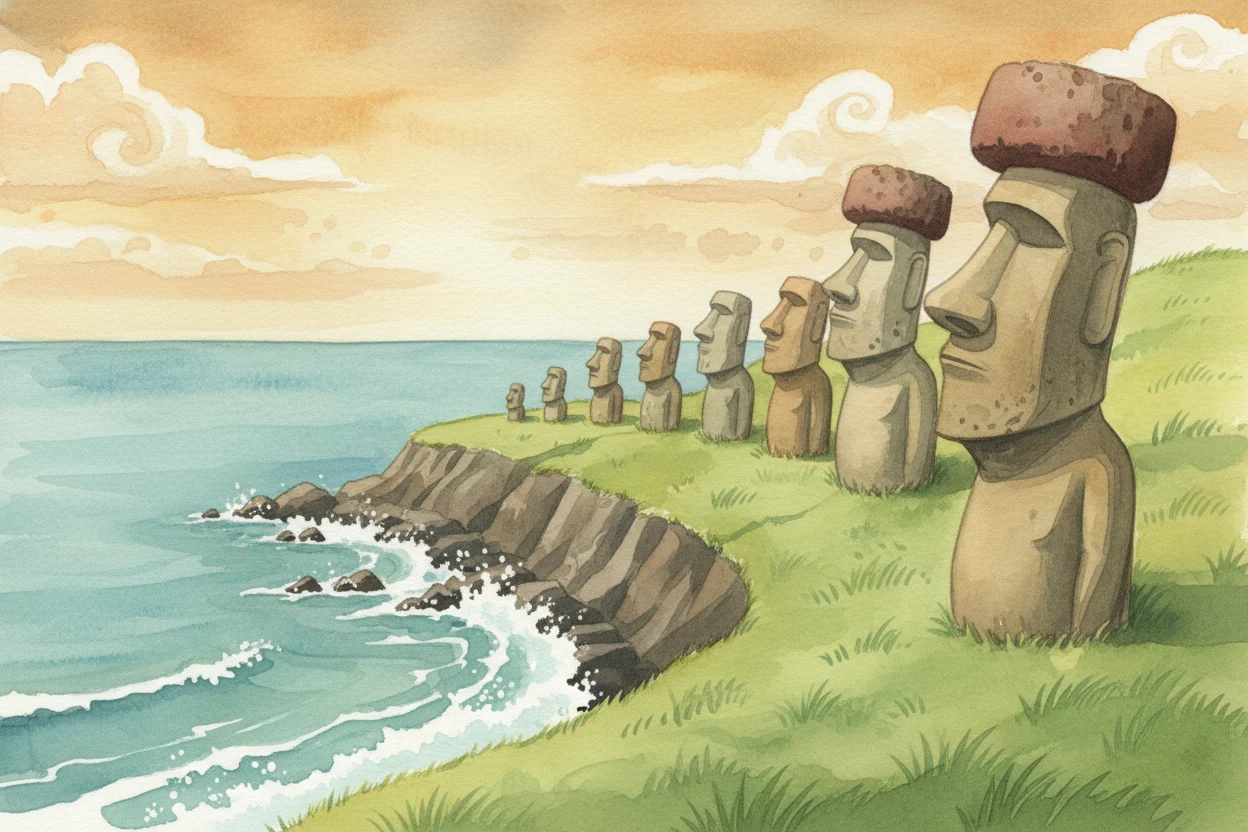
They stand in rows along the coast of a tiny island in the middle of the Pacific Ocean โ stone giants, hundreds of them, staring inland with deep-set eyes. Some have topknots perched on their heads like stone hats. Who on Earth had the tools, the time, and the sheer determination to carve nearly a thousand enormous statues out of solid rock?
The Rapa Nui people carved them โ Polynesian seafarers who arrived on the island around 1200 CE in double-hulled canoes, navigating by stars across thousands of miles of open ocean. They found a volcanic island covered in palm forests, claimed it as home, and over the next few centuries built one of the most ambitious sculpture projects in human history.
The statues are called moai, and they represented ancestors โ powerful chiefs and leaders watching over the living. Carving a moai wasn't just art. It was a way of saying, "Our family is strong. Our lineage matters. Our ancestors protect us." The bigger your moai, the more prestige your clan had.
Nearly all the moai were carved from the same place: a volcanic crater called Rano Raraku, where the stone was soft enough to shape but hard enough to last. Carvers used hand tools made of basalt, a harder volcanic rock, chipping away for months or even years. A single moai could weigh 14 tons โ about as heavy as ten cars.
Once carved, the moai had to travel. Some were moved over ten miles from the quarry to their final spots on stone platforms along the coast. But how do you move a 14-ton statue without wheels, without metal, without machinery? The Rapa Nui lashed ropes around the moai and rocked it upright, then "walked" it โ teams pulling the ropes side to side so the statue waddled forward like a fridge tipping back and forth on its corners.
Once a moai reached its platform, carvers gave it eyes โ inlaid with white coral and black obsidian. That's when it came alive. That's when the ancestor was truly watching. Some moai also received pukao, cylindrical red stone topknots carved from a different quarry and hoisted onto their heads, adding another five tons to the already massive sculptures.
At the peak of moai-building, nearly a thousand statues stood or were in progress. But by the 1700s, the forests were gone โ cleared for farmland, canoes, and the rollers and ropes needed to move moai. Without trees, the islanders couldn't fish far offshore or move new statues. Clans fought over dwindling resources. Many moai were toppled during the conflicts.
Today, many of the moai have been raised again. They stand as they once did โ faces toward the villages, backs to the sea โ silent witnesses to the ambition, artistry, and resilience of the Rapa Nui people. The ancestors are still watching.