Stone Sky Cities
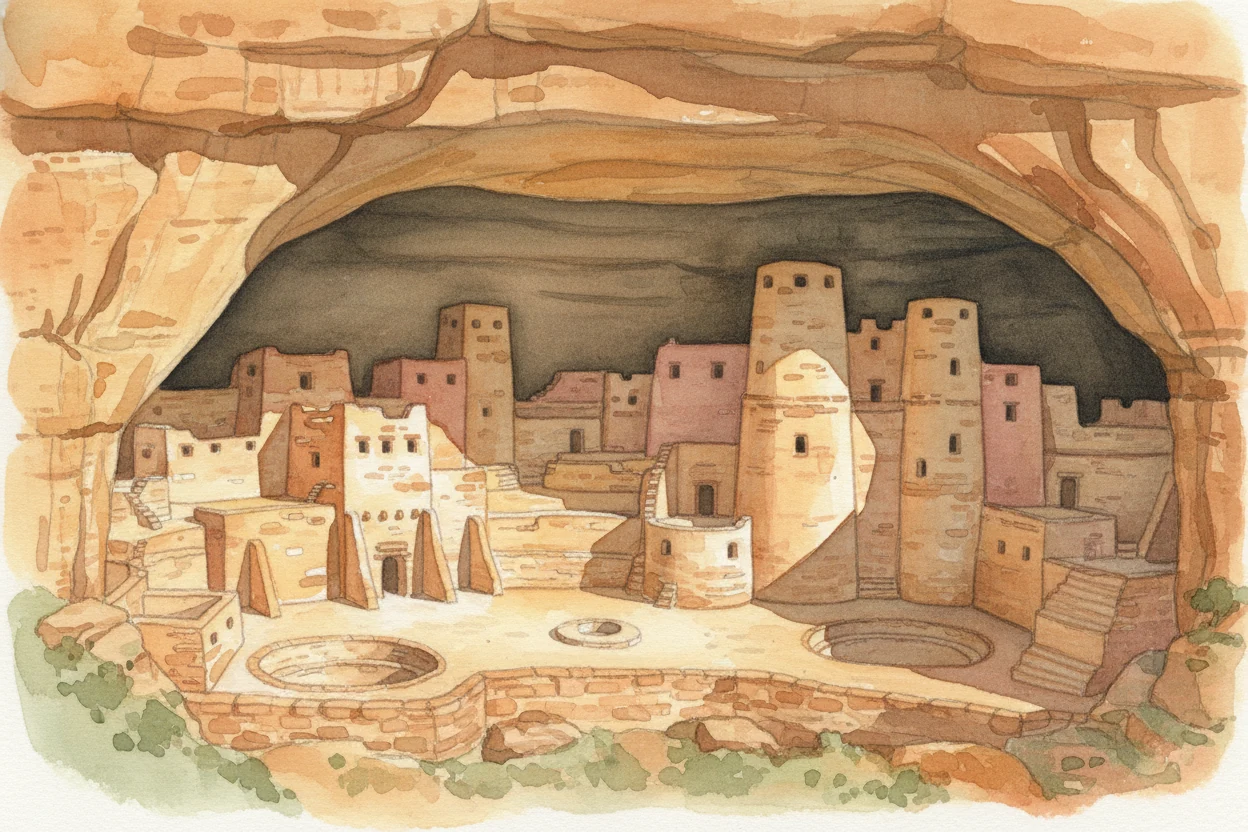
High in the cliffs of southwestern Colorado, tucked under stone overhangs like swallows' nests under a bridge, sit the most astonishing apartment buildings you've ever seen. Stone rooms. Tall towers. Plazas where families cooked and worked and gossiped, seven hundred years ago. Who built these sky-high cities? Who woke up every morning in a bedroom carved into a cliff?
The answer: the Ancestral Pueblo people, farmers and builders who'd lived in the Four Corners region for over a thousand years before they ever climbed into those cliffs. For centuries, they lived on the mesa tops—the flat tablelands above—in villages made of stone and timber. They grew corn, beans, and squash in the valleys. They made black-on-white pottery so beautiful it still takes your breath away. Then, around 1190 CE, they did something unexpected. They moved into the cliffs.
Why move into a cliff? Nobody knows for certain, but the cliffs offered something the mesa tops didn't: shelter. The deep stone overhangs kept rain and snow off your roof. In summer, they cast cool shade when the sun was high. In winter, the low-angled sun reached deep under the overhang, warming the stone like a giant radiator. The cliffs were also defensible—only a few ladders and narrow footholds led up, easy to guard. Whether they moved for comfort, safety, or both, the Ancestral Puebloans chose these alcoves carefully.
Building in a cliff is not like building on flat ground. There's no foundation to dig, no soil to level. You're working on slanted bedrock, under a ceiling of stone, with a sheer drop behind you. The Ancestral Puebloans carried every stone, every roof beam, every bucket of mortar up ladders and toe-hold trails. They shaped sandstone blocks with harder river stones, fitted them together with mud mortar, and built walls that still stand today. Some rooms are four stories tall, squeezed under the curve of the overhang like a ship in a bottle.
Life in the cliff dwellings was intensely communal. Families shared walls, courtyards, and kivas—the round, sunken ceremonial rooms where people gathered for rituals and storytelling. You'd grind corn on a stone metate in your courtyard while your neighbor repaired sandals two doors down and kids played in the plaza. Smoke from cooking fires drifted up and out of the alcove. In winter, everyone slept close to the fire. In summer, people climbed back up to the mesa tops to tend fields and hunt, descending to the cool cliff rooms at night.
But here's the mystery that haunts Mesa Verde: by 1300 CE—just a hundred years after moving into the cliffs—the Ancestral Puebloans left. Not just the cliff dwellings. The entire region. Drought had gripped the Four Corners for decades. Springs dried up. Crops failed. Neighboring groups competed for dwindling resources. The cliff dwellings, so carefully built, sat empty. The people migrated south and east, joining other Pueblo communities in New Mexico and Arizona, where their descendants live today.
For six hundred years, wind and silence filled the cliff houses. Then, in the 1880s, ranchers and archaeologists began exploring the alcoves. They found pottery still stacked in storerooms. Stone tools. Roof beams charred from ancient fires. The buildings had no roofs anymore—the wooden beams had rotted or burned away—but the stone walls stood firm, waiting. In 1906, Mesa Verde became America's first national park dedicated to preserving human-made structures. The cliff dwellings were no longer forgotten.
Today, you can climb the same toe-hold trails the Ancestral Puebloans carved into the rock. You can stand in a kiva and look up at the sky through the smoke hole. You can run your hand along stones fitted so precisely you can barely slip a knife blade between them. The people who built these cliff cities are gone, but their descendants—the Hopi, Zuni, and Puebloan peoples of the Southwest—remember them as ancestors. The cliff dwellings aren't ruins. They're home, seven centuries old, still teaching us what humans can build when stone, ingenuity, and community come together.