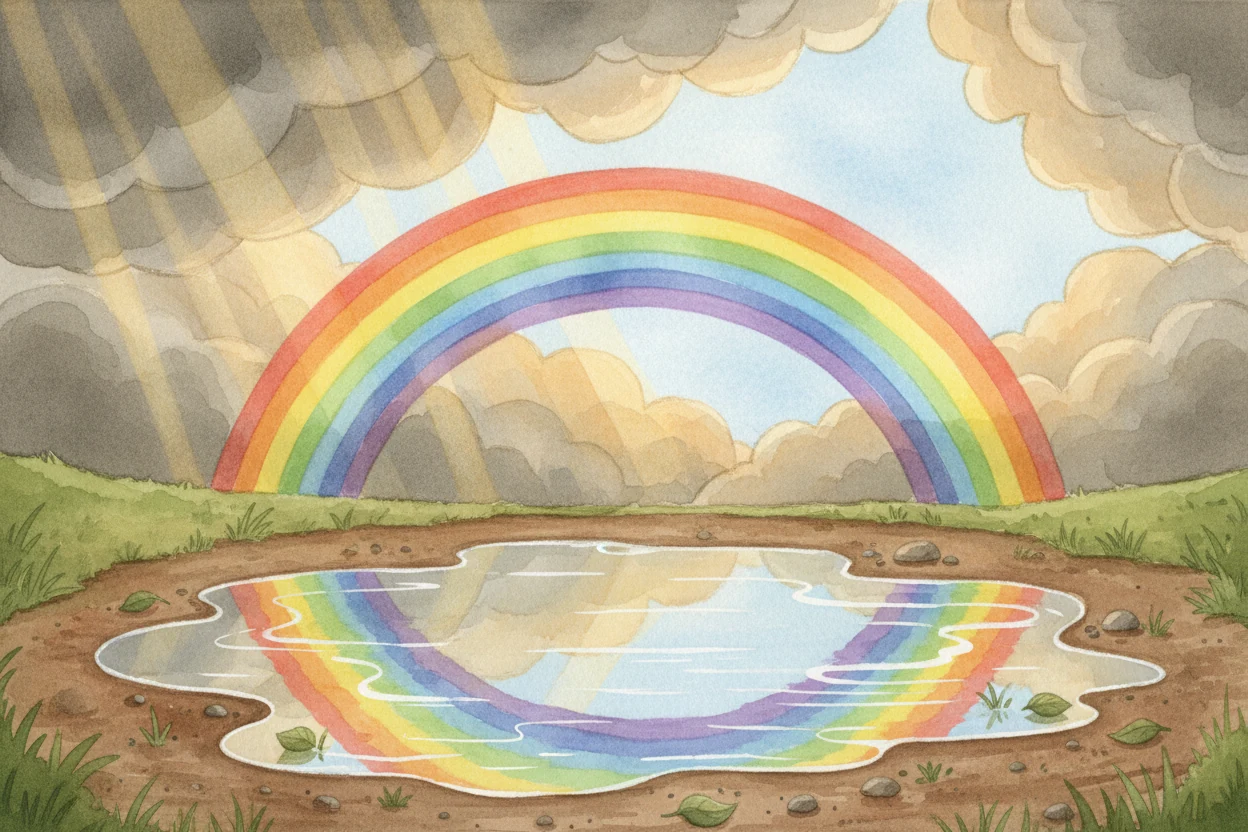
Rainbow's Secret Circle
You've seen them after summer storms โ those perfect arcs of color hanging in the sky. But why are rainbows always curved? Why not straight lines, or zigzags, or spirals? The answer is hidden in the shape of something very small.
A rainbow happens when sunlight bounces around inside millions of tiny water droplets floating in the air. Each droplet is a sphere โ round like a marble, round in every direction.
When a beam of sunlight enters a droplet, it bends, bounces off the back wall, and shoots back out toward your eye. White sunlight splits into colors during this journey โ red, orange, yellow, green, blue, violet. Each droplet sends one color to your eye, depending on the angle.
Here's the key: because the droplet is a sphere, light can only exit at one specific angle โ 42 degrees from the line between the sun and your eye. Not 41 degrees. Not 43. Exactly 42.
Now imagine you're standing in a field. The sun is behind you. Millions of droplets surround you in every direction โ up, down, left, right. But you only see rainbow colors from the droplets that are exactly 42 degrees away from that sun-you line.
What shape do you get when you collect all the points that are exactly 42 degrees away from a straight line? A circle. Or rather, an arc of a circle โ because the ground blocks the bottom half. The rainbow isn't painted on the sky. It's the set of all droplets at the magic angle.
Move to your left, and the rainbow moves with you. The droplets you're looking at now are different droplets than a moment ago โ but they're still at that same 42-degree angle. Every person sees their own private rainbow, made from their own set of droplets.
So the rainbow is curved because water drops are round, light is stubborn about its angles, and geometry always wins. The next time you see one, remember: you're looking at a perfect circle of light, half-hidden by the Earth.