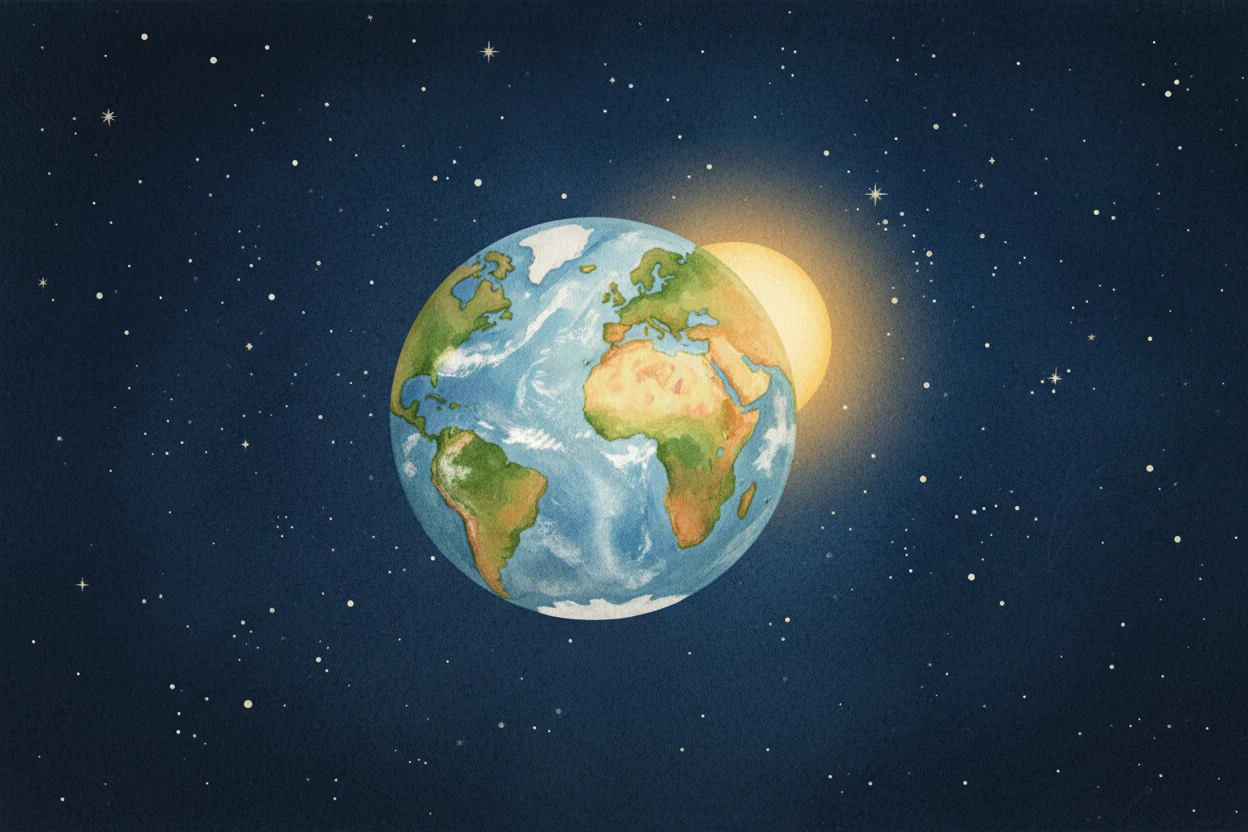
Earth's Wonky Tilt
Why does summer feel like the sun is hugging you, while winter makes you want to hide under three blankets? It's not because Earth scoots closer to the sun in June and runs away in December. Nope. The real reason is way cooler โ and it has to do with Earth doing something a little wonky as it spins through space.
Earth takes a whole year to orbit around the sun โ that's one big loop through space. But here's the thing: Earth doesn't stand up straight as it goes. It's tilted, like someone nudged it and it never bothered to straighten up. That tilt is about 23.5 degrees, which might not sound like much, but it changes everything.
Because of that tilt, different parts of Earth lean toward the sun โ or away from it โ at different times of the year. When your part of the planet tips toward the sun, sunlight hits you more directly, like a spotlight shining straight down. That's summer. The sun climbs higher in the sky, days stretch out long and warm, and you get more light packed into every hour.
Six months later, Earth has swung around to the other side of its orbit โ and now your part of the planet tips away from the sun. Sunlight arrives at a slant, spreading itself thin across the land like butter scraped over too much bread. That's winter. The sun hangs lower in the sky, days shrink short and cold, and every ray of light has to work harder to warm you up.
Here's the wild part: when it's summer where you are, it's winter on the opposite side of the planet. While you're at the beach in July, someone in Australia is bundled up in a coat. Earth's tilt doesn't play favorites โ it just tips one hemisphere toward the sun while tipping the other away. They trade places every six months, like a seesaw in space.
Twice a year, Earth hits a sweet spot called an equinox โ spring in March, fall in September. At those moments, neither hemisphere tilts toward or away from the sun. Sunlight spreads evenly across the whole planet, and day and night are nearly equal everywhere. It's like Earth pressing pause on the seesaw, balancing perfectly for just a moment before tipping again.
So seasons aren't about distance โ Earth's orbit is nearly circular, and the difference between closest and farthest from the sun is only about 3 million miles out of 93 million. That's nothing. What matters is the angle. Tilt toward the sun, and you get blasted with direct light. Tilt away, and you get the sun's leftovers, weak and stretched thin. That tilt is the whole story.
And that's why you can roast marshmallows in July and build snowmen in January โ all without Earth moving an inch closer to or farther from the sun. You're just riding a tilted planet as it loops through space, catching sunlight from a new angle every few months. Not bad for a planet that never learned to stand up straight.