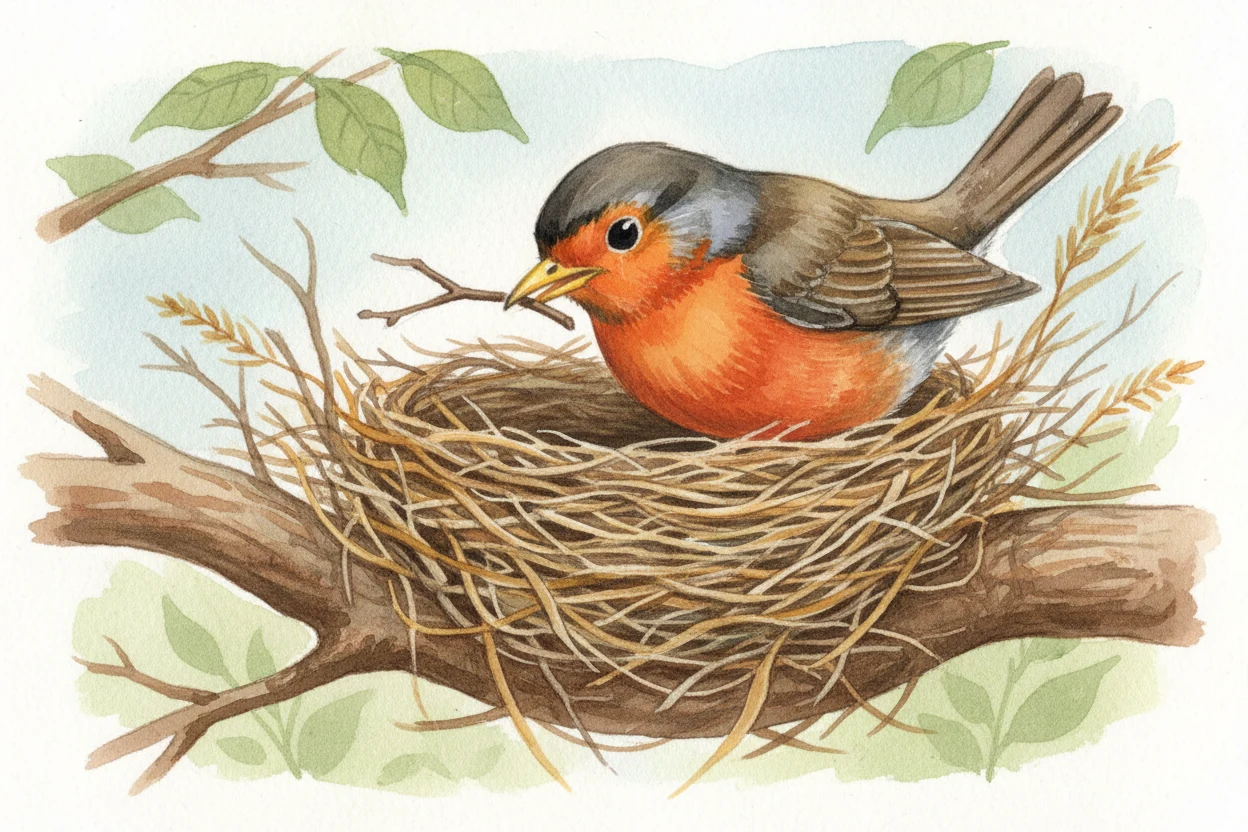
Twig Engineering
You've probably seen them tucked into tree branches, wedged under roof eaves, or balanced on window ledges โ messy tangles of twigs and grass that look like someone started a craft project and wandered off. But birds didn't abandon these structures. They built them on purpose, with zero blueprints and no Home Depot nearby. So why go to all that trouble?
The short answer: eggs. Bird eggs have hard shells, but they're still fragile โ drop one on bare rock or dirt and you've got scrambled breakfast instead of baby birds. A nest is basically a crash pad, a soft landing spot that keeps eggs from rolling away or cracking when Mom sits down. It's not fancy architecture. It's egg insurance.
But protection goes beyond cushioning. Eggs need warmth to develop โ the parent bird's body heat has to stay trapped around them, not leak out into the cold air. A nest acts like insulation, the same way a blanket keeps you warm in bed. Feathers, moss, and downy fluff tucked into the nest walls hold heat in, turning the whole structure into a tiny incubator.
And then there's the neighborhood watch problem. Eggs are basically protein-packed snacks for half the forest โ snakes, squirrels, raccoons, and other birds all see a nest as a buffet. So birds hide their nests, camouflaging them with materials that blend into the surroundings. A nest made of gray lichen on a gray branch becomes nearly invisible. It's not decoration. It's camouflage.
Once the eggs hatch, the nest becomes a nursery. Baby birds โ called chicks or nestlings โ can't fly, can't hunt, can't even stand up properly for days or weeks. They're basically tiny potatoes with beaks. The nest keeps them contained in one spot so the parents know exactly where to deliver the constant stream of insects, worms, and mashed-up food.
Different birds build wildly different nests because they face different problems. Eagles stack massive platforms of sticks in treetops โ some weigh over a ton โ because their chicks are huge and stay in the nest for months. Hummingbirds weave nests the size of a walnut shell using spider silk and thistle down, because their eggs are the size of jellybeans. Penguins skip nests entirely and balance eggs on their feet in Antarctica, because there's literally nothing to build with.
Some birds are renovators โ they return to the same nest year after year, patching holes and adding layers. Others are one-and-done builders, abandoning the nest once the chicks fledge and starting fresh next season. A few species, like cuckoos, are straight-up freeloaders โ they lay their eggs in other birds' nests and let someone else do all the work. Not every bird plays fair.
Here's the wildest part: no bird ever teaches a young bird how to build. A robin chick grows up, migrates south, spends months away from any nest, then flies back north the next spring and weaves a perfect cup-shaped nest on its first try. The instructions are hardwired โ encoded in the brain like preloaded software. Evolution spent millions of years debugging the code, and now it just runs.
So that messy tangle of twigs isn't random at all. It's a solution to a very specific engineering problem: how do you keep fragile eggs safe, warm, hidden, and in one place long enough for them to hatch and the chicks to grow strong enough to leave? The answer, tested across 10,000 species of birds over millions of years, is this: you build a nest.