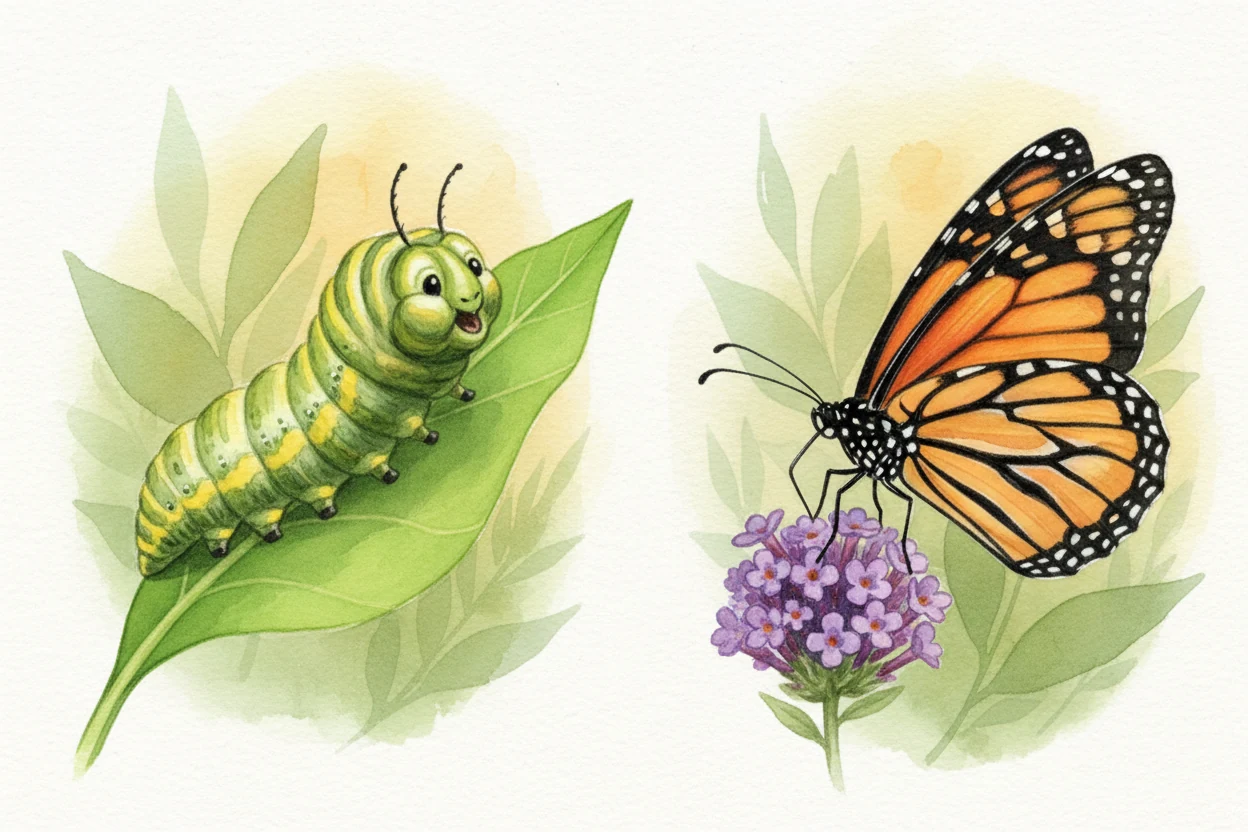
Two Lives, One Bug
You've seen them: fat striped caterpillars munching leaves like tiny eating machines, and delicate butterflies sipping nectar with their curly tongues. They couldn't look more different. So why does every butterfly start life as a caterpillar? It's not a costume change โ it's a survival strategy millions of years in the making.
The answer starts with a problem: what does a baby need, and what does an adult need? A butterfly needs to fly far, find flowers, and meet other butterflies to make eggs. But a baby that hatched with wings would be terrible at all those things โ too small, too weak, too fragile. So nature split the job in two.
Stage one: be a caterpillar, the eating specialist. A caterpillar has one job โ grow as fast as possible by devouring leaves non-stop. Its body is basically a tube with jaws at one end and stumpy legs for gripping. No wings to maintain, no flowers to find. Just eat, eat, eat until you're hundreds of times heavier than the day you hatched.
This is brilliant efficiency. Leaves are everywhere, packed with energy, and easy to chew if you've got the right mouth parts. The caterpillar is optimized for this: strong jaws, a stretchy body, sticky feet for climbing stems. It's a living leaf-processing factory, and it's very, very good at its job.
But here's the thing โ that tubby leaf-munching body is useless for the adult butterfly's life. You can't fly across a meadow with stumpy legs and no wings. You can't sip nectar from deep inside a flower with chewing jaws. So the caterpillar does something radical: it builds itself a sealed chamber called a chrysalis, and inside, it melts.
Melts. Most of the caterpillar's body dissolves into a soup of cells, like breaking down a machine into spare parts. But scattered through that soup are special clusters called imaginal discs โ they've been hiding inside the caterpillar since it was an egg, waiting. Now they wake up and start building: wings from the wing discs, long legs from the leg discs, curly tongue from the mouth discs, piece by piece.
Two weeks later, the chrysalis splits open and out climbs a butterfly โ totally new body, totally new life. Now it has huge wings for traveling miles, long spindly legs for perching on flower edges, and that elegant curled proboscis for drinking nectar like a living straw. Same animal, completely different toolkit. One childhood for growing, one adulthood for spreading.
So butterflies start as caterpillars because being two different animals in one lifetime is smarter than being one animal that's okay at everything. The caterpillar is the childhood โ the time to pack on weight and stored energy. The butterfly is adulthood โ the time to fly, explore, and make the next generation of caterpillars. It's like getting to live two completely different adventures in a single life.