cover

Paws & Memory

Why do cats knead blankets?
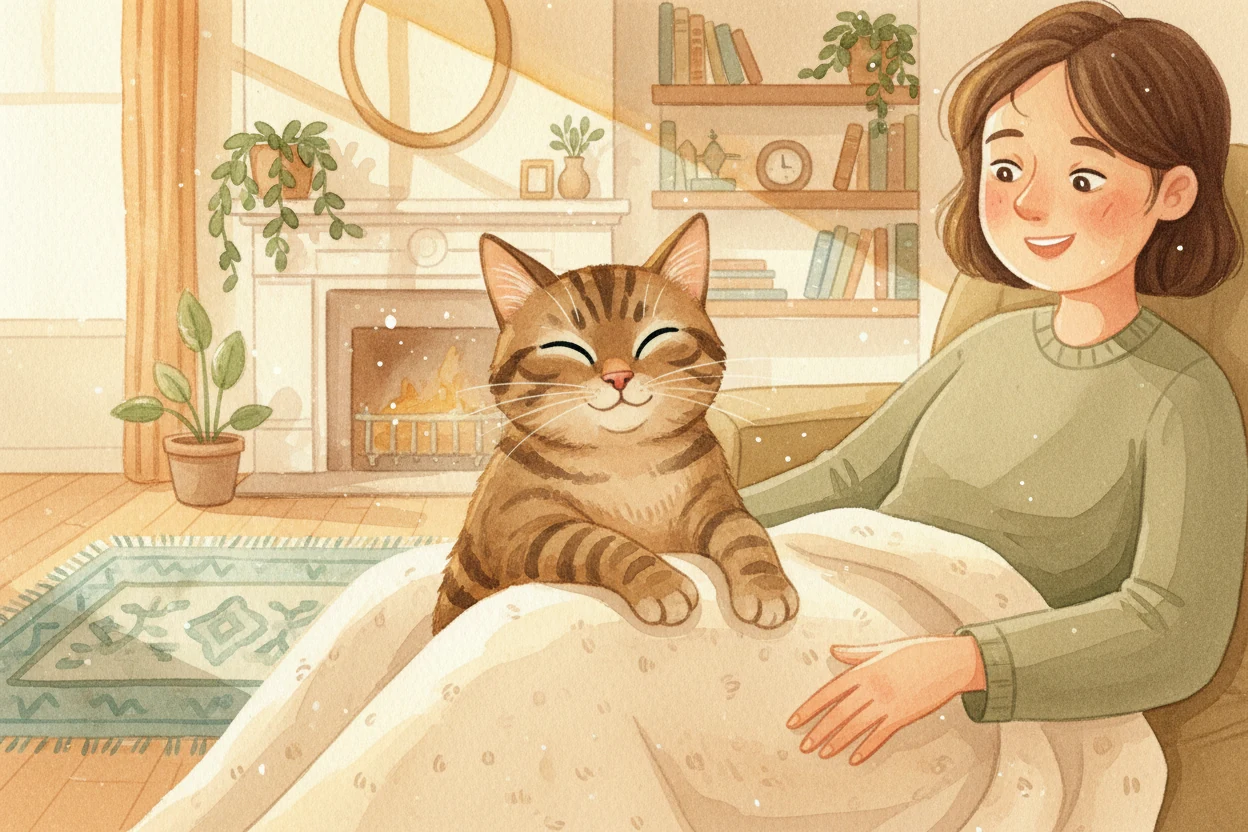
You're sitting on the couch when your cat hops up, settles onto your lap, and starts doing something extremely weird. ~~

You're sitting on the couch when your cat hops up, settles onto your lap, and starts doing something extremely weird. Push-push-push with the front paws, like a tiny baker working invisible dough. Sometimes the claws come out. Sometimes there's purring. Always there's that focused, blissed-out look on their face. What is happening?

~~Here's the thing:~~ your cat thinks they're a kitten again. When cats are just a few days old—blind, helpless, **barel

Here's the thing: your cat thinks they're a kitten again. When cats are just a few days old—blind, helpless, barely bigger than a mouse—they knead their mother's belly while nursing. The pushing motion helps milk flow from her mammary glands. Push-push-push means "more milk, please." It's one of the first things a kitten ever learns to do.

Most animals forget their baby behaviors when they grow up. ~~Cats don't.~~ They carry kneading into adulthood **like a

Most animals forget their baby behaviors when they grow up. Cats don't. They carry kneading into adulthood like a comfort object—a pacifier they never give up. When your cat kneads your blanket, their brain is running that ancient kitten program: "I'm safe, I'm warm, I'm with someone who takes care of me."

The behavior gets triggered by things that feel **mother-like**. Soft surfaces—blankets, pillows, your squishy stomach.

The behavior gets triggered by things that feel mother-like. Soft surfaces—blankets, pillows, your squishy stomach. Warmth. A full belly after dinner. Your smell, which means safety. The cat's not actually trying to get milk anymore. They're just… happy. So happy their body runs the code for "this is the best feeling I remember."

Some cats take it further. They'll knead and suckle the blanket at the same time, holding a corner in their mouth like a

Some cats take it further. They'll knead and suckle the blanket at the same time, holding a corner in their mouth like a kitten nursing. It looks ridiculous—this full-grown predator gumming a fleece throw—but it's the same comfort loop. Kneading releases endorphins, the brain's feel-good chemicals. It's literally a happiness spiral.

~~The claw situation?~~ **Not aggression—just enthusiasm.** Cats have *scent glands in their paw pads*. When they knead,

The claw situation? Not aggression—just enthusiasm. Cats have scent glands in their paw pads. When they knead, they're also marking the blanket (or you) as their territory. "This is mine. This person is mine. This soft thing is MINE." It's a compliment, even if it involves tiny puncture wounds.

Not all cats knead with the same intensity. Some do ~~the full bakery routine~~—**both paws, big motions, total commitme

Not all cats knead with the same intensity. Some do the full bakery routineboth paws, big motions, total commitment. Others just tap lightly, like they're testing the dough. A few never knead at all, usually cats weaned too early who didn't get enough time with that original milk-and-mother comfort. They missed the lesson.

So when your cat turns your lap into a ~~kneading station at 11 p.m.~~, they're telling you something important. *You're

So when your cat turns your lap into a kneading station at 11 p.m., they're telling you something important. You're their safe place. You're the warmth and softness and comfort they remember from the very beginning. They're kneading you because, in the best possible way, you feel like home.

How was this book?

A Wonderleaf Book

Paws & Memory

— Why do cats knead blankets? —

Wonderleaf Editions
— ex libris —
A Wonderleaf Book

Paws & Memory

Why do cats knead blankets?

Wonderleaf Editions · MMXXVI
Scene 1
You're sitting on the couch when your cat hops up, settles onto your lap, and starts doing something extremely weird. ~~
Paws & Memory2
Scene 1

You're sitting on the couch when your cat hops up, settles onto your lap, and starts doing something extremely weird. Push-push-push with the front paws, like a tiny baker working invisible dough. Sometimes the claws come out. Sometimes there's purring. Always there's that focused, blissed-out look on their face. What is happening?

3Paws & Memory
Scene 2
~~Here's the thing:~~ your cat thinks they're a kitten again. When cats are just a few days old—blind, helpless, **barel
Paws & Memory4
Scene 2

Here's the thing: your cat thinks they're a kitten again. When cats are just a few days old—blind, helpless, barely bigger than a mouse—they knead their mother's belly while nursing. The pushing motion helps milk flow from her mammary glands. Push-push-push means "more milk, please." It's one of the first things a kitten ever learns to do.

5Paws & Memory
Scene 3
Most animals forget their baby behaviors when they grow up. ~~Cats don't.~~ They carry kneading into adulthood **like a
Paws & Memory6
Scene 3

Most animals forget their baby behaviors when they grow up. Cats don't. They carry kneading into adulthood like a comfort object—a pacifier they never give up. When your cat kneads your blanket, their brain is running that ancient kitten program: "I'm safe, I'm warm, I'm with someone who takes care of me."

7Paws & Memory
Scene 4
The behavior gets triggered by things that feel **mother-like**. Soft surfaces—blankets, pillows, your squishy stomach.
Paws & Memory8
Scene 4

The behavior gets triggered by things that feel mother-like. Soft surfaces—blankets, pillows, your squishy stomach. Warmth. A full belly after dinner. Your smell, which means safety. The cat's not actually trying to get milk anymore. They're just… happy. So happy their body runs the code for "this is the best feeling I remember."

9Paws & Memory
Scene 5
Some cats take it further. They'll knead and suckle the blanket at the same time, holding a corner in their mouth like a
Paws & Memory10
Scene 5

Some cats take it further. They'll knead and suckle the blanket at the same time, holding a corner in their mouth like a kitten nursing. It looks ridiculous—this full-grown predator gumming a fleece throw—but it's the same comfort loop. Kneading releases endorphins, the brain's feel-good chemicals. It's literally a happiness spiral.

11Paws & Memory
Scene 6
~~The claw situation?~~ **Not aggression—just enthusiasm.** Cats have *scent glands in their paw pads*. When they knead,
Paws & Memory12
Scene 6

The claw situation? Not aggression—just enthusiasm. Cats have scent glands in their paw pads. When they knead, they're also marking the blanket (or you) as their territory. "This is mine. This person is mine. This soft thing is MINE." It's a compliment, even if it involves tiny puncture wounds.

13Paws & Memory
Scene 7
Not all cats knead with the same intensity. Some do ~~the full bakery routine~~—**both paws, big motions, total commitme
Paws & Memory14
Scene 7

Not all cats knead with the same intensity. Some do the full bakery routineboth paws, big motions, total commitment. Others just tap lightly, like they're testing the dough. A few never knead at all, usually cats weaned too early who didn't get enough time with that original milk-and-mother comfort. They missed the lesson.

15Paws & Memory
Scene 8
So when your cat turns your lap into a ~~kneading station at 11 p.m.~~, they're telling you something important. *You're
Paws & Memory16
Scene 8

So when your cat turns your lap into a kneading station at 11 p.m., they're telling you something important. You're their safe place. You're the warmth and softness and comfort they remember from the very beginning. They're kneading you because, in the best possible way, you feel like home.

17Paws & Memory

~ finis ~

Tiny picture books for big little questions.

— a small constellation of questions —
Wonderleaf
Editions