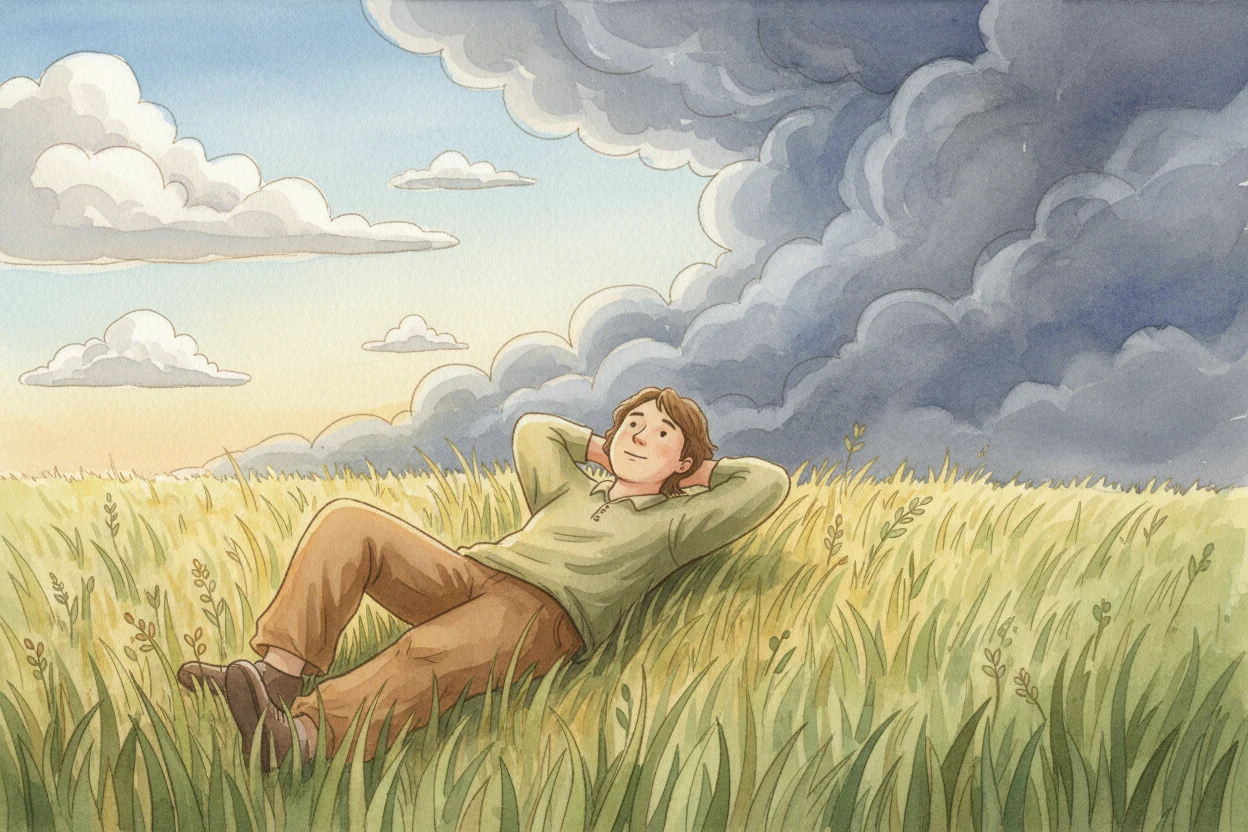
Cloud Color Party
Look up on a cloudy day and you'll see white puffs drifting across the sky โ or dark gray ones threatening rain. But here's the weird part: clouds are made of water, and water is clear. So why aren't clouds invisible?
The secret is in the size of the water drops. A cloud isn't one big blob of water โ it's trillions of tiny droplets, each smaller than the period at the end of this sentence. Light from the sun travels in waves, and when it hits something very small, it bounces.
Here's where it gets fun. Sunlight looks white, but it's actually a mix of all the colors โ red, orange, yellow, green, blue, indigo, violet. When light waves hit a tiny water droplet, they all bounce in random directions. Red bounces one way, blue another, green somewhere else.
Now imagine trillions of droplets doing this at once. Every color scatters so many times in so many directions that they all mix back together again. When all the colors of light blend, what do you see? White.
That's why thin clouds look bright white โ the sunlight bounces through them, mixing all its colors together, and reaches your eyes as white light. The cloud is basically a giant light-mixing party.
But what about gray clouds? Same droplets, same bouncing โ so what changed? The answer is thickness. In a thick storm cloud, light bounces so many times between so many droplets that most of it never makes it through to the bottom.
The top of that storm cloud is still bright white, catching all the sunlight. But the bottom is in shadow โ the cloud is blocking its own light. Less light reaching your eyes means the cloud looks darker. The thicker and taller the cloud, the grayer it appears.
So clouds aren't white or gray because of what they're made of โ they're all just water. They're white or gray because of how thick they are and how much light escapes through them. Next time you see a white puff turn gray, you're watching it grow taller, trapping more light inside itself, throwing its own shadow.