cover

Your Voice Symphony

Why do our voices sound different from each other?
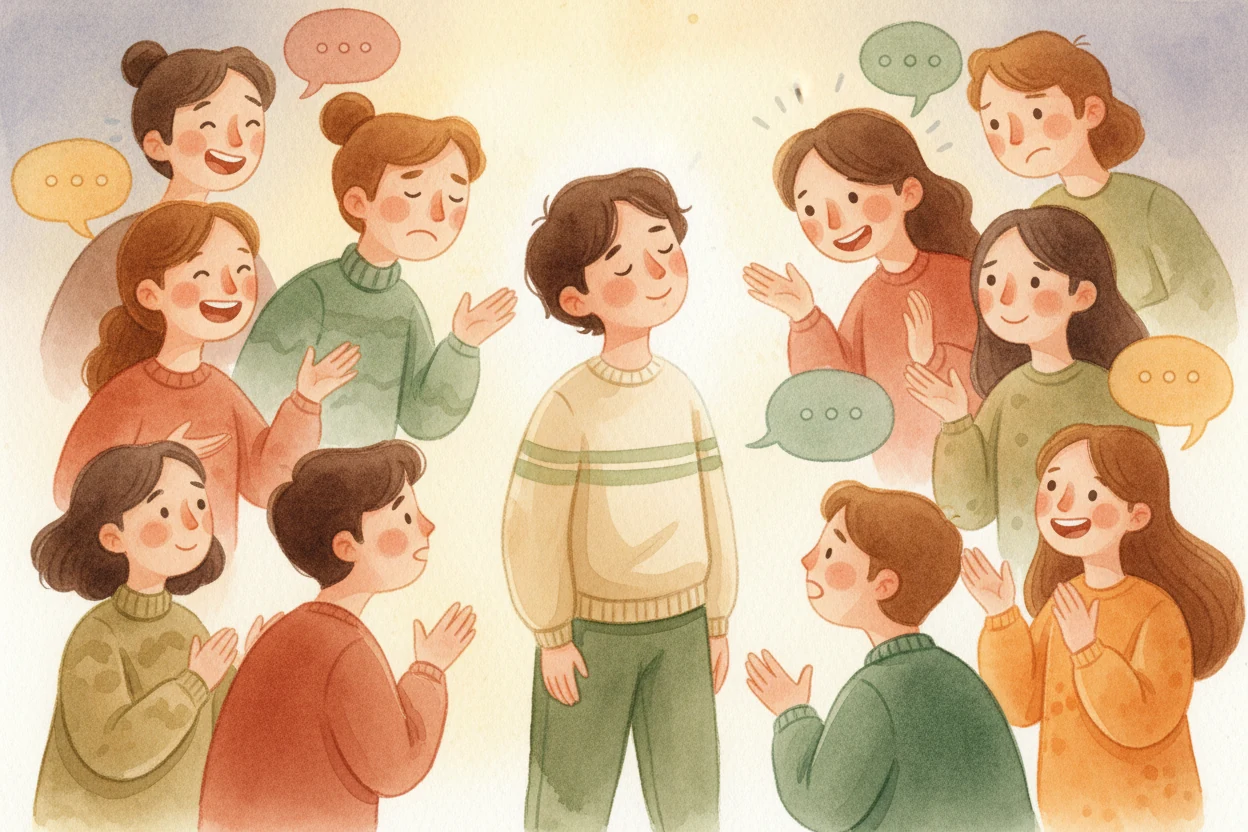
Stand in a crowded room and **close your eyes**. You can still tell who's speaking โ€” your friend's voice is _smooth and

Stand in a crowded room and close your eyes. You can still tell who's speaking โ€” your friend's voice is smooth and low, your sister's is bright and quick, the teacher's rumbles like distant thunder. What makes each voice unmistakably theirs?

Every voice starts the same way: air from your lungs rushes past two small folds in your throat called ++vocal cords++.

Every voice starts the same way: air from your lungs rushes past two small folds in your throat called vocal cords. When they snap together and apart super fast โ€” hundreds of times per second โ€” they chop that air into vibrations. That's the buzz that becomes sound.

~~But here's where it gets personal.~~ Thicker, longer vocal cords vibrate slower, making a lower pitch โ€” **like a thick

But here's where it gets personal. Thicker, longer vocal cords vibrate slower, making a lower pitch โ€” like a thick rubber band twanging lazily. Thinner, shorter cords zip back and forth faster, creating a higher pitch. That's why most adults sound lower than kids, and why everyone's starting note is a little different.

~~Next stop:~~ your throat, mouth, and nose become a **custom sound studio**. The vibration from your cords bounces arou

Next stop: your throat, mouth, and nose become a custom sound studio. The vibration from your cords bounces around inside these spaces, and certain frequencies get amplified while others fade. A big resonant throat is like a cathedral for sound โ€” it deepens and enriches the tone. A smaller space brightens it.

Then your tongue, lips, and teeth sculpt the sound into words. ~~But even when you're~~ **not** speaking โ€” just humming

Then your tongue, lips, and teeth sculpt the sound into words. But even when you're not speaking โ€” just humming โ€” the exact shape of your mouth changes which overtones ring out. Your personal architecture is like no one else's: the curve of your palate, the length of your vocal tract, the space behind your nose. All of it filters the sound in a way that's uniquely you.

Stack it all up: the pitch your cords produce, the resonances your spaces create, the textures your mouth adds. The resu

Stack it all up: the pitch your cords produce, the resonances your spaces create, the textures your mouth adds. The result is your ++timbre++ โ€” the fingerprint of your voice. It's why a piano and a violin playing the same note sound completely different, and why you sound like you and not your neighbor.

And you're not stuck with just one voice. *Tighten your vocal cords and push more air*, ~~you go higher and louder~~. Re

And you're not stuck with just one voice. Tighten your vocal cords and push more air, you go higher and louder. Relax them, you drop low and breathy. Change the shape of your mouth mid-word and suddenly you're doing an accent, a whisper, a shout, a silly character voice. You're a one-person orchestra.

~~So the next time~~ someone calls your name across the room, remember: your voice is a **symphony of biology**. _Cords,

So the next time someone calls your name across the room, remember: your voice is a symphony of biology. Cords, cavities, and curves working together to make a sound no one else in the world can make. That's you, ringing out loud and clear.

How was this book?

A Wonderleaf Book

Your Voice Symphony

โ€” Why do our voices sound different from each other? โ€”

Wonderleaf Editions
โ€” ex libris โ€”
A Wonderleaf Book

Your Voice Symphony

Why do our voices sound different from each other?

Wonderleaf Editions ยท MMXXVI
Scene 1
Stand in a crowded room and **close your eyes**. You can still tell who's speaking โ€” your friend's voice is _smooth and
Your Voice Symphony2
Scene 1

Stand in a crowded room and close your eyes. You can still tell who's speaking โ€” your friend's voice is smooth and low, your sister's is bright and quick, the teacher's rumbles like distant thunder. What makes each voice unmistakably theirs?

3Your Voice Symphony
Scene 2
Every voice starts the same way: air from your lungs rushes past two small folds in your throat called ++vocal cords++.
Your Voice Symphony4
Scene 2

Every voice starts the same way: air from your lungs rushes past two small folds in your throat called vocal cords. When they snap together and apart super fast โ€” hundreds of times per second โ€” they chop that air into vibrations. That's the buzz that becomes sound.

5Your Voice Symphony
Scene 3
~~But here's where it gets personal.~~ Thicker, longer vocal cords vibrate slower, making a lower pitch โ€” **like a thick
Your Voice Symphony6
Scene 3

But here's where it gets personal. Thicker, longer vocal cords vibrate slower, making a lower pitch โ€” like a thick rubber band twanging lazily. Thinner, shorter cords zip back and forth faster, creating a higher pitch. That's why most adults sound lower than kids, and why everyone's starting note is a little different.

7Your Voice Symphony
Scene 4
~~Next stop:~~ your throat, mouth, and nose become a **custom sound studio**. The vibration from your cords bounces arou
Your Voice Symphony8
Scene 4

Next stop: your throat, mouth, and nose become a custom sound studio. The vibration from your cords bounces around inside these spaces, and certain frequencies get amplified while others fade. A big resonant throat is like a cathedral for sound โ€” it deepens and enriches the tone. A smaller space brightens it.

9Your Voice Symphony
Scene 5
Then your tongue, lips, and teeth sculpt the sound into words. ~~But even when you're~~ **not** speaking โ€” just humming
Your Voice Symphony10
Scene 5

Then your tongue, lips, and teeth sculpt the sound into words. But even when you're not speaking โ€” just humming โ€” the exact shape of your mouth changes which overtones ring out. Your personal architecture is like no one else's: the curve of your palate, the length of your vocal tract, the space behind your nose. All of it filters the sound in a way that's uniquely you.

11Your Voice Symphony
Scene 6
Stack it all up: the pitch your cords produce, the resonances your spaces create, the textures your mouth adds. The resu
Your Voice Symphony12
Scene 6

Stack it all up: the pitch your cords produce, the resonances your spaces create, the textures your mouth adds. The result is your ++timbre++ โ€” the fingerprint of your voice. It's why a piano and a violin playing the same note sound completely different, and why you sound like you and not your neighbor.

13Your Voice Symphony
Scene 7
And you're not stuck with just one voice. *Tighten your vocal cords and push more air*, ~~you go higher and louder~~. Re
Your Voice Symphony14
Scene 7

And you're not stuck with just one voice. Tighten your vocal cords and push more air, you go higher and louder. Relax them, you drop low and breathy. Change the shape of your mouth mid-word and suddenly you're doing an accent, a whisper, a shout, a silly character voice. You're a one-person orchestra.

15Your Voice Symphony
Scene 8
~~So the next time~~ someone calls your name across the room, remember: your voice is a **symphony of biology**. _Cords,
Your Voice Symphony16
Scene 8

So the next time someone calls your name across the room, remember: your voice is a symphony of biology. Cords, cavities, and curves working together to make a sound no one else in the world can make. That's you, ringing out loud and clear.

17Your Voice Symphony

~ finis ~

Tiny picture books for big little questions.

โ€” a small constellation of questions โ€”
โœฆWonderleaf
Editions