cover

Pickle's Sour Fortress

Why do pickles last so long?
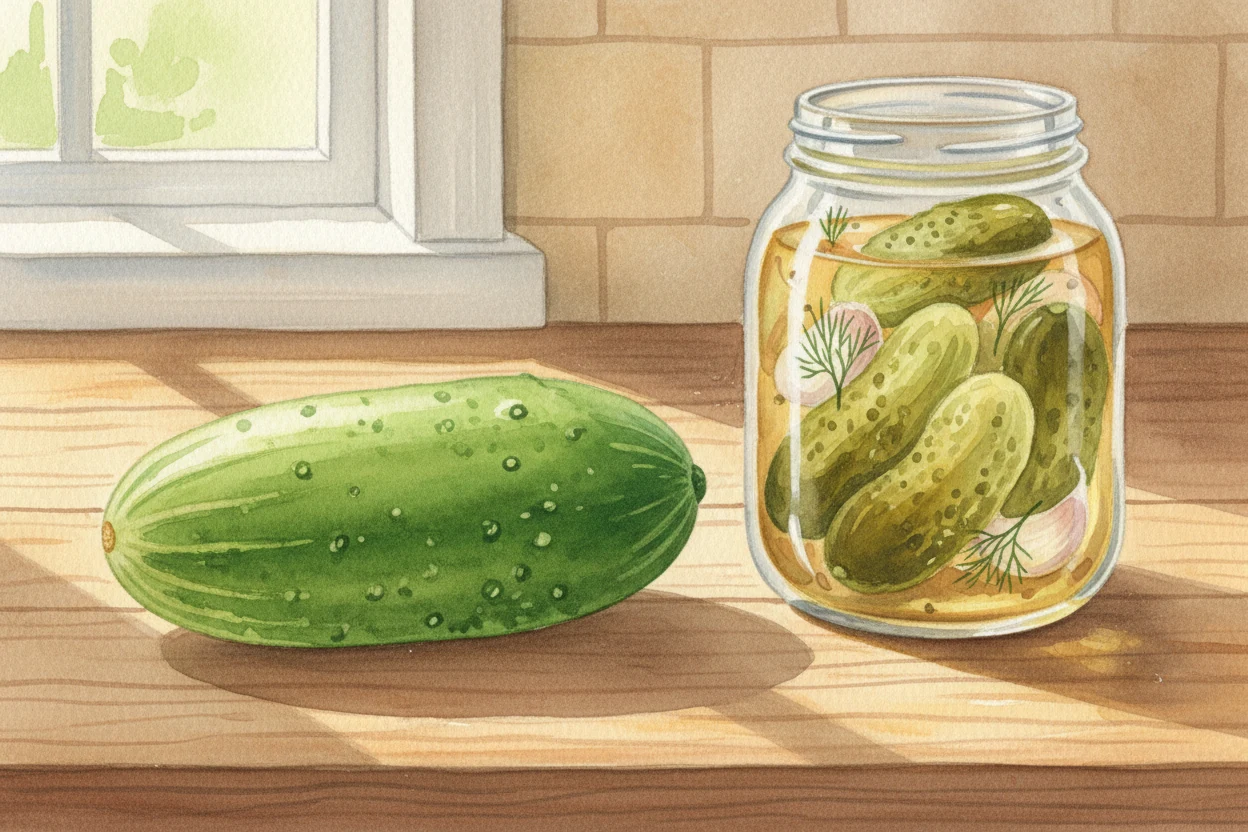
A cucumber lasts maybe a week in your fridge before it gets soft and sad. But turn it into a pickle, and suddenly it's g

A cucumber lasts maybe a week in your fridge before it gets soft and sad. But turn it into a pickle, and suddenly it's good for months โ€” sometimes a year or more. What kind of kitchen magic is that?

The secret is that pickles live in a world most tiny creatures hate: **an ocean of vinegar and salt**. Bacteria and mold

The secret is that pickles live in a world most tiny creatures hate: an ocean of vinegar and salt. Bacteria and mold need water to survive, and they can't handle super-acidic, super-salty places. It's like trying to set up camp in a desert made of lemon juice.

When you make a pickle, you dunk the cucumber in ++brine++ โ€” that's water mixed with lots of salt and vinegar. The vineg

When you make a pickle, you dunk the cucumber in brine โ€” that's water mixed with lots of salt and vinegar. The vinegar drops the pH way down, making everything acidic. Most bacteria can't even function below a pH of 4.6. Pickles sit around 3 to 4, which is acid-strong enough to shut down almost everything that wants to grow.

The salt does **double duty**. It sucks water out of the cucumber's cells through osmosis โ€” *water molecules rush toward

The salt does double duty. It sucks water out of the cucumber's cells through osmosis โ€” water molecules rush toward the saltier side to balance things out. With less water inside, there's less for bacteria to drink. And high salt also messes with bacteria's ability to hold themselves together. They basically shrivel.

Some pickles are made with a different trick: fermentation. You skip the vinegar and let good bacteria โ€” like ++Lactobac

Some pickles are made with a different trick: fermentation. You skip the vinegar and let good bacteria โ€” like Lactobacillus โ€” eat the cucumber's natural sugars. Those bacteria poop out lactic acid (yes, really), which makes the brine acidic all on its own. The acid they create protects the pickle from bad bacteria trying to move in.

Either way โ€” vinegar or fermentation โ€” you end up with **the same result**: a cucumber soaked in acid and salt, sealed i

Either way โ€” vinegar or fermentation โ€” you end up with the same result: a cucumber soaked in acid and salt, sealed in a jar with no air. Bacteria, mold, and yeast need oxygen, water, and a comfortable pH to party. Pickles offer none of those things. It's a hostile planet.

As long as the jar stays sealed, **nothing gets in**. No new bacteria, no air, no contamination. _The acid and salt keep

As long as the jar stays sealed, nothing gets in. No new bacteria, no air, no contamination. The acid and salt keep standing guard. Open the jar, though, and the clock starts ticking โ€” air brings new microbes, and even pickles can't hold them off forever once exposed.

~~So that's the trick.~~ You're not preserving a cucumber โ€” you're transforming it into something that lives in a **tiny

So that's the trick. You're not preserving a cucumber โ€” you're transforming it into something that lives in a tiny, sour, salty fortress where almost nothing else can survive. The pickle isn't magic. It's just really, really good at being inhospitable.

How was this book?

A Wonderleaf Book

Pickle's Sour Fortress

โ€” Why do pickles last so long? โ€”

Wonderleaf Editions
โ€” ex libris โ€”
A Wonderleaf Book

Pickle's Sour Fortress

Why do pickles last so long?

Wonderleaf Editions ยท MMXXVI
Scene 1
A cucumber lasts maybe a week in your fridge before it gets soft and sad. But turn it into a pickle, and suddenly it's g
Pickle's Sour Fortress2
Scene 1

A cucumber lasts maybe a week in your fridge before it gets soft and sad. But turn it into a pickle, and suddenly it's good for months โ€” sometimes a year or more. What kind of kitchen magic is that?

3Pickle's Sour Fortress
Scene 2
The secret is that pickles live in a world most tiny creatures hate: **an ocean of vinegar and salt**. Bacteria and mold
Pickle's Sour Fortress4
Scene 2

The secret is that pickles live in a world most tiny creatures hate: an ocean of vinegar and salt. Bacteria and mold need water to survive, and they can't handle super-acidic, super-salty places. It's like trying to set up camp in a desert made of lemon juice.

5Pickle's Sour Fortress
Scene 3
When you make a pickle, you dunk the cucumber in ++brine++ โ€” that's water mixed with lots of salt and vinegar. The vineg
Pickle's Sour Fortress6
Scene 3

When you make a pickle, you dunk the cucumber in brine โ€” that's water mixed with lots of salt and vinegar. The vinegar drops the pH way down, making everything acidic. Most bacteria can't even function below a pH of 4.6. Pickles sit around 3 to 4, which is acid-strong enough to shut down almost everything that wants to grow.

7Pickle's Sour Fortress
Scene 4
The salt does **double duty**. It sucks water out of the cucumber's cells through osmosis โ€” *water molecules rush toward
Pickle's Sour Fortress8
Scene 4

The salt does double duty. It sucks water out of the cucumber's cells through osmosis โ€” water molecules rush toward the saltier side to balance things out. With less water inside, there's less for bacteria to drink. And high salt also messes with bacteria's ability to hold themselves together. They basically shrivel.

9Pickle's Sour Fortress
Scene 5
Some pickles are made with a different trick: fermentation. You skip the vinegar and let good bacteria โ€” like ++Lactobac
Pickle's Sour Fortress10
Scene 5

Some pickles are made with a different trick: fermentation. You skip the vinegar and let good bacteria โ€” like Lactobacillus โ€” eat the cucumber's natural sugars. Those bacteria poop out lactic acid (yes, really), which makes the brine acidic all on its own. The acid they create protects the pickle from bad bacteria trying to move in.

11Pickle's Sour Fortress
Scene 6
Either way โ€” vinegar or fermentation โ€” you end up with **the same result**: a cucumber soaked in acid and salt, sealed i
Pickle's Sour Fortress12
Scene 6

Either way โ€” vinegar or fermentation โ€” you end up with the same result: a cucumber soaked in acid and salt, sealed in a jar with no air. Bacteria, mold, and yeast need oxygen, water, and a comfortable pH to party. Pickles offer none of those things. It's a hostile planet.

13Pickle's Sour Fortress
Scene 7
As long as the jar stays sealed, **nothing gets in**. No new bacteria, no air, no contamination. _The acid and salt keep
Pickle's Sour Fortress14
Scene 7

As long as the jar stays sealed, nothing gets in. No new bacteria, no air, no contamination. The acid and salt keep standing guard. Open the jar, though, and the clock starts ticking โ€” air brings new microbes, and even pickles can't hold them off forever once exposed.

15Pickle's Sour Fortress
Scene 8
~~So that's the trick.~~ You're not preserving a cucumber โ€” you're transforming it into something that lives in a **tiny
Pickle's Sour Fortress16
Scene 8

So that's the trick. You're not preserving a cucumber โ€” you're transforming it into something that lives in a tiny, sour, salty fortress where almost nothing else can survive. The pickle isn't magic. It's just really, really good at being inhospitable.

17Pickle's Sour Fortress

~ finis ~

Tiny picture books for big little questions.

โ€” a small constellation of questions โ€”
โœฆWonderleaf
Editions