cover

Ouch Alarm

Why do we feel pain?
You stub your toe on the coffee table and โ€” ~~OW!~~ โ€” **suddenly your whole world is that throbbing spot** on your foot.

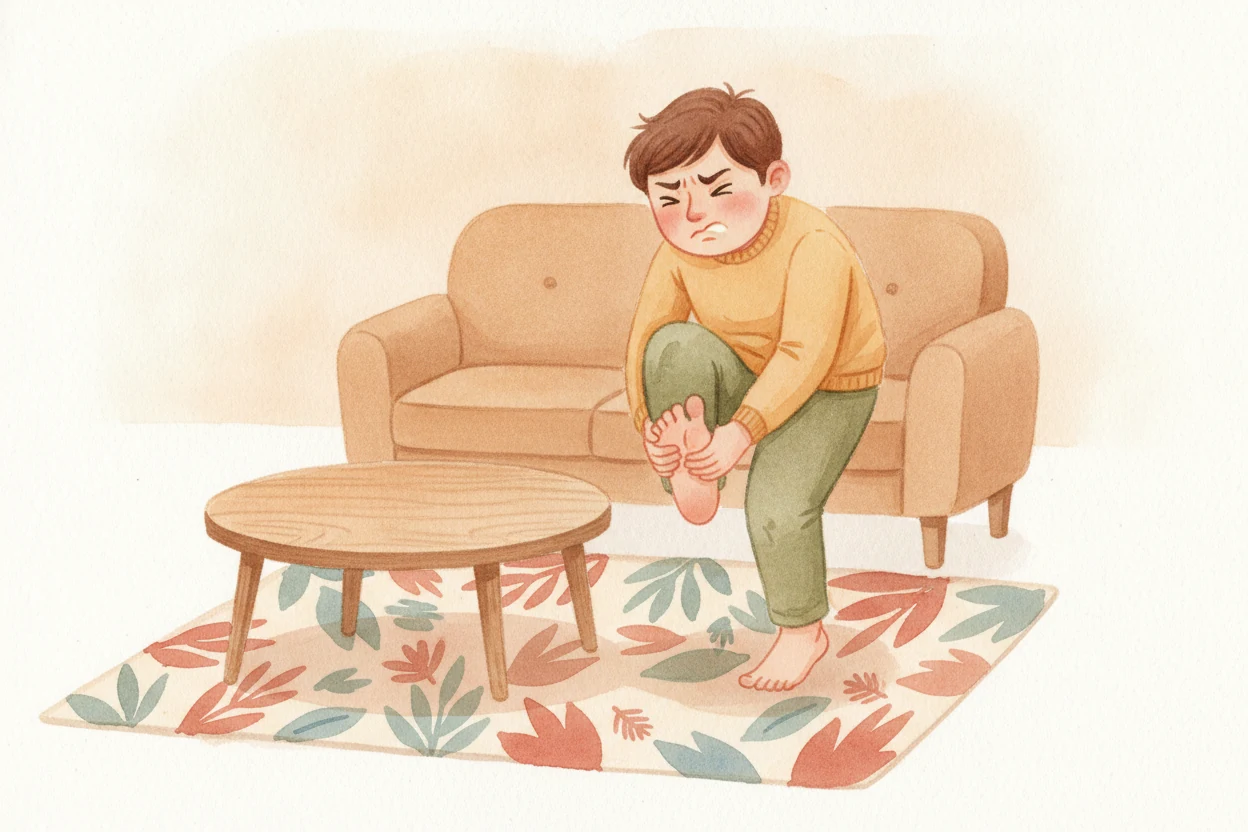
You stub your toe on the coffee table and โ€” OW! โ€” suddenly your whole world is that throbbing spot on your foot. Why does your body do this to you? Why can't you just bounce off furniture like a cartoon character and keep walking?

~~Pain is your body's alarm system.~~ When something harmful touches you โ€” **a hot stove, a sharp thorn, a whack from a

Pain is your body's alarm system. When something harmful touches you โ€” a hot stove, a sharp thorn, a whack from a table โ€” special sensors in your skin wake up and shout a message to your brain. These sensors are called nociceptors, which is just a fancy word for "danger detectors." They only fire when something could actually hurt you.

The message races up through your nerves like electricity through a wire. Fast fibers carry the sharp, sudden "~~STOP RI

The message races up through your nerves like electricity through a wire. Fast fibers carry the sharp, sudden "STOP RIGHT NOW!" signal โ€” that first bright jolt when you touch the hot pan. Slower fibers carry the achy, throbbing "something is wrong here" feeling that arrives a moment later and doesn't leave.

Your brain receives the alarm and instantly checks: ~~Is this actually dangerous?~~ Your toe isn't broken, just bonked โ€”

Your brain receives the alarm and instantly checks: Is this actually dangerous? Your toe isn't broken, just bonked โ€” but your brain cranks up the pain anyway to make absolutely sure you'll remember. Next time, you'll walk around that table. Pain is a teacher with a very loud voice.

~~Here's the wild part:~~ **pain happens in your brain, not in your toe**. The toe just sends the report. *Your brain de

Here's the wild part: pain happens in your brain, not in your toe. The toe just sends the report. Your brain decides how much it hurts based on what else is going on. If you're playing soccer and stub your toe during the winning goal, you might barely notice. If you're sitting quietly and stub it in the dark, it feels like the end of the world. Same toe, different story.

Sometimes the alarm system gets confused. ++Phantom pain++ happens when someone loses a limb but still feels pain where

Sometimes the alarm system gets confused. Phantom pain happens when someone loses a limb but still feels pain where it used to be โ€” the brain keeps expecting signals from sensors that are no longer there. Chronic pain happens when the alarm keeps ringing even after the danger is gone, like a smoke detector with a dying battery that won't stop beeping.

Your brain also has its own **volume knob**. When you rub a sore spot, you're sending touch signals that crowd out some

Your brain also has its own volume knob. When you rub a sore spot, you're sending touch signals that crowd out some of the pain signals โ€” like turning up the music so you can't hear the alarm as well. When you're scared or stressed, your brain can crank the pain UP. When you're distracted or flooded with adrenaline, it can turn the pain DOWN. You're not imagining it; your brain is actually changing the volume.

~~So pain isn't your body being mean to you.~~ **It's your body trying to keep you alive.** *Every "ouch" is a little no

So pain isn't your body being mean to you. It's your body trying to keep you alive. Every "ouch" is a little note: pay attention, move carefully, let this heal. Without pain, you'd burn your hand on the stove and leave it there. You'd walk on a broken ankle until it shattered. Pain is annoying, but it's also the reason you're still in one piece.

How was this book?

A Wonderleaf Book

Ouch Alarm

โ€” Why do we feel pain? โ€”

Wonderleaf Editions
โ€” ex libris โ€”
A Wonderleaf Book

Ouch Alarm

Why do we feel pain?

Wonderleaf Editions ยท MMXXVI
Scene 1
You stub your toe on the coffee table and โ€” ~~OW!~~ โ€” **suddenly your whole world is that throbbing spot** on your foot.
Ouch Alarm2
Scene 1

You stub your toe on the coffee table and โ€” OW! โ€” suddenly your whole world is that throbbing spot on your foot. Why does your body do this to you? Why can't you just bounce off furniture like a cartoon character and keep walking?

3Ouch Alarm
Scene 2
~~Pain is your body's alarm system.~~ When something harmful touches you โ€” **a hot stove, a sharp thorn, a whack from a
Ouch Alarm4
Scene 2

Pain is your body's alarm system. When something harmful touches you โ€” a hot stove, a sharp thorn, a whack from a table โ€” special sensors in your skin wake up and shout a message to your brain. These sensors are called nociceptors, which is just a fancy word for "danger detectors." They only fire when something could actually hurt you.

5Ouch Alarm
Scene 3
The message races up through your nerves like electricity through a wire. Fast fibers carry the sharp, sudden "~~STOP RI
Ouch Alarm6
Scene 3

The message races up through your nerves like electricity through a wire. Fast fibers carry the sharp, sudden "STOP RIGHT NOW!" signal โ€” that first bright jolt when you touch the hot pan. Slower fibers carry the achy, throbbing "something is wrong here" feeling that arrives a moment later and doesn't leave.

7Ouch Alarm
Scene 4
Your brain receives the alarm and instantly checks: ~~Is this actually dangerous?~~ Your toe isn't broken, just bonked โ€”
Ouch Alarm8
Scene 4

Your brain receives the alarm and instantly checks: Is this actually dangerous? Your toe isn't broken, just bonked โ€” but your brain cranks up the pain anyway to make absolutely sure you'll remember. Next time, you'll walk around that table. Pain is a teacher with a very loud voice.

9Ouch Alarm
Scene 5
~~Here's the wild part:~~ **pain happens in your brain, not in your toe**. The toe just sends the report. *Your brain de
Ouch Alarm10
Scene 5

Here's the wild part: pain happens in your brain, not in your toe. The toe just sends the report. Your brain decides how much it hurts based on what else is going on. If you're playing soccer and stub your toe during the winning goal, you might barely notice. If you're sitting quietly and stub it in the dark, it feels like the end of the world. Same toe, different story.

11Ouch Alarm
Scene 6
Sometimes the alarm system gets confused. ++Phantom pain++ happens when someone loses a limb but still feels pain where
Ouch Alarm12
Scene 6

Sometimes the alarm system gets confused. Phantom pain happens when someone loses a limb but still feels pain where it used to be โ€” the brain keeps expecting signals from sensors that are no longer there. Chronic pain happens when the alarm keeps ringing even after the danger is gone, like a smoke detector with a dying battery that won't stop beeping.

13Ouch Alarm
Scene 7
Your brain also has its own **volume knob**. When you rub a sore spot, you're sending touch signals that crowd out some
Ouch Alarm14
Scene 7

Your brain also has its own volume knob. When you rub a sore spot, you're sending touch signals that crowd out some of the pain signals โ€” like turning up the music so you can't hear the alarm as well. When you're scared or stressed, your brain can crank the pain UP. When you're distracted or flooded with adrenaline, it can turn the pain DOWN. You're not imagining it; your brain is actually changing the volume.

15Ouch Alarm
Scene 8
~~So pain isn't your body being mean to you.~~ **It's your body trying to keep you alive.** *Every "ouch" is a little no
Ouch Alarm16
Scene 8

So pain isn't your body being mean to you. It's your body trying to keep you alive. Every "ouch" is a little note: pay attention, move carefully, let this heal. Without pain, you'd burn your hand on the stove and leave it there. You'd walk on a broken ankle until it shattered. Pain is annoying, but it's also the reason you're still in one piece.

17Ouch Alarm

~ finis ~

Tiny picture books for big little questions.

โ€” a small constellation of questions โ€”
โœฆWonderleaf
Editions