Stone Giants & Hidden Cities
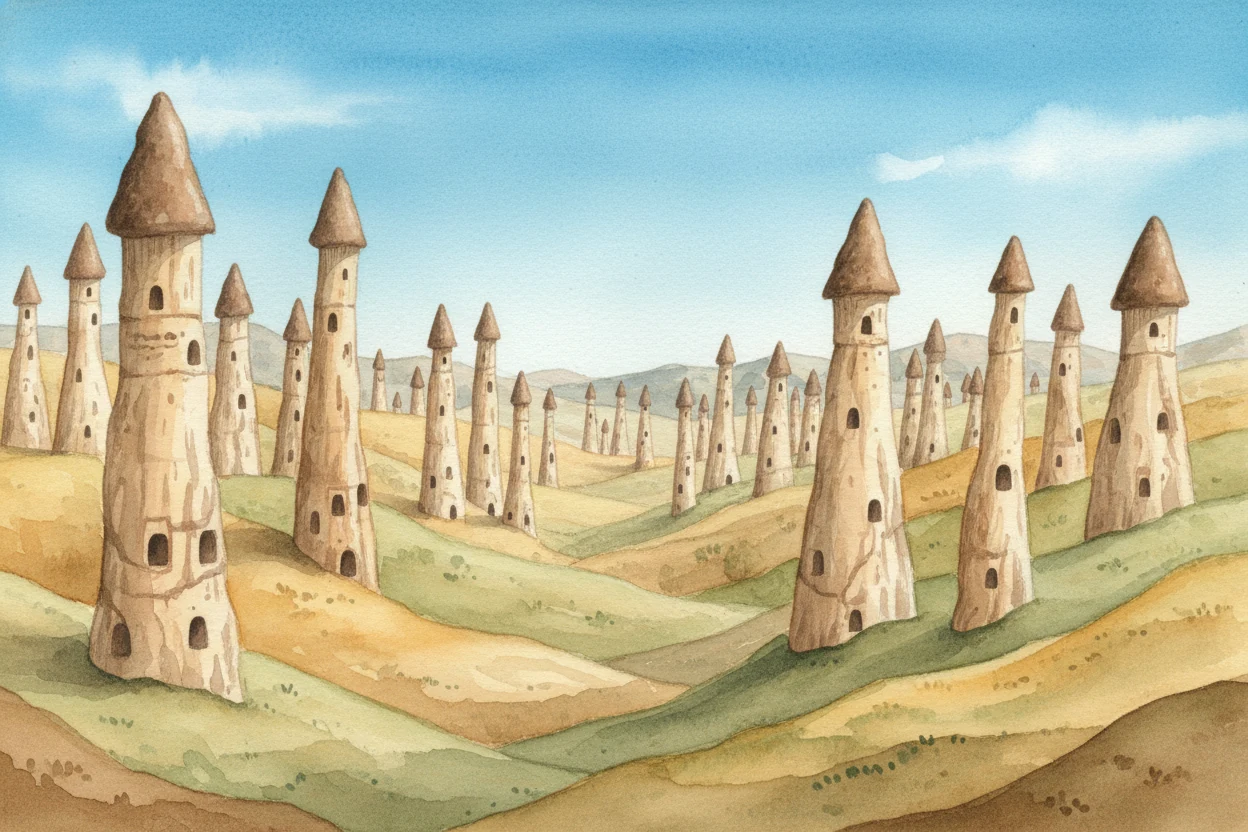
In the middle of Turkey, a whole valley looks like it belongs on another planet. Tall stone towers stand like skinny giants wearing pointy hats. Hillsides are carved with hundreds of windows and doorways, like someone took a cookie cutter to the rock itself. This is Cappadocia, and the stone towers aren't buildings โ they're what's left after millions of years of wind and rain carved the landscape. The caves aren't natural hiding spots โ people cut them, room by room, into the soft rock.
The story starts with volcanoes. Millions of years ago, three volcanoes near Cappadocia erupted over and over, covering the valley in layers of ash. The ash piled up hundreds of feet thick and then did something unusual โ it pressed together into a soft rock called tuff. Tuff is weird: hard enough to stand in tall formations, but soft enough that you can carve it with simple metal tools, almost like cutting into cold butter.
Rain and wind went to work on the tuff like sculptors with a chisel. Water seeped into cracks and froze in winter, splitting the rock. Streams cut deep valleys. Wind sandblasted the softer layers. Over millions of years, the landscape turned into a forest of stone pillars. Some formations got topped with a harder capstone โ a tougher rock that acted like an umbrella, protecting the softer tuff underneath. That's why so many towers have that pointy-hat shape.
Then humans arrived and thought: why build a house when you can carve one? Starting around 4,000 years ago, people realized tuff was a gift. They could dig a doorway into a hillside, then hollow out rooms, shelves, even chimneys. The rock stayed cool in summer and warm in winter. It didn't rot or burn. A family could expand their home just by carving another room deeper into the cliff.
By the time Christianity spread through the region in the early centuries CE, Cappadocians were master rock-carvers. Monks dug monasteries deep into the cliffs โ chapels with vaulted ceilings, frescoed walls, even underground refectories where dozens could eat together. Some churches were carved ten stories down, hidden from raiders. The monks painted the walls with bright reds, blues, and golds. Hundreds of these painted cave churches still exist.
The most astonishing trick was going down instead of up. Cappadocians dug entire underground cities โ not just a few rooms, but labyrinths with ventilation shafts, wells, storage rooms, stables, even schools. The city of Derinkuyu goes down eleven levels, deep enough to shelter 20,000 people. Families would retreat underground during invasions, rolling giant millstone doors into tunnels to seal themselves in. Airshafts, some over 180 feet deep, brought fresh air to the lowest levels.
For centuries, Cappadocians lived half above ground, half below. They stored grain in cool carved chambers. They pressed grapes in rock-cut wineries. Pigeons nested in thousands of small holes carved into cliff faces โ the pigeon droppings were collected as fertilizer for orchards. The landscape became a partnership: nature made the stone towers, humans made them useful.
Today, people still live in some of the cave houses, though most are now hotels, museums, or art galleries. Hot air balloons drift over the stone forest at sunrise, their passengers looking down at a landscape shaped by volcanoes, carved by weather, and hollowed by human hands. The towers and caves are a reminder: sometimes the best architecture isn't built โ it's revealed, one careful cut at a time.