Salt's Triple Trick
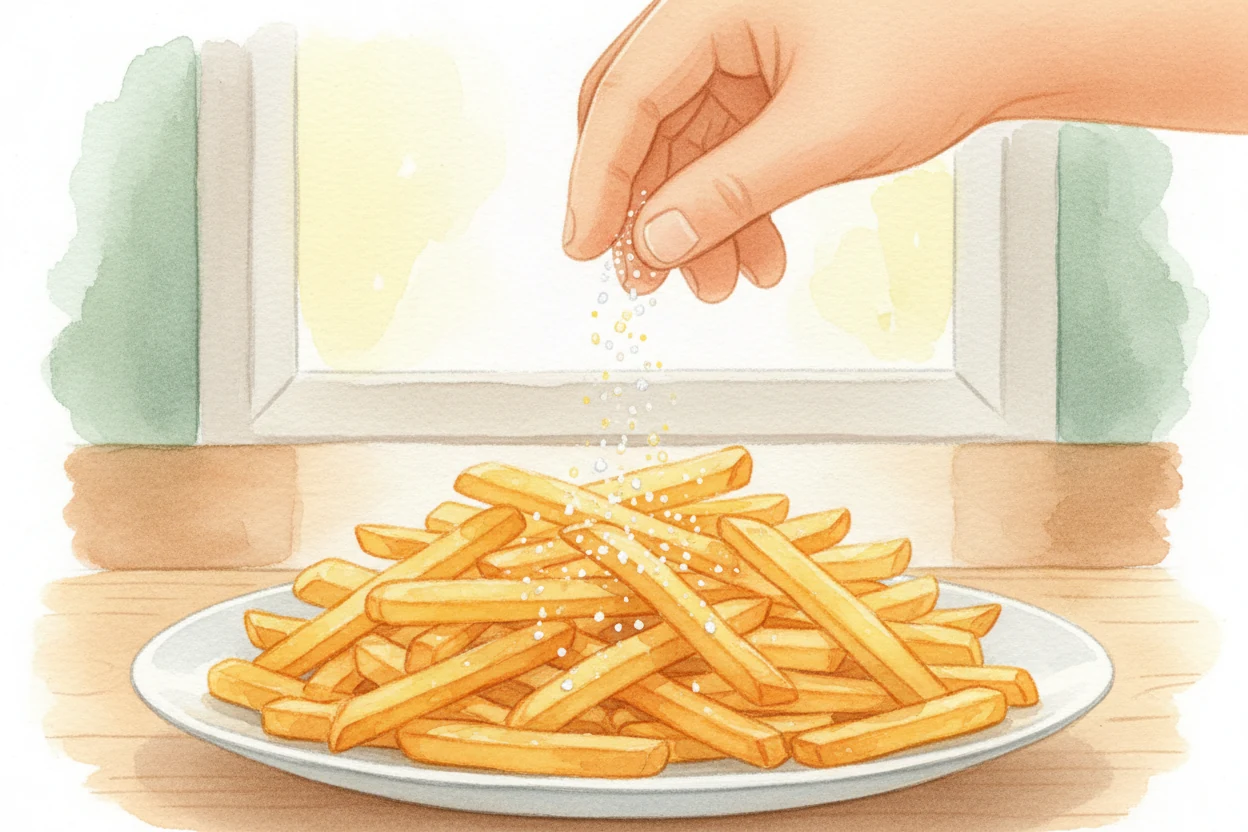
You sprinkle a little salt on your fries and suddenly they go from boring to delicious. What is salt actually doing in there? It's not just making things "salty" โ it's performing three completely different magic tricks on your tongue at once.
Your tongue is covered in thousands of tiny taste buds, each one like a detective trying to figure out what just landed in your mouth. They send signals to your brain: "Sweet!" "Sour!" "Bitter!" But they don't all shout at the same volume. Some tastes are louder than others, and salt is the volume knob.
Trick number one: salt blocks bitterness. Many foods โ coffee, dark chocolate, grapefruit โ have bitter compounds that can overwhelm your other taste buds. Salt molecules land on those bitter receptors and physically get in the way, like someone gently covering a fire alarm so it stops shrieking. Suddenly you can taste the chocolate's sweetness, the coffee's richness.
Trick number two: salt makes you produce more saliva. More spit means flavor molecules from your food dissolve faster and travel to more taste buds. It's like turning up the brightness on a screen โ the picture was always there, but now you can actually see it. That tomato? It was already sweet and tangy. The salt just made sure you noticed.
Trick number three, the sneakiest one: salt doesn't just affect your tongue. It travels up your nose. When you chew, aromas from your food drift up through the back of your throat to smell receptors in your nasal cavity. Salt changes the way certain aroma molecules evaporate from your food, sending a richer, more complex signal to your nose. Taste and smell work as a team, and salt is coaching both players.
Here's the wild part: salt makes sweet things taste sweeter and savory things taste meatier, but it doesn't add sweetness or meatiness itself. It's more like a key unlocking flavors that were already hiding in the food. A pinch of salt in cookie dough doesn't make the cookies salty โ it makes the sugar and butter and vanilla louder.
Too little salt and your food tastes flat, like a song played on one instrument. Too much and all you taste is the salt itself, drowning everything else out. The perfect amount is different for every dish, every person. Your tongue is calibrated by what you grew up eating. That's why your grandmother's "just right" might be your friend's "way too salty."
Salt isn't a flavor enhancer because it's magic. It's a flavor enhancer because it's a molecule that happens to fit perfectly into the locks on your taste buds, turning some signals down and others up. Evolution gave us a craving for it because our bodies need sodium to survive. The fact that it also makes fries taste incredible? That's just a very delicious accident.