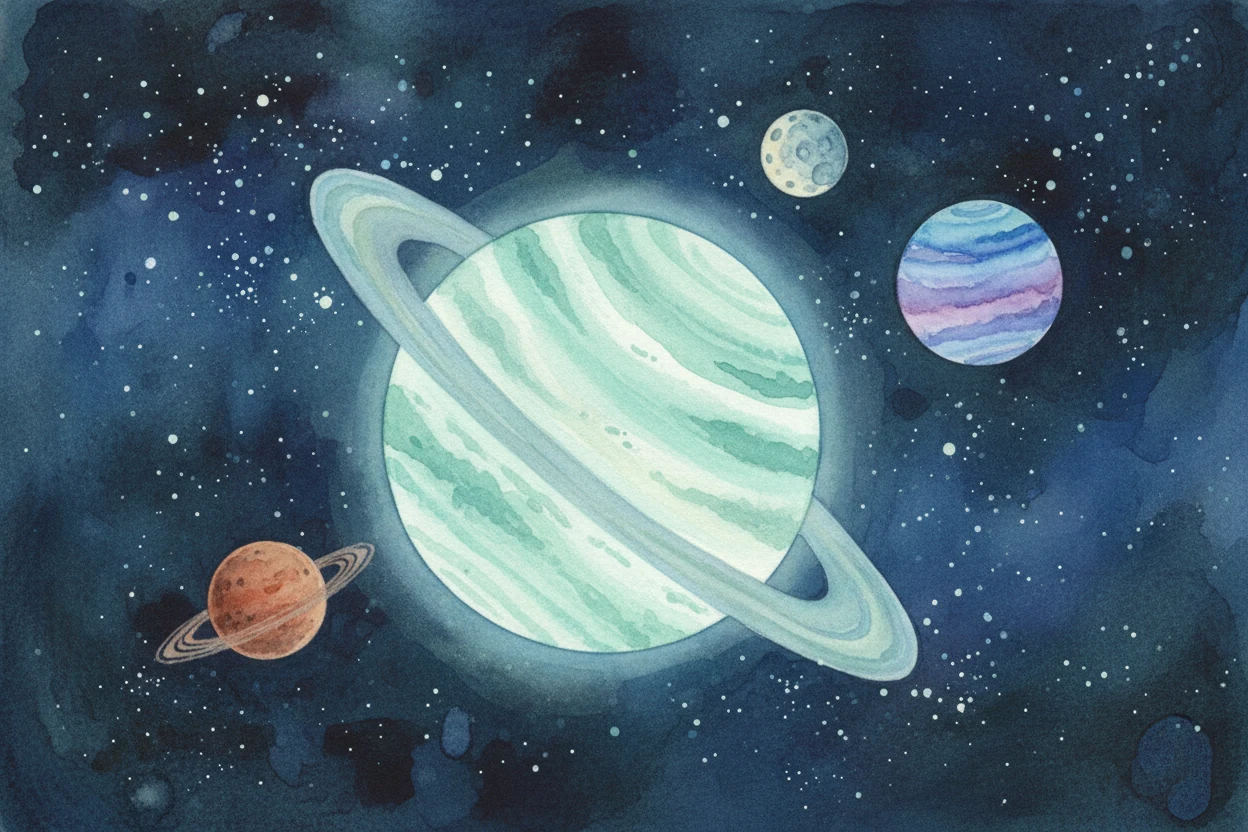
The Sideways Planet

Most planets spin like spinning tops, twirling neatly upright as they loop around the Sun. Then there's Uranus, the oddball of the family, lying on its side like a marble rolling across a table. It's not posing for a photo. It genuinely got knocked over โ and the story of how is one of the best mysteries in the solar system.

First, what does "spinning on its side" even mean? Think of a planet's spin axis as an invisible skewer poked through its top and bottom. Most planets keep that skewer pointing mostly up-and-down as they orbit. Uranus's skewer points almost sideways โ about 98 degrees over. It basically rolls around the Sun instead of standing on it.

Now rewind the clock four and a half billion years, back to when the planets were brand new. Space was a messy construction site. Leftover chunks of rock and ice โ some as big as small planets themselves โ were still zooming around, bumping into things. The early solar system was a demolition derby, and everybody got dented.

The leading idea is simple and dramatic: something huge slammed into young Uranus. Scientists think it may have been a body several times the mass of Earth โ an enormous, planet-sized wrecking ball. A collision that big doesn't just scratch the paint. It can shove a whole planet over onto its side.

Here's the gentle truth, though: this wasn't an explosion like in the movies. It happened over hours, in slow, silent space. The crash heaved Uranus's tilt sideways and left it dizzy but whole. Think of nudging a spinning globe โ one firm push and it keeps spinning, just at a brand-new angle.

But scientists are careful people, and one giant whack has a small problem. A single hit might have left Uranus spinning more wobbly than it does. So some researchers suspect it wasn't one big punch but two โ or a few โ collisions that tipped the planet over in stages, like a tree pushed gradually until it leans.

There's a lovely clue that backs up the crash story: Uranus's moons. They circle the planet lined up neatly with its tilted equator โ sideways, just like Uranus. If the planet had always leaned this way, that's hard to explain. But if a giant impact flung out debris that later clumped into moons, they'd naturally orbit along the new tilt. The moons are the wreckage that built itself back into a tidy ring.

Living sideways gives Uranus the strangest seasons anywhere. Because one pole leans almost straight at the Sun for years, each pole gets about 21 years of continuous daylight, then 21 years of unbroken night. Imagine a summer where the Sun never sets โ for two decades. Uranus throws the longest sunbathing parties in the solar system.

So why does Uranus spin on its side? Because long ago, in a crowded young solar system, it got knocked clean over โ maybe by one colossal collision, maybe by a few โ and it has been rolling along ever since, perfectly content. It's not broken. It's not wrong. It's just a planet that took a bump and decided sideways was a fine way to live.

Next time someone calls Uranus weird, you can smile. Every planet got banged around in the beginning โ Uranus just wears its dent the boldest. And honestly, rolling through space at a jaunty tilt for billions of years? That takes a certain confidence.