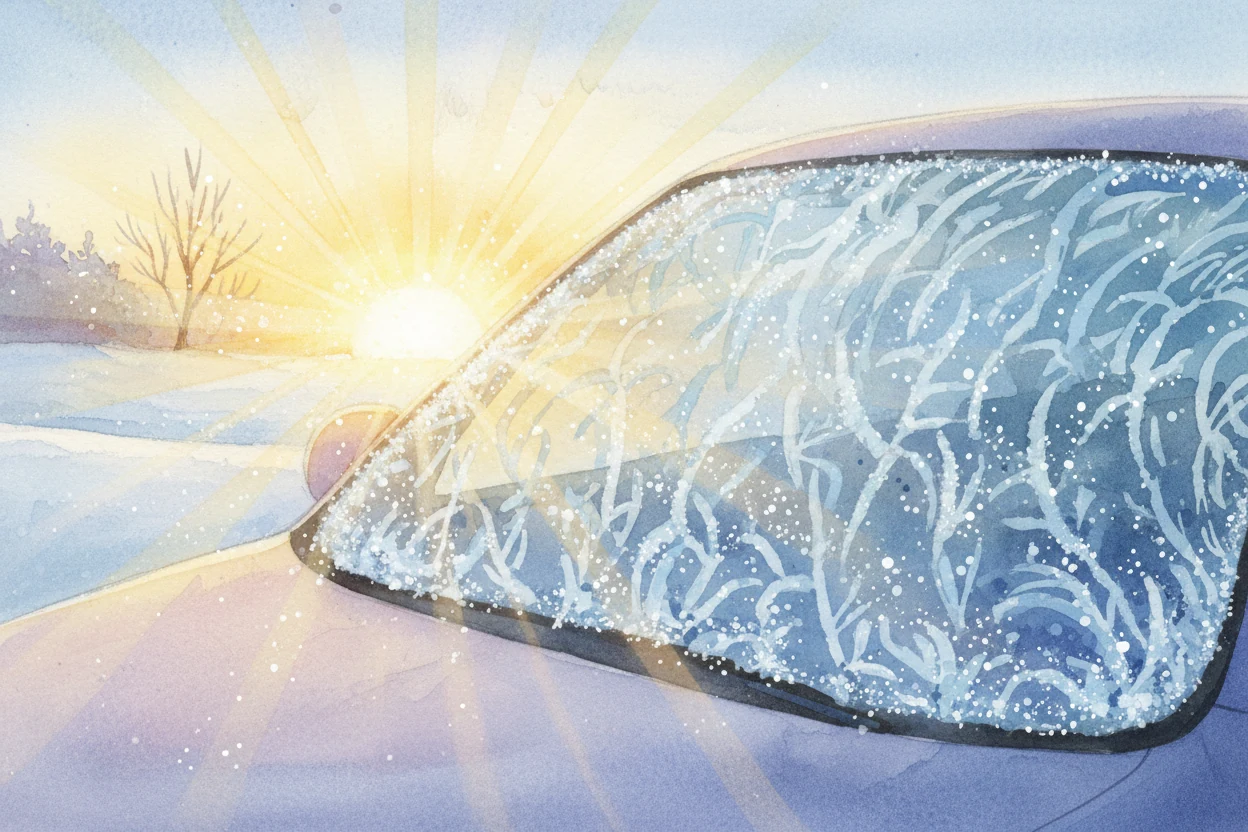
Frost's Mirror Dance
You've seen it on winter mornings โ grass and car windows glittering like someone sprinkled diamond dust everywhere overnight. What makes frost so sparkly when plain ice in your freezer looks dull and cloudy?
The secret is all about how ice crystals grow. When water vapor in the air touches a freezing-cold surface โ like a blade of grass on a 28-degree night โ it skips the liquid stage entirely and freezes directly into ice. That's frost.
But here's where frost gets its magic: because the vapor freezes slowly, molecule by molecule, the ice grows into thousands of tiny flat crystals, each one perfectly smooth and angled like a miniature mirror.
Every single crystal faces a slightly different direction. One tilts left, another tilts right, another points up. It's like covering a surface with a million microscopic mirrors, all jumbled together.
When sunlight hits all those angled crystals, each mirror catches the light and bounces it in a different direction. Some beams shoot straight into your eyes โ and that's a sparkle. Thousands of crystals mean thousands of sparkles.
Regular ice โ like a frozen puddle or an ice cube โ doesn't grow that way. It freezes fast and messily, with air bubbles trapped inside and a rough surface. Light scatters every which way instead of bouncing cleanly, so you get white and cloudy instead of sparkly.
The smaller and flatter the frost crystals, the more sparkle you get. That's why hoarfrost โ the kind that grows on cold, still nights โ looks like glitter heaven. Each crystal is paper-thin and polished smooth by slow, careful freezing.
So frost sparkles because it's actually a field of tiny mirrors, built one perfect crystal at a time. Next winter morning, crouch down close and watch the sparkles shift as you move your head โ you're seeing thousands of mirrors catch the light just for you.