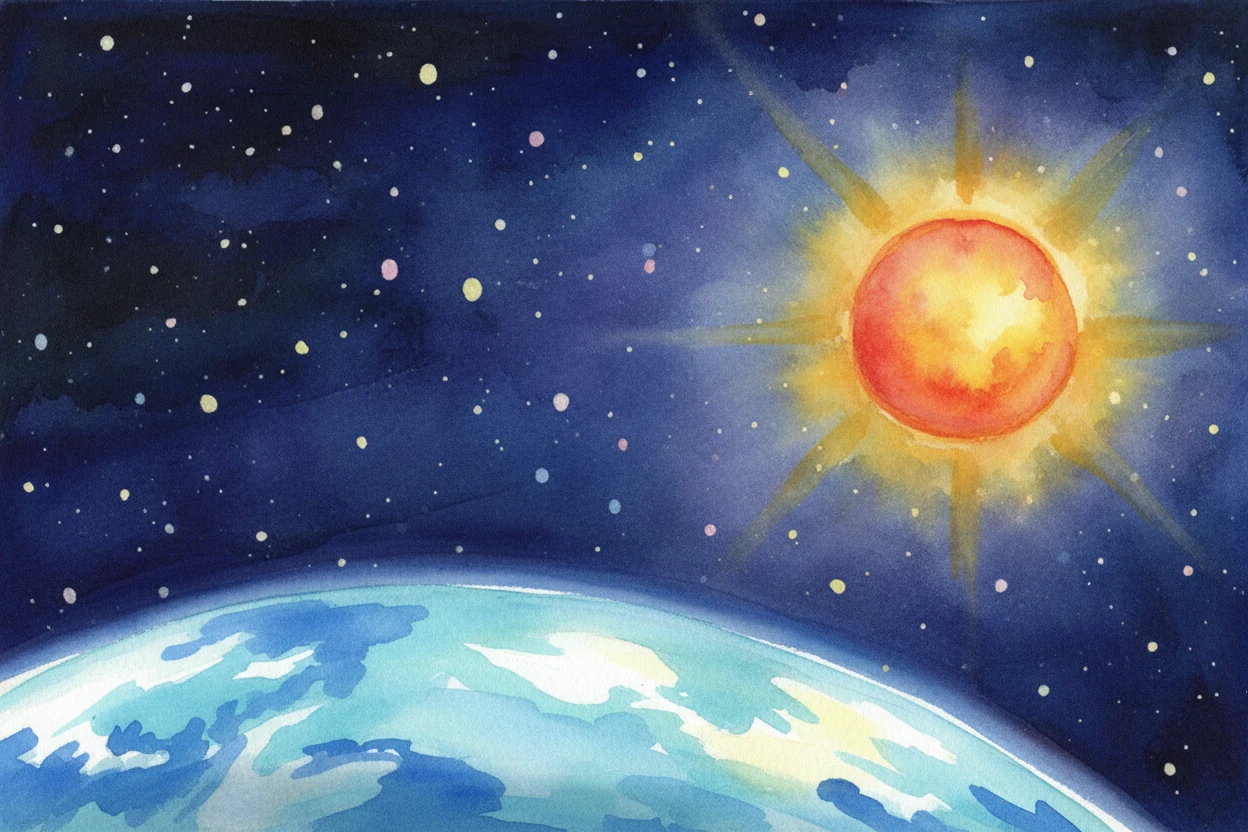
Light's Lonely Race
You've seen those photos of space โ the blackness between stars, the deep darkness beyond Earth. Why is it so dark out there when the sun is right there, blazing away?
Here's the thing: light doesn't just hang around in the air like fog. Light is always moving โ racing in straight lines at incredible speed, the fastest thing in the universe. When a beam of light leaves the sun, it shoots past you and keeps going. It doesn't stop to light up the emptiness.
On Earth, you can see light from the side โ a flashlight beam cutting through a dusty room, headlights in the fog. But you're not seeing the light itself. You're seeing the dust and water droplets that the light smacked into, bouncing some of it into your eyes.
Space is almost perfectly empty. No air, no dust, no fog โ just a vacuum stretching on forever. The sun's light races through that emptiness in straight lines. Unless a photon happens to crash directly into your eyeball, you don't see it. It just zips past in the dark.
It's like being in a pitch-black room with a thousand laser pointers shining across it. You can't see the beams unless one points right at you, or unless the light hits something โ a wall, a hand, a speck of dust. Space is that dark room, and almost nothing is there to hit.
Stars are the same way. Each star is a sun blasting light in all directions. But space is so enormous and empty that most of that light travels forever without hitting anything. The light that does reach your eyes shows you the star โ a tiny bright point โ but everything in between stays dark.
Even when you're standing on Earth in full daylight, space above you is still black. Astronauts on the moon saw this: the sun blazing, the lunar surface bright as snow, but the sky overhead completely dark. No air to scatter the light, so no blue, no glow โ just stars and blackness, even at noon.
So space is dark because there's nothing *there โ no air, no dust, no clouds to catch the light and bounce it around. Light races through the emptiness in straight lines, and unless it crashes into something,